

Quick Summary: The waste management and recycling industry presents significant workplace safety risks, from machinery entanglement and vehicle collisions to long-term health issues caused by exposure to chemicals, dust, and biological agents. Implementing a systematic approach like ISO 45001 is crucial for identifying, assessing, and controlling these hazards, ensuring compliance, and protecting workers. A robust safety system not only prevents injuries but also enhances operational efficiency and strengthens a company's ability to win major contracts by demonstrating a commitment to professional risk management.
When you look at a waste management or recycling facility, the dangers aren't always obvious. They range from the immediate, like a serious injury from machinery, to the slow-burning, like chronic health problems from breathing in hazardous substances. The key to keeping people safe is having a rock-solid system, like ISO 45001, to spot every single one of the workplace safety risks in waste management & recycling, figure out how bad it is, and then get it under control.
This isn’t just about ticking boxes. It’s about building a safer place for your team to work, every single day. The risks are woven into the very fabric of the job – in the collection rounds, on the sorting lines, and around the processing equipment. Getting a handle on these threats is the first, and most important, step.
Uncovering the Real Dangers in Waste and Recycling
Let's be blunt: waste management is a high-risk game. It’s a tough mix of heavy machinery, unpredictable materials, and demanding physical labor. For any Australian SME in this sector, truly understanding the full range of hazards isn't just a compliance headache; it's about protecting your most important asset – your people.
This industry is so much more than just emptying bins. It’s an industrial worksite where vehicle traffic, powerful machinery, and exposure to all sorts of substances create a complex web of risk. We need to move past vague ideas and name the specific dangers your crew faces on the ground.
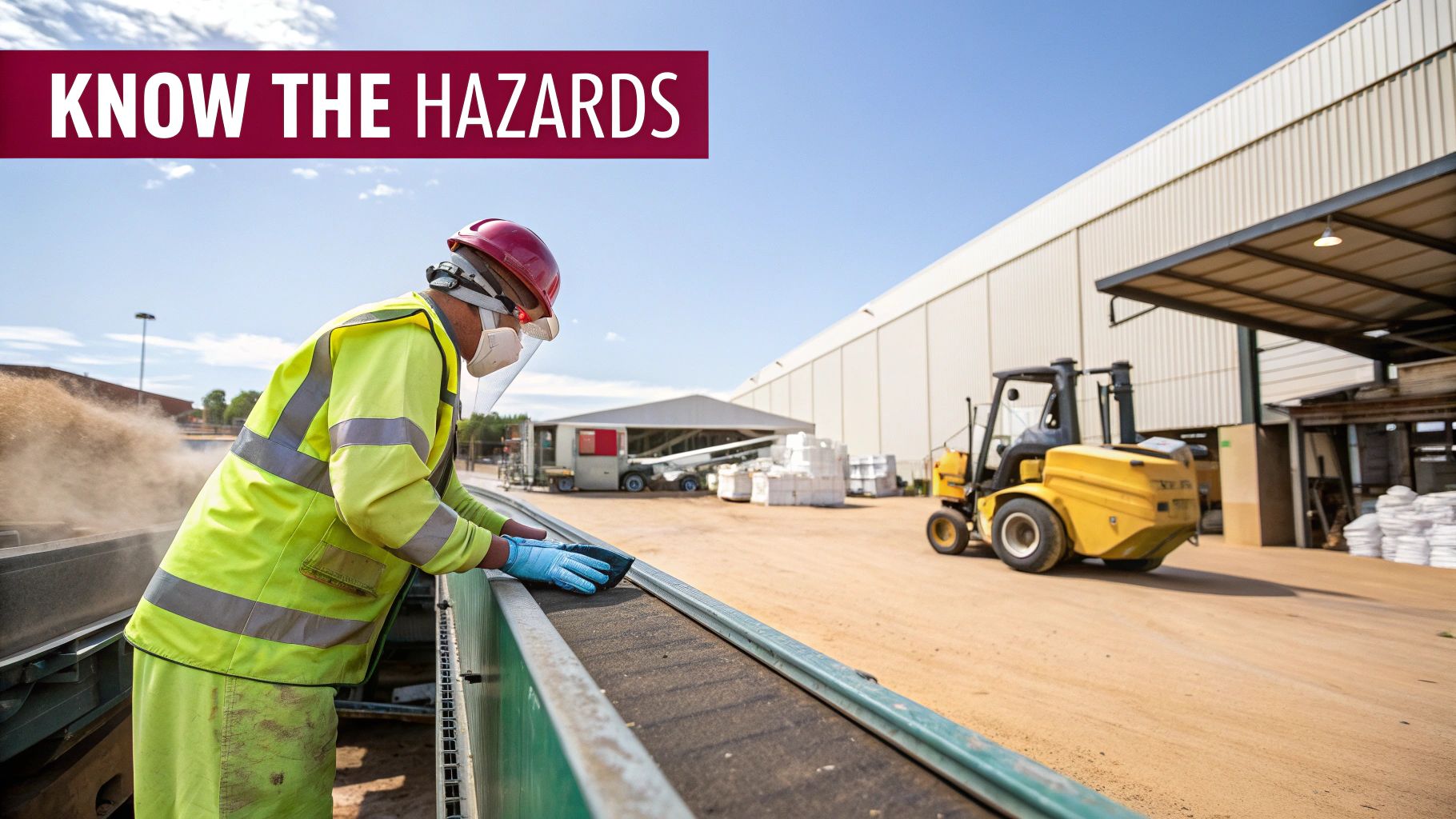
Physical and Mechanical Dangers
The most visible threats are often the physical ones. The constant dance between people, vehicles, and machines is where things can go wrong, fast.
Vehicle and Mobile Plant Collisions: A busy yard is a minefield of forklifts, front-end loaders, and collection trucks. Without a clear traffic management plan and strict exclusion zones, the risk of a collision causing a severe or fatal injury is frighteningly high.
Machinery Entanglement: Think about balers, compactors, and conveyors – they're all built with powerful moving parts designed to crush and tear. If a machine guard is missing, a lockout/tagout procedure is skipped during maintenance, or even if someone's clothing gets caught, the results can be catastrophic. When sourcing equipment like tracked dumper hire, its inherent safety features must be a top consideration.
Manual Handling Injuries: The endless lifting, carrying, and sorting of heavy, awkward bins and materials is the number one cause of musculoskeletal disorders (MSDs). These aren't one-off accidents; they're injuries that build up over time, leading to chronic pain and potentially long-term disability for your workers.
To give you a clearer picture, here’s a breakdown of how these hazards translate into real-world risks.
Top Hazards and Potential Outcomes in Waste Facilities
| Hazard Category | Specific Hazard Example | Potential Safety Risk |
|---|---|---|
| Mobile Plant | Forklift operating near pedestrians | Collision leading to crush injuries, fractures, fatality |
| Fixed Plant | Unguarded conveyor belt | Entanglement, amputation, severe lacerations |
| Manual Tasks | Repetitive lifting of heavy bins | Musculoskeletal disorders (back, shoulder, wrist injuries) |
| Biological | Handling unbagged medical or food waste | Infections, respiratory illness, allergic reactions |
| Chemical | Leaking batteries or chemical containers | Chemical burns, toxic fume inhalation, poisoning |
| Airborne | Dust from sorting construction debris | Silicosis, asthma, long-term respiratory disease |
This table shows just how quickly a seemingly routine task can turn into a life-altering event if the right controls aren't in place.
Health and Exposure Hazards
It's not just the things you can see that can hurt you. Workers are constantly exposed to invisible dangers that can cause serious long-term health problems. These hazards are often in the air they breathe or hidden inside the waste itself.
"Improper treatment and disposal of healthcare waste can create health risks by indirectly releasing pathogens and toxic pollutants into the environment. For example, the disposal of untreated medical waste can contaminate drinking, surface, and groundwaters."
This quote is a stark reminder that what comes into your facility can have consequences far beyond your fenceline if it's not managed properly.
Here are some of the key exposure threats on-site:
Biological Hazards: Every bag of rubbish can contain a cocktail of bacteria, viruses, and fungi from food scraps, medical waste, or animal refuse. Breathing these in or getting them on your skin can lead to nasty infections and respiratory illnesses.
Chemical Hazards: You never know what’s been thrown out. Incorrectly disposed-of chemicals, batteries, and e-waste can release toxic substances. This can cause anything from skin burns and respiratory damage to acute poisoning.
Airborne Particles: The dust kicked up during sorting and processing isn't just dirt. It can be loaded with fine particles of glass, silica, and other materials that, over time, can cause irreversible lung conditions.
These aren't just theoretical problems. Regulators are paying close attention. In Western Australia, for example, the waste industry's high rate of injuries from manual tasks has triggered proactive inspection programs from WorkSafe WA. They're scrutinising everything from machinery guarding to psychosocial hazards like fatigue, showing just how seriously these risks are being taken.
Conducting a Practical Risk Assessment on Your Floor
Spotting the hazards scattered across your facility is the first step, but it’s a passive one. A proper risk assessment is where you turn that awareness into action. It’s about moving from just knowing about the workplace safety risks in waste management & recycling to actively taking them apart, piece by piece.
This isn't about ticking boxes or creating paperwork that gathers dust. Think of it as a hands-on investigation of your operations—a forensic examination of your work floor. You're methodically searching for the clues that point to a future incident, like unguarded machinery, chaotic traffic flow, or unsafe lifting practices, and fixing them before they cause real harm.
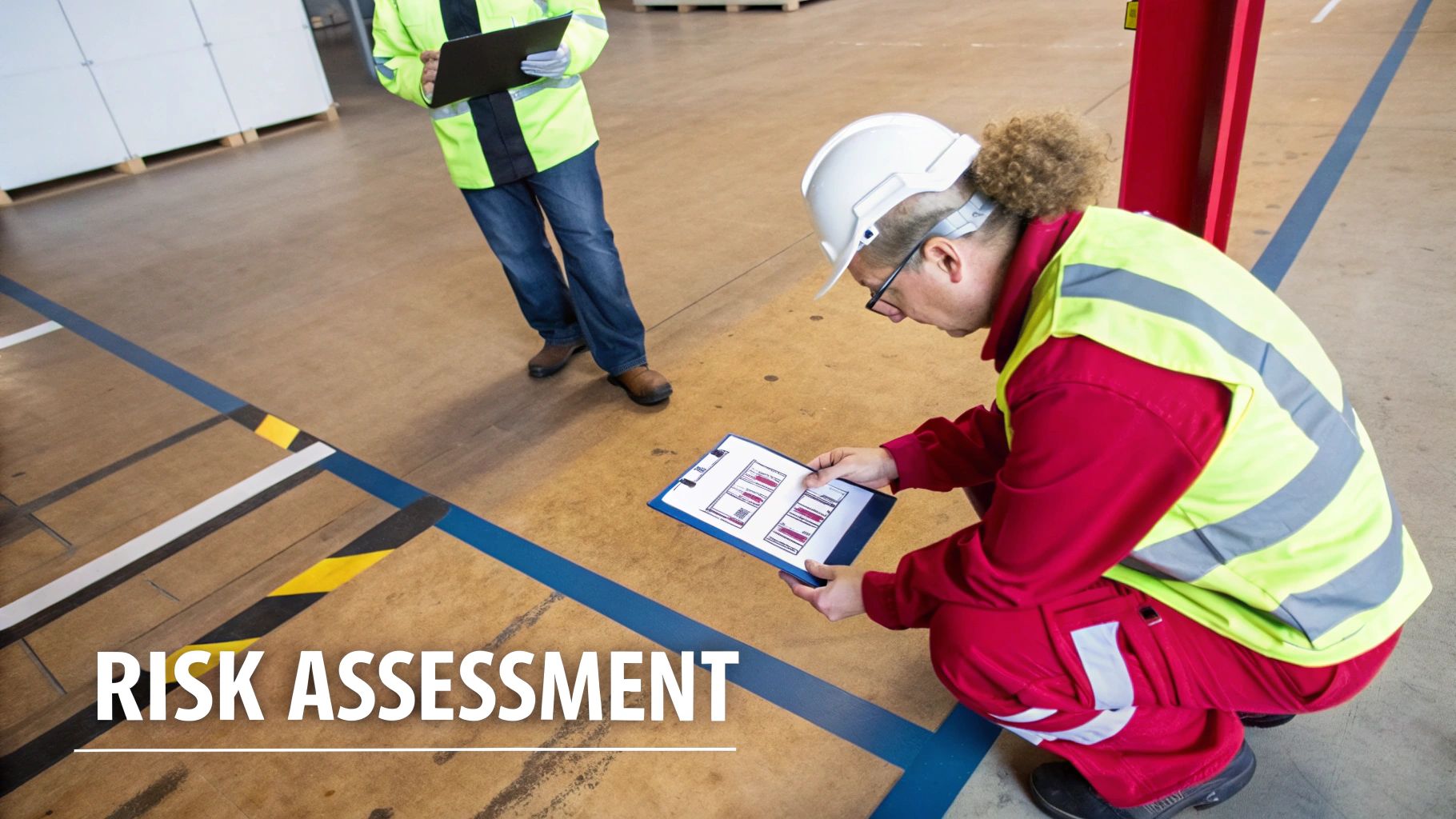
Step 1: Spot the Hazard
First things first: you need to walk the floor. And I mean really walk it, with a critical eye.
This is where you bring your team in. Your workers are on the frontline every single day, and they’ll see the day-to-day dangers a manager walking through might miss. Look at every task, every process, and every piece of equipment as if you're seeing it for the first time.
Don’t just see a conveyor belt; see the potential for a sleeve to get snagged. Don’t just see a forklift; see the blind corner where it could collide with a pedestrian. Write everything down, no matter how small it seems. This list is the bedrock of your entire safety plan.
Step 2: Identify Who Is at Risk and How
Okay, you've found a hazard. The next question is simple: who could get hurt, and how? This is where you need to think beyond the person doing the immediate task.
For instance, a welder might be fully protected by their own gear, but what about the people working nearby? Are they exposed to the fumes or the arc flash?
You need to consider everyone who sets foot on your site:
- Direct Operators: The obvious ones using the machinery or doing the manual task.
- Nearby Workers: Staff in the general area who could be hit by moving vehicles or exposed to excessive noise.
- Maintenance Staff: These folks face unique risks, like stored energy in a machine that's been turned off or exposure to chemicals during a clean-out.
- Visitors and Drivers: Don't forget contractors and truck drivers. They aren't familiar with your site's layout, rules, and hidden dangers.
Figuring this out shows you the true ripple effect a single hazard can have.
Step 3: Evaluate the Risk and Prioritise Action
Let's be realistic—not all risks are created equal. You can't fix everything at once, so you need a smart way to decide what to tackle first.
This is where a risk matrix is your best friend. It’s a simple tool that helps you plot the likelihood of an incident happening against the consequence (i.e., how badly someone would get hurt).
A hazard that’s very likely to occur and could cause a fatality—like an unguarded baler—is an immediate, code-red priority. On the other hand, a sharp edge on a filing cabinet that might cause a minor cut is a lower priority. This approach makes sure you’re putting your time, money, and energy where it will make the biggest difference.
A risk assessment isn’t just about finding problems; it’s about prioritising solutions. The risk matrix gives you a clear, visual roadmap to tackle the biggest dangers first.
Step 4: Record Your Findings and Implement Controls
If it isn't written down, it didn't happen. Documenting your findings is your proof of due diligence and creates a clear action plan.
Most businesses use a risk register to keep track of every hazard, its risk score, and the controls put in place to manage it. To get a handle on this crucial document, you can find out more about what a risk register is and how it works.
Once a risk is recorded, you have to control it. This is where the Hierarchy of Controls comes into play (we'll dive into that next). The goal is to choose the most effective fix possible. For a noisy machine, for example, building an acoustic enclosure (an engineering control) is always a better solution than just handing out earplugs (PPE).
Step 5: Review and Update Regularly
Your workplace isn't frozen in time. New machinery arrives, work procedures get updated, and your team changes. Because of this, your risk assessment can't be a one-and-done deal. It has to be a living document.
Set a schedule for regular reviews—at least once a year, or anytime there's a significant change. A new sorting line? Review the risks. A near-miss incident? Review the risks.
This ongoing cycle keeps your safety systems relevant and effective. It helps you catch new hazards before they become problems and shows you're genuinely committed to keeping your people safe.
Right, so you've mapped out the hazards lurking around your waste or recycling facility. What's next? The crucial part: taming them. But here's the thing – not all safety measures are created equal. This is where the Hierarchy of Controls comes in.
Think of it as the playbook for smart safety, and it's a core part of standards like ISO 45001. It's basically an upside-down pyramid that ranks risk controls from most to least effective. It forces us to think bigger than just handing out hi-vis vests and hard hats, pushing for real, permanent solutions first.
Level 1: Elimination – The Ultimate Fix
The best way to deal with a hazard? Get rid of it. Completely. Elimination means redesigning a process or task so the danger simply doesn't exist anymore. It’s the gold standard because it rips the problem out at the root.
It's not always easy or even possible, but you have to ask the question first.
- Real-world example: Imagine your team manually sorting recyclables from a fast-moving conveyor, dodging broken glass and sharp metal. The risk of serious cuts is constant. By installing an automated sorting system with optical scanners and robotic arms, you've eliminated that specific risk for those workers. They're no longer in the line of fire.
This isn't just a band-aid; it fundamentally changes the work to make it inherently safe.
Level 2: Substitution – Replacing the Danger
If you can’t get rid of a hazard entirely, the next best move is to swap it for something safer. Substitution is all about replacing a hazardous chemical, a dangerous piece of kit, or a risky process with a less harmful alternative.
This approach can slash risk without needing a complete operational overhaul.
- Real-world example: Your workshop might use a potent, solvent-based cleaner for degreasing machine parts. It works, but the fumes are toxic and it's harsh on the skin. Swapping it for an effective, biodegradable water-based solution substitutes the danger for a much safer alternative, protecting your team from chemical burns and respiratory issues.
Level 3: Engineering Controls – Redesigning the Workspace
Okay, so you can't eliminate or substitute the hazard. Now it’s time to isolate your people from it using engineering controls. These are physical changes you make to the workplace, equipment, or process that act as a barrier or contain the hazard at its source.
The beauty of these controls is that they don't rely on someone remembering to do something – they just work.
An engineering control is like building a permanent storm shelter. It protects everyone inside, all the time. PPE is like handing someone an umbrella—it only protects one person, is easily lost or broken, and is useless if they forget to open it.
Here are a few classic examples you’d see in a busy yard:
- Installing physical barriers and guardrails to create protected walkways, keeping people safely separated from moving loaders and forklifts.
- Fitting acoustic enclosures around noisy beasts like shredders and granulators to bring down dangerous noise levels for everyone on the floor.
- Adding local exhaust ventilation hoods directly over sorting lines to suck up and remove dust and other nasty airborne particles before anyone breathes them in.
These are permanent upgrades that build safety directly into the fabric of your facility.
Level 4: Administrative Controls – Changing How People Work
Moving down the pyramid, we get to administrative controls. This is all about the rules, procedures, and training you implement to change how people work around a hazard. Think safe work procedures, warning signs, and training sessions.
These are absolutely essential, but they rely on human behaviour, which makes them less foolproof than the controls higher up the list. They should support your higher-level controls, not be your only defence.
- Implementing strict lockout/tagout (LOTO) procedures to ensure machinery is de-energised and cannot be started up during maintenance.
- Developing Safe Work Method Statements (SWMS) for high-risk jobs, like clearing a jam in a baler or entering a confined space.
- Conducting regular, practical training on everything from safe lifting techniques to vehicle awareness on site.
- Rotating jobs to limit how long a single worker is exposed to a highly repetitive task or a noisy environment.
Level 5: Personal Protective Equipment (PPE) – The Last Resort
Right at the bottom, the last line of defence, is Personal Protective Equipment (PPE). This is your hard hats, safety glasses, hi-vis vests, cut-resistant gloves, and respirators.
Don't get me wrong, PPE is critically important. But it should always be the last thing you reach for after you've tried everything else. Why? Because it does nothing to remove the hazard itself; it just puts a barrier between it and the worker.
Its effectiveness hinges entirely on people using it correctly 100% of the time, and it can fail without warning. PPE protects the person, whereas all the other controls aim to control the hazard itself.
Weaving ISO 45001 into Your Daily Operational Fabric
If you see ISO 45001 as just another certificate to hang on the wall, you’re missing the entire point. It’s like owning a high-performance engine but only ever seeing it as a heavy lump of metal. The real value isn’t in passing the audit; it’s in making safety an automatic, reflexive part of how you operate every single day, genuinely reducing the constant workplace safety risks in waste management & recycling.
For a busy Australian SME, the standard’s official language can feel a bit dense and intimidating. But once you translate it into practical, on-the-ground actions, it becomes a clear recipe for a safer, more efficient business. It's all about turning abstract clauses into concrete habits.
This diagram shows the hierarchy of risk control, a core idea in ISO 45001 for tackling hazards head-on.
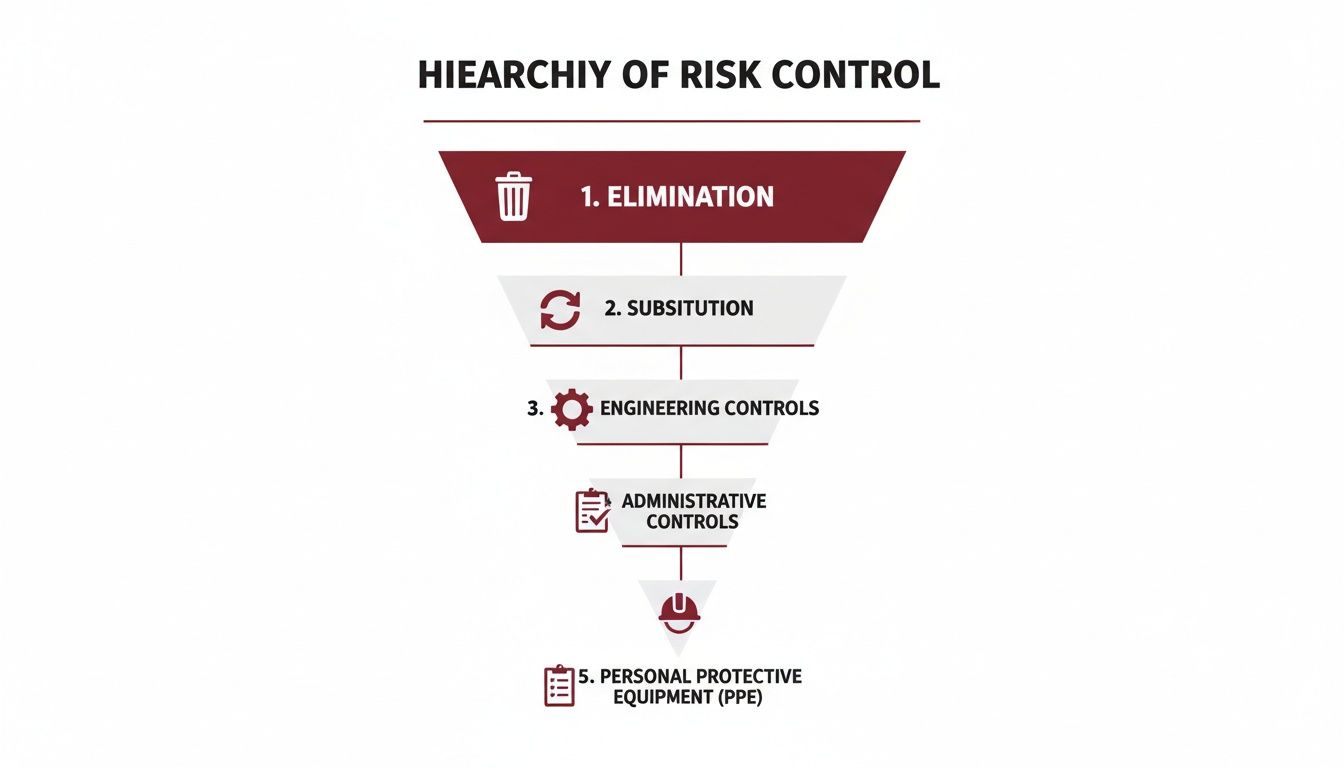
The pyramid shape makes it obvious: relying on PPE is your last resort, not your first line of defence. The real wins come from eliminating the hazard or engineering it out of the process altogether.
From Rulebook to Reality
So, let's look at how key ISO 45001 principles actually come to life on the floor of a recycling facility. Forget memorising clauses; think about building a culture.
Take Clause 5: Leadership and Worker Participation. This isn't about managers firing off safety memos from a distant office. It's real when the daily toolbox talk starts with the question, "What looks dangerous out there today?" and everyone is expected to answer honestly. It’s alive when a team member feels confident enough to halt a job because they've spotted an unguarded conveyor belt, knowing they won’t be blamed for the delay.
Leadership is a manager investing in new lifting equipment after listening to genuine concerns about manual handling strains. Participation is when that same crew helps write the Safe Work Method Statement (SWMS) for the new gear, because who knows it better?
Driving Improvement Through Simple Systems
Another crucial piece of the puzzle is Clause 10: Improvement. In the real world, this is powered by a straightforward, no-blame system for reporting incidents and near-misses.
When a worker reports a forklift skidding on an oil patch, the first response shouldn't be disciplinary action. It should be a "thank you for the heads-up," followed by a quick investigation into why the oil was there in the first place.
This simple shift in attitude transforms your team. They stop being passive observers and become your frontline safety watchdogs, spotting small problems before they balloon into serious incidents. Every near-miss report is a free lesson in how to make your operation safer.
And this proactive mindset is critical, especially when you consider the sheer scale of the challenge. Australia's commercial sector alone sends over 20 million tonnes of waste to landfill each year. As this overview on waste transport shows, poorly managed waste streams directly elevate risks for workers, from slips and falls to life-threatening machinery entanglements.
Documentation That Actually Works For You
Finally, let’s tackle the dreaded "paperwork." A well-run ISO 45001 system doesn't create bureaucracy for its own sake. It creates clarity, consistency, and legal protection.
Good documentation isn't about filling cabinets; it’s about building a reliable, defensible system that proves your commitment to keeping your people safe.
Here’s what that looks like in practice:
- Safe Work Method Statements (SWMS): Not generic templates downloaded from the internet, but living, step-by-step guides for your high-risk tasks, developed with the people who do the job every day.
- Training Records: A simple but organised log showing who was trained on what equipment and when. This is your proof of competency.
- Maintenance Logs: A clear, up-to-date record showing that critical safety gear on your machinery—like e-stops and guards—is regularly checked and works perfectly.
- Risk Registers: A live document that tracks your identified hazards and the controls you've put in place, showing a systematic and proactive approach to managing risk.
When done right, this paperwork doesn't create chaos; it reduces it. It gives your team clear instructions, proves your due diligence, and turns safety from a manager's headache into a shared responsibility. That's the real fabric of a safe and successful operation.
Winning Tenders and Preparing for Your Certification Audit
For any Australian SME in the waste and recycling game, getting your ISO 45001 certification is much more than just a box-ticking exercise. It's fast becoming one of the most powerful tools in your commercial arsenal, especially when you're bidding for those big government and corporate contracts.
For these clients, demonstrating you can properly manage workplace safety risks in waste management & recycling isn't a nice-to-have; it's a deal-breaker.
Think of your certification as a business development asset, not a cost centre. It’s your official, independently verified proof that you’re a professional, low-risk partner. When your tender response lands on the desk, that certification immediately lifts you above competitors who can only talk about their safety culture. You've got the paperwork to back it up.
What Auditors and Tender Panels Are Really Looking For
When an auditor walks through your door or a tender panel starts scoring your submission, they’re hunting for concrete evidence. They need to see a living, breathing safety management system in action—not just a dusty folder of documents nobody has looked at since last year. Being prepared is all about having your proof organised and ready to go.
Here's a look at the kind of evidence they'll almost certainly ask for:
- Management Review Minutes: This is your proof that the leadership team is genuinely invested in OHS. It shows safety isn’t just delegated away but is a regular, high-level conversation about performance, incidents, and where you’re heading next.
- A Comprehensive Risk Register: This document is the heart and soul of your safety system. It needs to clearly map out the specific hazards at your facility, how you’ve assessed the risks, and the control measures you've actually put in place.
- Proof of Worker Consultation: Auditors want to see that your team has a real say. This could be anything from minutes of toolbox talks and safety committee meetings to feedback forms you used when bringing in new equipment.
- Incident and Near-Miss Reports: This shows you have a system for learning from your mistakes. Funnily enough, a file with zero reports often looks more suspicious than one with a few, as it can signal a poor reporting culture.
- Training and Competency Records: You have to be able to prove your people are properly trained for their specific jobs and understand the risks they face every day. This covers everything from forklift licences to inductions on a new baler.
How to Frame Your Certification in Tender Responses
Just dropping the line "We are ISO 45001 certified" into your tender response is a missed opportunity. To make it count, you need to frame it as a direct benefit to the client. Tell a story that screams professionalism and risk reduction.
Instead of simply stating the fact, try explaining what it means for their project:
"Our ISO 45001 certified OHS management system ensures we proactively identify and control all workplace safety risks, which significantly reduces the likelihood of project delays or incidents. For our clients, this provides the assurance of a safe, compliant, and professionally managed partner, minimising their own risk exposure."
This simple shift turns your internal safety system into a valuable benefit for the client. This is especially true for those handling specialised streams like e-waste, where documenting every step is vital. Things like Certificates of Destruction aren't just about compliance; they prove you handle data security and operational integrity properly—a huge selling point for high-value clients.
At the end of the day, preparing for an audit and leveraging your certification in a tender are two sides of the same coin. Both come down to proving that your commitment to safety is systematic, documented, and genuinely effective. Get that right, and you’ll turn a regulatory requirement into a clear competitive advantage that wins business and builds lasting trust.
Frequently Asked Questions
When you're running a business in the waste and recycling industry, navigating the world of workplace safety can feel complex. Let's tackle some of the most common questions we hear from Australian owners and managers about managing risks and getting certified to ISO 45001.
What's the Single Biggest Workplace Safety Risk I Should Be Worried About?
While every site is different, the one that consistently causes the most serious injuries is hazardous manual tasks. Think about the daily grind: lifting heavy bins, sorting materials on a fast-moving conveyor, or holding awkward postures for hours on end. These are the activities notorious for causing musculoskeletal disorders (MSDs).
This isn't about dramatic, one-off accidents. The real danger is the slow, cumulative damage that builds up over months and years. It leads to chronic pain for your team, expensive workers' compensation claims, and a huge drain on productivity. It’s no surprise that regulators like Safe Work Australia are all over this – these injuries are common, debilitating, and completely preventable with the right risk management, which is exactly what an ISO 45001 system helps you do.
Good controls are about more than just a "lift with your knees" poster. It's about fundamentally rethinking the work itself and using mechanical aids to take the strain off the human body.
How Long Does It Take for a Small Recycling Business to Get ISO 45001 Certified?
This is more flexible than most people think. The timeline really depends on what systems you already have in place. For a small to medium-sized business with dedicated expert help, achieving certification within a few months is very realistic.
The journey usually breaks down into a few key steps:
- System Development: We work with you to build a management system that actually fits your day-to-day operations.
- Implementation: This is where we roll out the new procedures and get your team on board.
- Internal Review: We do a 'test run' audit to make sure everything is working as it should be.
- External Audit: The final step, where an accredited certification body gives you the official tick of approval.
The key is partnering with a consultant who gets the waste industry. They'll help you build a lean, practical system that avoids the generic, paperwork-heavy approach that slows things down and doesn’t add real-world value.
Is ISO 45001 Actually Mandatory for Waste Management Companies in Australia?
Legally, no government body will shut you down for not having it. But in reality, it has become an undeniable commercial requirement. If you want to grow, you’ll find that major government and corporate tenders now list accredited OH&S certification as a non-negotiable prerequisite.
Without certification, you’re often automatically screened out before you even get a chance to bid. It effectively puts a ceiling on your business's potential.
Beyond winning work, the standard gives you a clear, internationally recognised framework to meet your legal duties under state WHS/OHS laws. It helps you prove you’ve taken every reasonably practicable step to keep your workers safe, putting you in a much stronger, more defensible position.
My Business Is Small – Isn't an ISO 45001 System Overkill for Us?
This is probably the biggest myth we hear. ISO 45001 was designed to be completely scalable, meaning it can be tailored to fit a business of any size. A safety system for a 10-person recycling yard should look completely different from one built for a 500-person national company.
For a smaller business, a well-designed system cuts through the noise and focuses squarely on your specific, high-priority workplace safety risks in waste management & recycling. It's not about creating layers of bureaucracy.
A great system for an SME should be:
- Simple: Easy for your crew to understand and use every single day.
- Practical: Slips right into how you already operate, rather than fighting against it.
- Value-Adding: Genuinely helps prevent incidents, improves efficiency, and gives you peace of mind.
The goal isn't to bury you in paperwork. It's to give you a powerful tool that makes your workplace safer and your business stronger.
Recent Comments