

Quick Summary: This guide addresses critical workplace safety risks in transport & logistics, including vehicle incidents, manual handling injuries, and driver fatigue. It provides actionable strategies for implementing effective controls, such as traffic management plans and ergonomic assessments, aligning them with the ISO 45001 framework to build a robust safety culture, protect workers, and gain a competitive business advantage.
The Australian transport and logistics industry is a cornerstone of our economy, but it presents significant safety challenges. We're talking about serious incidents involving vehicles, debilitating injuries from manual tasks, and the pervasive threat of fatigue. Managing these workplace safety risks in transport & logistics isn't just about compliance; it's about safeguarding your people, ensuring operational continuity, and securing valuable contracts. This guide will walk you through the biggest hazards and provide a solid framework for implementing effective safety controls aligned with ISO 45001 standards.
Navigating the Complexities of Logistics Safety
The most significant workplace safety risks in transport & logistics are born from the very nature of the job: the constant movement of vehicles, goods, and people. The dangers are diverse, ranging from catastrophic truck rollovers and life-altering injuries from lifting heavy loads, to the silent but deadly impact of driver fatigue. Getting a handle on these risks is absolutely critical to keeping your operation running smoothly.
Australia's transport and logistics sector truly keeps the country moving, but it's a high-pressure environment where a single safety mistake can have devastating outcomes. A core part of managing this pressure comes down to effective fleet management.
This guide is designed to give you a clear path forward. We'll break down how to properly identify, assess, and control the major hazards your business will inevitably face. We're moving beyond basic checklists here. Instead, we'll focus on building a practical framework for a strong safety culture that not only protects your team but also gives you a real edge when you're tendering for new work.
Understanding the High Cost of Inaction on Safety Risks
Why should you be laser-focused on workplace safety in the transport and logistics game? The simple answer is that ignoring it costs you, big time. We’re talking about real-world consequences that hit your people hard and can cripple your business financially. This isn't just a box-ticking exercise; it's about survival and growth in one of Australia's toughest industries.
The human and financial fallout from a single incident can be massive. For a small or medium-sized business, these aren't just numbers on a spreadsheet—they're direct threats to your day-to-day operations. A serious injury can take a skilled driver off the road, kickstart a stressful investigation, and send your insurance premiums through the roof. The knock-on effects can kill team morale, grind productivity to a halt, and damage the reputation you've worked so hard to build with your clients.
The Stark Reality of Industry Risks
Ignoring workplace safety risks in transport & logistics is a gamble you can't afford to take. The very nature of the industry—tight deadlines, complex worksites, and long hours—creates a perfect storm for hazards if you're not on top of them.
Let's be blunt: Australia's transport, postal, and warehousing sector is consistently one of our deadliest. It’s a major contributor to work-related fatalities, and the statistics from Safe Work Australia are sobering. Vehicle incidents are the biggest killer, accounting for a staggering percentage of all worker deaths nationwide. If you want to dig deeper, you can explore the full scope of the issue in the official Australian work health and safety statistics.
This reality hits home when you're running an SME. Failing to get these risks under control doesn't just put your team in harm's way; it can mean losing out on major contracts where a rock-solid safety record is a deal-breaker.
From Reactive Chore to Business Advantage
Too many businesses get stuck in a reactive safety loop, only scrambling to fix things after someone gets hurt. It’s an expensive, inefficient way to operate and does nothing to build a culture where people genuinely look out for each other. The alternative is to get on the front foot and turn safety from a painful chore into a powerful business advantage.
This is where a structured framework like ISO 45001 comes in. It gives you a clear roadmap to:
- Spot hazards before they can cause an incident.
- Put effective controls in place that actually work with your daily operations, not against them.
- Prove your commitment to safety to your crew, your clients, and the regulators.
By bringing a system like this into your business, you stop just putting out fires. You start building an operation where safety is part of every decision, protecting your most important asset—your people—and making you a stronger, more competitive player in the market. That proactive mindset is what separates the businesses that thrive from those that just get by.
The Eight Critical Workplace Safety Risks in Transport & Logistics
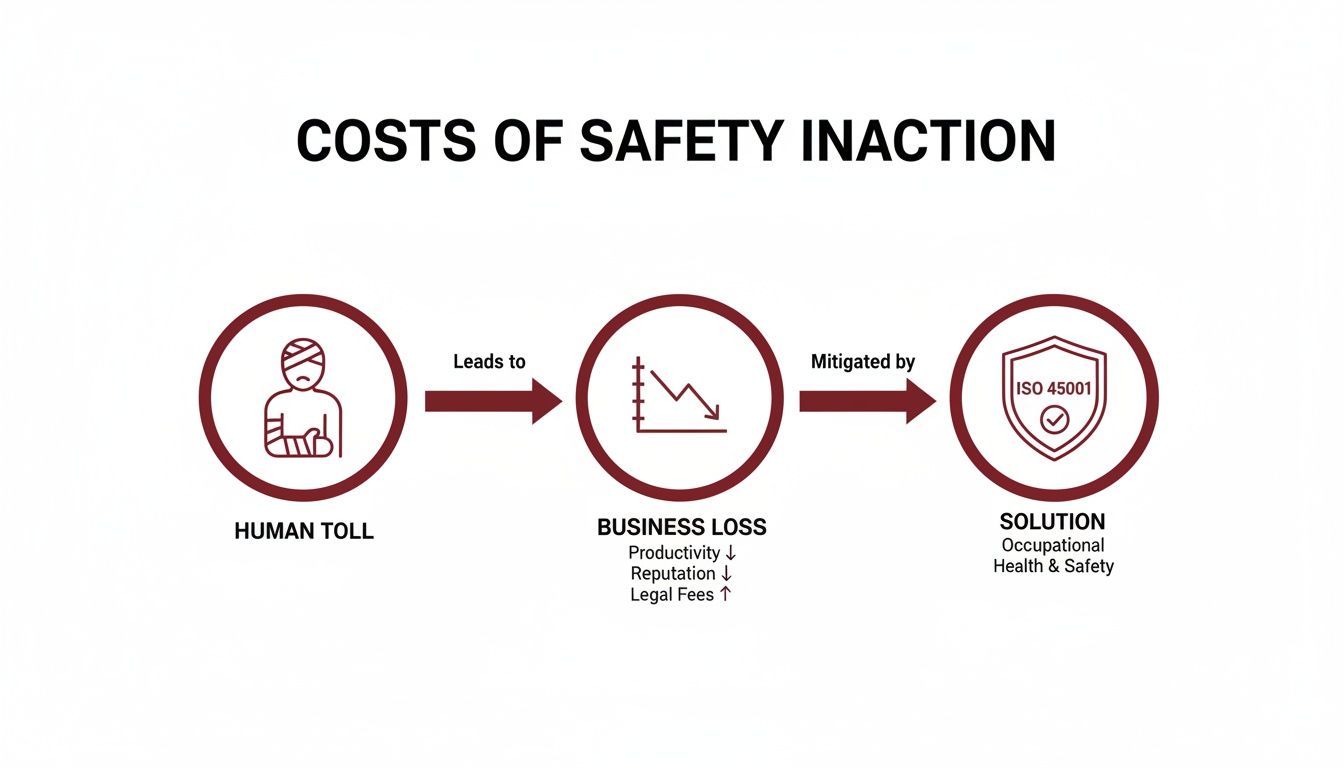
This infographic perfectly captures the domino effect of poor safety. It starts with the human cost, which quickly spirals into serious business losses. A system like ISO 45001 isn't just about compliance; it's about breaking that chain reaction. Failing to manage workplace safety risks in transport & logistics creates a cascade of negative outcomes that can cripple an otherwise healthy business.
Vehicle Operations and Traffic Management
It goes without saying that the biggest risks in this industry involve vehicles on the move. But this isn't just about semi-trailers on the highway. We’re talking about forklifts zipping around a warehouse, delivery vans navigating tight city streets, and prime movers manoeuvring through a packed depot. An incident can be as minor as a scraped bumper or as devastating as a multi-vehicle pile-up.
Usually, the cause is a mix of human error and the environment itself. Speeding, a driver distracted by their phone, a truck with faulty brakes, or a yard with a chaotic traffic layout—all of these can lead to disaster. The fallout is always serious, from worker fatalities and massive public liability claims to crippling operational downtime.
The starting point for getting this right is a solid traffic management plan. The golden rule is to separate people from moving vehicles wherever you possibly can. Beyond that, other key controls include:
- Regular Vehicle Inspections: Non-negotiable pre-start checks are your first line of defence, catching mechanical issues before they turn deadly.
- Driver Training and Competency: A licence is just the beginning. Your drivers need to be skilled in defensive driving and intimately familiar with the rules of every site they enter.
- Clear Signage and Speed Limits: Use big, clear signs to post speed limits and direct traffic flow through your depots and yards. Don't make people guess.
Manual Handling and Musculoskeletal Disorders
Lifting, carrying, pushing, and pulling are the bread and butter of logistics work. But done the wrong way, day in and day out, these simple actions lead to musculoskeletal disorders (MSDs). These are the debilitating injuries to backs, shoulders, and joints that represent some of the most common and expensive claims in the industry.
Picture a courier constantly heaving awkward packages out of a van, or a warehouse worker bent over, hand-loading pallets for an entire shift. That strain adds up. It leads to chronic pain, long periods off work, and in the worst cases, permanent disability. The root cause is simple: a mismatch between what the job demands and what a person's body can safely handle.
The core principle here is to change the work, not the worker. Expecting someone to be strong enough to lift heavy items all day is a recipe for disaster. Redesigning the process to eliminate the heavy lift is the real solution.
To tackle these risks, you need to work your way down the hierarchy of controls:
- Elimination: The best option. Can you automate the task or get rid of the manual lift altogether?
- Substitution: If you can't eliminate it, bring in mechanical help. Think forklifts, pallet jacks, or conveyor belts.
- Engineering: Make the environment better. This could mean installing adjustable-height workbenches or providing ergonomic tools that reduce strain.
- Administration: As a last resort, implement job rotation to share the load and provide thorough training on safe lifting techniques.
Driver Fatigue
Fatigue isn’t just about feeling a bit drowsy. It’s a genuine state of mental and physical impairment that kills a driver’s ability to operate safely. It makes reaction times sluggish, clouds judgement, and can lead to micro-sleeps—those terrifying moments where a driver nods off for a few seconds, which is all it takes for a fatal crash.
What causes it? Long hours, impossibly tight schedules, and broken sleep patterns are the main offenders. The pressure to keep freight moving often pushes drivers well past their limits. With fatigue costing businesses billions every year, managing it is not just a safety issue—it's a financial imperative.
Managing fatigue has to be a team effort. It demands:
- Realistic Scheduling: Plan your routes and deadlines to allow for proper rest breaks, as required by law. Don't set your drivers up to fail.
- Fatigue Management Policies: Create a clear, written policy that gives drivers the confidence to report when they're too tired to drive, without fearing they’ll lose their job.
- Training and Awareness: Teach everyone, from drivers to schedulers, how to spot the signs of fatigue in themselves and their colleagues.
Loading and Unloading Operations
The loading dock is easily one of the most dangerous places in logistics. It’s a chaotic intersection of people, massive trucks, forklifts, and heavy freight. The big dangers here are falls from the dock edge, workers being hit by shifting loads, or crushing incidents involving moving vehicles.
A classic, and horrific, scenario is a truck driver pulling away from the dock while a forklift operator is still inside the trailer. Other risks come from loads that aren’t secured properly and end up toppling over during unloading.
A few key controls can make your loading docks dramatically safer:
- Vehicle Restraints: Use physical dock locks or even simple wheel chocks to make sure a trailer is anchored in place and can’t move an inch.
- Communication Systems: A simple red-light/green-light system is a foolproof way to signal to a driver when it's safe to depart.
- Load Securing Procedures: Properly train your team on how to brace and strap cargo so it stays put, both on the road and during unloading.
By methodically tackling these crucial workplace safety risks in transport & logistics, you start to build a resilient safety culture. This not only protects your team but also makes your entire business stronger from the inside out. The remaining risks we'll cover are just as important to manage with the same careful attention.
Putting Practical Controls in Place That Actually Work
Spotting the many workplace safety risks in transport & logistics is one thing. The real work—and where you’ll see genuine safety improvements—starts when you implement practical, effective controls that your team can actually follow, day in and day out. This is all about turning theory into action on the ground.
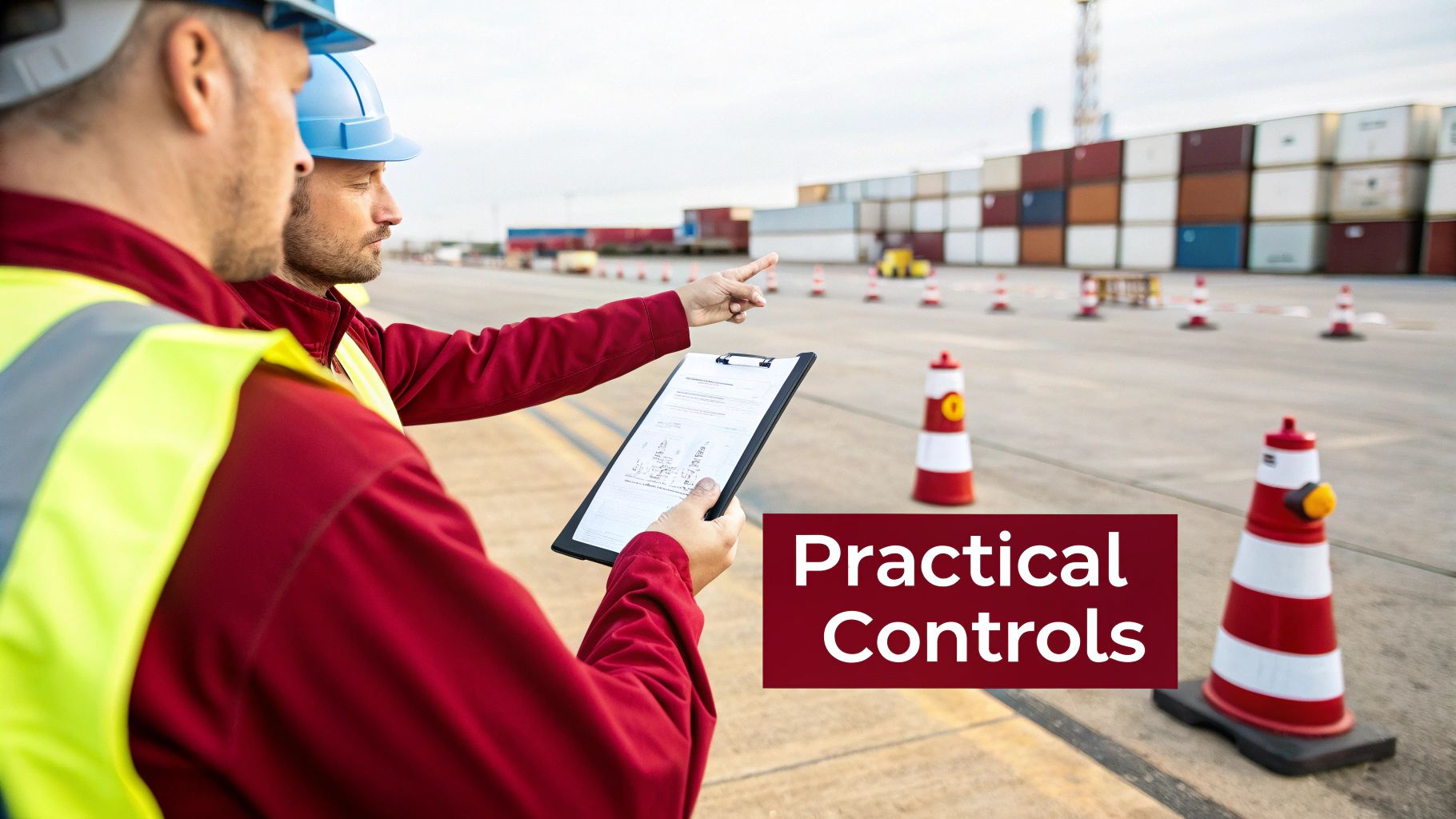
Forget vague advice. Let’s get into a 'how-to' guide for tackling two of the industry's biggest headaches: chaotic vehicle movements and high-risk manual handling. We'll break down what works and show you how these controls deliver real-world results.
Designing an Effective Traffic Management Plan
A busy depot without a clear traffic plan is just an accident waiting to happen. The goal is simple: create a predictable, controlled environment where people and vehicles aren't constantly in conflict. Think of a good traffic management plan as your site's very own rulebook for movement.
At its core, the principle is to separate people and vehicles wherever possible. This is, without a doubt, the single most effective way to prevent devastating collisions and crush injuries.
A solid plan needs these key components:
- Designated Walkways: Use high-visibility paint to mark out clear pedestrian-only paths. Better yet, physically separate them from vehicle routes with guardrails or barriers.
- Clear Signage and Road Markings: You need stop signs, speed limits, and directional arrows to guide drivers instinctively. Don't forget mirrors on blind corners—they are absolute lifesavers.
- One-Way Systems: If you can make it work on your site, a one-way traffic flow is brilliant. It eliminates the risk of head-on collisions and makes navigating the yard much simpler for everyone, especially visitors and contractors who aren't familiar with the layout.
- Exclusion Zones: Create clear 'no-go' zones for pedestrians around high-risk areas. Loading bays and anywhere a forklift is operating should be strictly off-limits to anyone on foot.
Mastering Manual Handling with Brains, Not Brawn
Manual handling injuries are a constant drain on our industry. They cause real pain for workers and come with a hefty price tag for businesses. In fact, musculoskeletal disorders are a massive problem in Australia's transport, postal, and warehousing sector, leading to some of the highest rates of serious workers' compensation claims.
The best strategy? Engineer the heavy lifting out of the job altogether.
Your primary goal should be to modify the task to suit the person, not expect the person to endure the task. This mindset shift is central to preventing long-term injuries.
Effective controls for manual handling look like this:
- Conducting Ergonomic Assessments: Go out and watch how the work actually gets done. Look for awkward postures, repetitive movements, and heavy lifts that are causing strain. Then, get the team involved in brainstorming better ways to do it.
- Investing in Mechanical Aids: Give your people the right tools for the job. This means easy access to pallet jacks, forklifts, conveyor belts, and vacuum lifters to take the load off their bodies.
- Team Lifting and Training: While mechanical aids are always the first choice, sometimes a manual lift is unavoidable. When that happens, make sure your team is properly trained in safe lifting techniques and uses team lifting for anything oversized or heavy.
Real-World Success Stories
Let's look at how these principles translate into real business improvements. Here are two anonymised examples.
Case Study 1: A Regional Freight Business Tackles Yard Chaos
A regional freight company was dealing with constant near-misses in their depot. It was a chaotic mix of B-doubles, forklifts, and staff all sharing the same space.
- Action Taken: They rolled out a simple but highly effective traffic management plan. They painted dedicated pedestrian walkways, created a one-way system for all trucks, and made high-vis vests mandatory for anyone outside the office.
- Outcome: Within just six months, reported near-misses plummeted by over 80%. The organised traffic flow also made loading more efficient, and their visible commitment to safety even helped them win a major new contract.
Case Study 2: A Metro Warehouse Reduces Manual Handling Injuries
A third-party logistics (3PL) warehouse had a growing problem with back and shoulder injuries among their pick-and-pack team. This was driving up their workers' compensation claims and causing high staff turnover.
- Action Taken: The company brought in an expert for an ergonomic review. Based on the findings, they invested in height-adjustable packing benches and some new lightweight, motorised pallet jacks. They also reorganised the warehouse to store the heaviest, most popular items at waist height, cutting down on bending and reaching.
- Outcome: They achieved a 40% reduction in manual handling injury claims in the first year alone. Staff morale went up, and the lower insurance premiums gave their bottom line a direct, healthy boost.
Connecting Your Safety Efforts to ISO 45001
If you’re already using traffic management plans, training your crew in safe manual handling, or writing fatigue policies, you're doing more than just improving safety. You're actually laying the foundations for ISO 45001 certification. This global standard for occupational health and safety isn't some abstract rulebook; it’s a framework that brings structure and recognition to the good work you’re already doing.
Think of it this way: your day-to-day safety tasks are the bricks. ISO 45001 is the architectural blueprint that helps you assemble them into a solid, certified structure. This organised approach ensures no critical workplace safety risks in transport & logistics fall through the cracks and shows your team and clients you’re serious about their wellbeing.
Demystifying the Clauses
The language in the ISO 45001 standard can look a bit dense at first, but the ideas behind it are surprisingly simple. For instance, when you map out a traffic management plan for your depot, you’re directly tackling Clause 8.1 Operational Planning and Control. All this clause really asks is that you plan, implement, and control your processes to manage health and safety risks.
In the same way, your procedures for managing driver fatigue or ensuring correct loading techniques fit perfectly with the standard's push to eliminate hazards. The point is, getting certified isn’t about starting over. It’s about organising and documenting your current safety practices to meet an internationally recognised benchmark.
The real power of ISO 45001 is that it shifts your safety mindset from reactive to proactive. You move from just responding to incidents to building a system that stops them from happening in the first place.
Mapping Your Risks to the Standard
Once you see how your existing controls plug into the ISO 45001 framework, the path to certification starts to look a lot less daunting. Vehicle incidents are a tragic reality in our industry, with machinery operators and drivers facing some of the highest fatality rates in Australia. An ISO 45001 system hits these risks head-on through requirements for journey planning and, crucially, keeping pedestrians and vehicles safely apart. As you can learn by exploring more about workplace fatalities in Australia, companies with this certification often see fewer incidents because of their structured approach.
To make it even clearer, here’s how common logistics risks connect directly to specific ISO 45001 clauses and the kind of paperwork you’ll need.
| Common Logistics Risk | Corresponding ISO 45001 Clause | Example Documentation Required |
|---|---|---|
| Vehicle Collisions | Clause 8.1: Operational Planning and Control | Documented Traffic Management Plan, Vehicle Pre-Start Checklists, Driver Training Records |
| Driver Fatigue | Clause 8.1.2: Eliminating Hazards | Fatigue Management Policy, Work Scheduling Procedures, Driver Fitness-for-Duty Declarations |
| Manual Handling Injuries | Clause 6.1.2: Hazard Identification | Risk Assessments for Manual Tasks, Safe Work Method Statements (SWMS), Training on Lifting Techniques |
| Subcontractor Incidents | Clause 8.1.4: Procurement | Contractor Prequalification Records, Site Induction Register, Subcontractor Safety Performance Reviews |
This mapping is more than just a box-ticking exercise; it’s your strategic roadmap to getting certified. It proves that the practical safety measures you have on the ground are exactly what auditors want to see. By methodically documenting these controls, you build a robust safety management system that protects your workers and will stand up to any audit. For those ready to take that step, our guide on the path to ISO 45001 certification provides a detailed overview.
Ultimately, linking your safety efforts to this standard elevates them from a collection of separate tasks into a powerful, cohesive system. This system doesn't just minimise workplace safety risks in transport & logistics—it also gives you a real commercial edge in a tough market.
Practical Safety Audit Checklist for Logistics Operations
Knowing about the workplace safety risks in transport & logistics is one thing, but actively finding and fixing them is what truly matters. To help you get started straight away, here’s a practical safety audit checklist. It’s built around the major risk areas we’ve already covered, giving you a solid framework for a self-assessment.
Think of these questions as a way to take the pulse of your safety systems. They’ll help you spot the gaps that need urgent attention and show you where you’re already strong. This isn't just about ticking boxes; it's a real-world tool to strengthen your safety culture.
Vehicle Operations and Traffic Management
The constant buzz of vehicles moving around your site is almost always your biggest risk. One blind spot, one moment of inattention, and you’re looking at a serious incident. Your audit needs to be ruthless in checking how people and vehicles mix (or don't).
- Are your pedestrian walkways clearly painted and, ideally, physically separated from vehicle traffic with barriers?
- Is your site signage—speed limits, stop signs, direction arrows—obvious, easy to read, and in all the right places?
- Do you have a non-negotiable pre-start vehicle check that drivers must complete and sign off on every single day?
- Is there a one-way traffic flow system to eliminate the chance of head-on collisions in your yard?
Loading and Unloading Operations
Loading docks are pressure cookers. It’s where things can go wrong fast. A solid system here is your best defence against falls, crush injuries, and shifting loads. The key is crystal-clear communication and reliable physical controls.
- Does every loading dock have working vehicle restraints, like dock locks or wheel chocks, and is their use mandatory for every single job?
- Is there a simple, foolproof communication system—like red and green lights—to tell a driver when it’s safe to pull away?
- Do you have a clear process to check that a load is stable before anyone opens the trailer doors?
A near miss on a loading dock is a gift. It's a free lesson in what could go wrong. Your audit shouldn't just look for what's compliant; it should actively ask your forklift operators and truckies where the system is weak. Their experience on the ground is gold.
Manual Handling and Musculoskeletal Health
Sprains, strains, and chronic back pain don't happen by accident; they happen by design. Your job is to design tasks so that heavy and repetitive lifting is engineered out wherever possible. This part of the audit is all about the tools and processes you give your people.
- Are mechanical aids like pallet jacks, forklifts, or hoists easy to access, in good nick, and actually being used by your team?
- Have you done proper ergonomic assessments on jobs that involve a lot of lifting, bending, or working in awkward positions?
- Is there a clear rule against staff trying to lift items over a set weight limit on their own?
- Are the heaviest or most-used goods stored at a sensible height (around waist level) to reduce bending and reaching?
Driver Fatigue Management
Fatigue is an invisible threat, but it’s just as dangerous as drink driving because it destroys judgement. A formal system is the only way to get on top of it. Your audit needs to check if your policies and schedules put driver safety ahead of delivery deadlines.
- Do you have a written fatigue management policy, and has every driver and scheduler actually been trained on it?
- Are your rosters and schedules designed to stick to legal driving hours and guarantee proper rest breaks?
- Is there a straightforward, no-blame way for a driver to put their hand up and say they’re too tired to drive safely?
Your Logistics Safety Questions Answered
When you're running a busy SME, juggling safety compliance with the day-to-day grind can feel overwhelming. It's natural to have questions. Here are some straightforward answers to the things we get asked most often, designed to give you clarity and confidence.
What’s the Single Biggest Safety Risk We Should Tackle First?
For almost every transport and logistics business in Australia, the most critical danger comes from vehicle-related incidents. Nothing else in our industry carries the same devastating potential for serious injury or death.
Your absolute first priority should be creating a rock-solid traffic management plan for any site you control. The golden rule is simple but non-negotiable: keep people and moving vehicles separate. Once that’s in place, build on it with thorough driver training, strict fatigue management rules, and mandatory pre-start vehicle checks that are actually documented. Nailing this area means you’re tackling your biggest threat head-on.
How Can a Small Business Possibly Afford All These Safety Measures?
Great safety isn't about throwing money at the problem; it's about smart, targeted action. Many of the most effective safety controls cost very little but deliver massive returns. Think about things like running better toolbox talks, putting up clear, simple signage, or documenting your procedures properly.
The trick is to be strategic. Start with a proper risk assessment to figure out where the real dangers are. That way, you can focus your limited budget where it will make the most difference. Always remember, the cost of preventing an accident is a tiny fraction of the cost of cleaning one up—both in financial and human terms. Investing in safety is really just an investment in keeping your business running.
If We Get ISO 45001 Certified, Does That Mean We’re Automatically Safe?
Achieving ISO 45001 certification gives you an incredible blueprint for a top-tier safety management system. But having the blueprint doesn't build the house. The certificate proves you have the right systems to identify, assess, and control your workplace safety risks in transport & logistics.
Real, lasting safety happens when those systems become second nature—part of your company's DNA, from the boss right down to the newest hire. The standard is your roadmap, but it's the consistent, daily effort of your team that truly makes a workplace safe.
How Do We Handle the Safety Risks Our Subcontractors Bring On-Site?
You're just as responsible for your subcontractors' safety as you are for your own team's. It's a key requirement under WHS law and a core part of ISO 45001. Your safety management system has to include them, no exceptions.
This starts with a solid pre-qualification process. Before they even set foot on your site, you need to be verifying their safety documents, licences, and insurance. From there, you must provide a site-specific induction, spell out your safety rules clearly, and actively monitor that they're following them. Your system needs to define exactly how this happens every single time, ensuring everyone is protected to the same standard.
Ready to build a safety system that not only protects your team but also helps you win bigger contracts? The expert team at ISO45001 Consulting can walk you through every step of the certification journey, creating a practical system that’s a perfect fit for your business. Get in touch with us today and let's make your workplace safer and more competitive.
Recent Comments