

Quick Summary: Managing workplace safety risks in pharmaceuticals is a critical business function, not just a compliance task. This guide outlines key hazards like chemical exposure, biological agents, and psychosocial stress. It details how to apply the Hierarchy of Controls and leverage the ISO 45001 framework to build a resilient, compliant, and productive work environment.
When you're dealing with workplace safety risks in pharmaceuticals, it's about much more than just ticking boxes. You're identifying a whole range of hazards—from chemical exposure and biological agents to complex process failures—and putting a system like ISO 45001 in place to protect your people and stay compliant. It's a hands-on strategy that prevents accidents and fosters a truly resilient safety culture.
The risks in a pharmaceutical setting are incredibly diverse, spanning chemical hazards, biological agents, ergonomic strains, and equipment malfunctions. Getting on top of these dangers demands a structured and proactive approach that weaves safety into the very fabric of your operations. This isn't just about compliance; it's about building a work environment that is both safe and highly productive.
Understanding Key Pharmaceutical Workplace Safety Risks

In the high-stakes pharmaceutical sector, cutting-edge innovation and rock-solid safety standards must go hand in hand. The potential for harm isn't just a hypothetical; it’s baked into the very materials and processes that create life-saving drugs. This reality turns managing workplace safety risks in pharmaceuticals into a core business function, not just another regulatory task to get through.
Think of a strong safety management system like the rigorous quality control you apply to your products. Just as QC ensures every single batch is perfect, a safety system brings that same discipline to protecting your most important asset: your team.
Moving Beyond Compliance to Competitive Advantage
When you treat safety as a strategy, you shift it from being seen as a cost to being a driver of operational excellence. It’s simple, really: a safe workplace is an efficient one. Proactively managing your risks cuts down on disruptions from incidents, lowers workers' compensation claims, and boosts morale and productivity across the board.
What’s more, proving your commitment to world-class safety gives you a real competitive edge. It becomes a powerful differentiator when you're bidding for major contracts with government agencies or large corporations who demand absolute certainty in their supply chains.
A well-implemented safety system is proof that your organisation can manage complex processes reliably and responsibly. It tells potential clients that you are a low-risk, high-value partner capable of meeting the most stringent requirements.
This guide is designed to walk you through identifying, assessing, and controlling the specific hazards found in the pharmaceutical industry. We'll break down how a formal framework like ISO 45001 provides a clear roadmap to not only protect your people but also to build a stronger, more resilient business.
Identifying Key Pharmaceutical Workplace Hazards
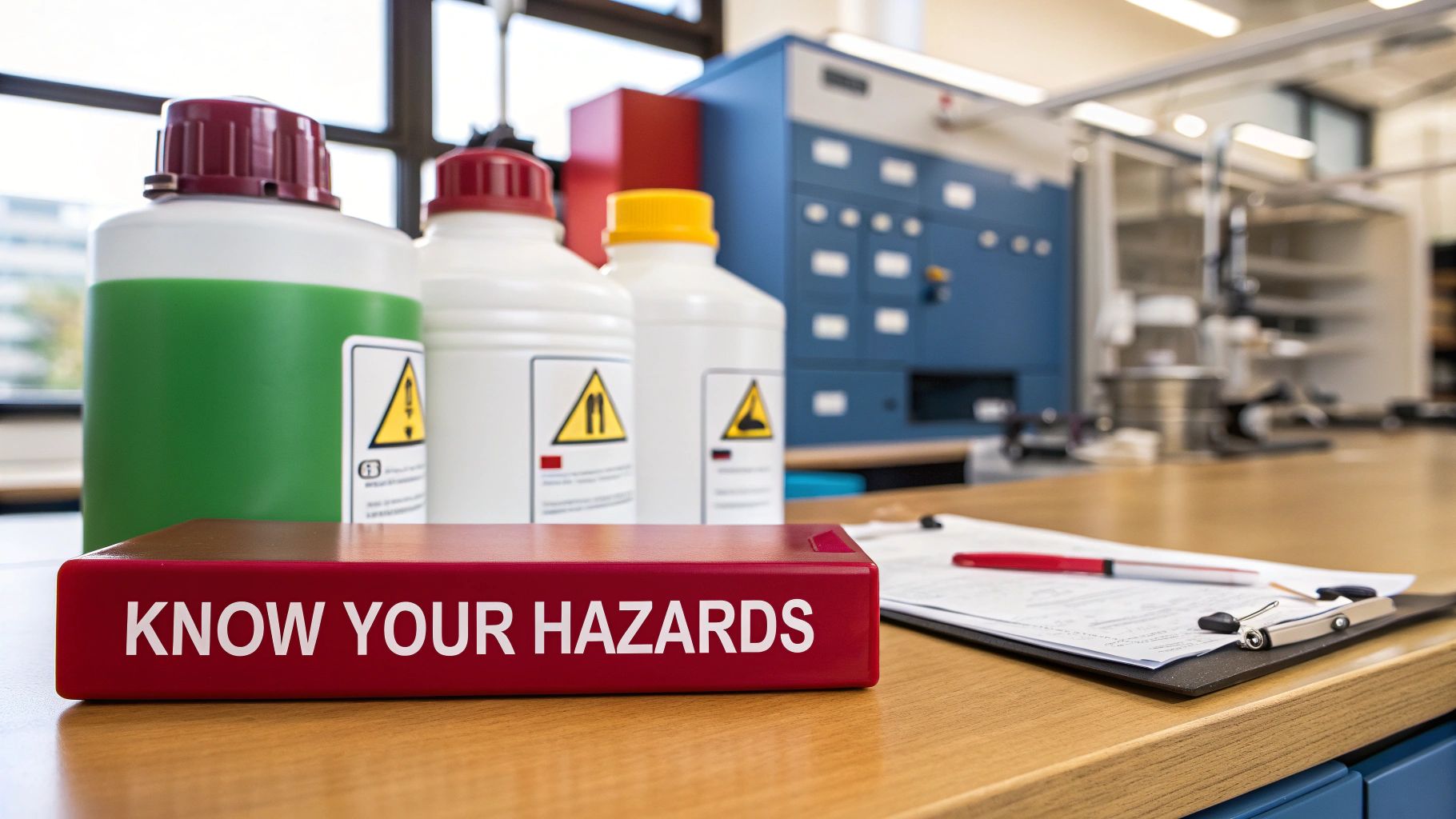
Before you can get a handle on workplace safety, you first need to know what you’re up against. The hazards in the pharmaceutical world are often complex and sometimes invisible, going well beyond the obvious slip or trip. To build a robust risk assessment, you need a systematic way of thinking.
This means moving away from generic checklists and really digging into the specific dangers lurking in your labs, on your production lines, and throughout your warehouses. Each type of hazard presents its own unique challenges and demands tailored solutions.
Let’s break down the main categories you're likely to encounter.
Chemical and Biological Hazards
The very essence of pharmaceutical work is manipulating substances designed to have a powerful biological effect on the human body. It’s no surprise, then, that chemical and biological agents are the most obvious and significant workplace safety risks.
Chemical Hazards: This isn’t just about the obvious corrosives. It includes exposure to Active Pharmaceutical Ingredients (APIs), which can be incredibly potent even in minuscule amounts. Then you have the solvents, cleaning agents, and reagents used daily, each carrying risks from skin irritation and respiratory damage to outright flammability.
Biological Hazards: This category covers the risks of working directly with live organisms, like the bacteria and viruses used in vaccine development, or sensitive cell cultures. It also extends to biological by-products and potential allergens that can trigger serious reactions in staff who have become sensitised over time.
Getting these basics right is the critical first step. For a closer look at managing a wide array of substances, our guide on the health and safety risks in chemical manufacturing is a great resource.
Physical and Ergonomic Risks
While the chemical dangers often steal the spotlight, the physical and ergonomic strains on your team are just as important. These risks are easy to overlook but are a major source of long-term health problems and lost productivity.
Think about the repetitive tasks that fill a typical day. A lab technician pipetting for hours on end, or a quality inspector manually checking products on a fast-moving line. These actions can easily lead to musculoskeletal disorders (MSDs) like carpal tunnel syndrome.
On top of that, you have manual handling. Moving heavy drums of raw materials, lifting boxes of finished goods—these activities can cause serious back injuries without the right equipment and procedures. Poorly designed workstations that force people into awkward positions for hours are another classic, and entirely preventable, source of ergonomic risk.
Process Safety and Psychosocial Hazards
Beyond direct harm from substances or physical strain, the work processes and the workplace environment create their own distinct layers of risk that demand attention.
Process safety failures are the low-probability, high-consequence events you read about. Imagine a runaway chemical reaction in a reactor vessel causing an explosion, or a containment breach releasing a highly toxic API into the facility. These incidents are rare, but their potential for devastation is enormous.
Psychosocial hazards are just as serious, though much less visible. The high-stakes, zero-error culture that’s common in pharmaceuticals can lead to immense stress, burnout, and mental health issues. This isn't just a personal problem—a stressed, fatigued worker is far more likely to make a critical mistake.
To give you a clearer picture, here’s a breakdown of how these hazards typically show up in a pharmaceutical setting.
Common Hazard Categories in Pharmaceutical Operations
| Hazard Category | Description | Common Examples in Pharmaceuticals |
|---|---|---|
| Chemical | Exposure to hazardous substances via inhalation, ingestion, or skin contact. | Active Pharmaceutical Ingredients (APIs), potent compounds, solvents, reagents, cleaning agents. |
| Biological | Exposure to microorganisms, cell cultures, or biological materials. | Viruses and bacteria in vaccine R&D, genetically modified organisms, sensitising agents. |
| Ergonomic | Risks from poorly designed tasks or workstations leading to musculoskeletal injury. | Repetitive pipetting, microscope use, manual tablet inspection, lifting heavy containers. |
| Process Safety | Failures in systems designed to contain hazardous materials or energy. | Runaway reactions, loss of containment from vessels/pipework, dust explosions. |
| Fire/Explosion | Ignition of flammable liquids, vapours, or combustible dusts. | Handling flammable solvents (e.g., ethanol, acetone), accumulation of fine powder dusts. |
| Controlled Substances | Risks related to the security and handling of narcotics or other regulated drugs. | Diversion/theft, accidental exposure during handling, regulatory compliance failures. |
| Psychosocial | Factors in the work environment that affect psychological health and wellbeing. | High-pressure deadlines, demand for precision, shift work, fear of making errors. |
| Contractors/Field | Hazards faced by non-employees on-site or employees working off-site. | Unfamiliarity with site rules, lack of specific training, lone worker situations for sales reps. |
Recognising these diverse hazards is fundamental. A solid understanding of these categories is the bedrock on which you can build an effective safety management system, especially one aiming for a standard as comprehensive as ISO 45001.
Getting to Grips with Australian WHS Regulations
Knowing the specific safety risks in your pharmaceutical operation is only half the battle. The other half is understanding how those risks fit into the real-world legal landscape here in Australia. For any pharma business, Work Health and Safety (WHS) legislation isn't just a set of suggestions—it's a legal duty. These regulations take the abstract idea of 'safety' and turn it into concrete, enforceable responsibilities for employers.
At first glance, the framework can look a bit overwhelming. But its core principle is refreshingly simple: businesses must do whatever is reasonably practicable to ensure the health and safety of their people. This 'duty of care' is especially crucial in the pharmaceutical world, where handling potent substances and running complex processes means the stakes are just that much higher.
The Sobering Reality of Workplace Incidents
The official data from Safe Work Australia really brings home why manufacturing, which includes pharmaceuticals, is still considered a high-risk sector. In a recent year, Australian workplaces saw a staggering 146,700 serious compensation claims lodged. That's more than 400 claims every single day. Even more sobering, the manufacturing industry was one of the top six sectors responsible for 80% of the 188 work-related fatalities.
While the stats don't break down to the pharmaceutical industry specifically, the common culprits—like vehicle incidents in warehouses or falls from height in production areas—are major contributors to these tragic numbers. A single serious incident is far more than a personal tragedy; it can shut down production, trigger expensive investigations, tarnish your brand's reputation, and even put the future of your business at risk. You can dig deeper into these numbers and explore the latest 2025 work health and safety data for Australian workplaces.
The Rising Tide of Psychosocial Hazards
Beyond the obvious physical dangers, Australian WHS laws are now shining a much-needed spotlight on psychosocial risks—the parts of a job that can quietly chip away at an employee's mental wellbeing. With its high-pressure, zero-error culture, the pharmaceutical industry is fertile ground for these hidden dangers.
Just think about the daily pressures that can lead to mental strain:
- Immense Pressure: The constant demand for absolute precision, where the stakes are incredibly high, creates a stressful environment.
- Shift Work: Working odd hours or rotating shifts messes with natural sleep patterns, taking a toll on both mental and physical health.
- Repetitive Tasks: Doing the same thing over and over can lead to boredom and mental fatigue, which ironically makes errors more likely.
- Fear of Failure: When one small mistake can have massive consequences, it's only natural for people to feel a constant sense of anxiety.
These aren't trivial issues. Mental health conditions now make up 12% of all serious workers' compensation claims in Australia, and that number is on the rise. This signals a fundamental shift in how we need to think about workplace safety.
A truly safe workplace is one that protects both the body and the mind. Tackling psychosocial hazards is no longer a 'nice-to-have'—it's a core part of your legal and ethical responsibility.
More Than Just a Box-Ticking Exercise
Meeting your WHS obligations shouldn't feel like a chore you just have to get through. See it for what it is: a strategic opportunity to build a stronger, more productive, and more reputable business. When you proactively manage both the physical and mental safety risks in your pharmaceutical operation, you build a culture where people feel safe, respected, and empowered to bring their A-game.
This kind of proactive approach takes your business beyond simple compliance. It turns risk management into a powerful tool that protects your people, your operations, and ultimately, your bottom line. A robust framework like ISO 45001 gives you the structured, systematic approach you need to meet these regulatory demands head-on.
Applying the Hierarchy of Controls to Pharmaceutical Risks
Once you’ve got a handle on the specific workplace safety risks in your pharmaceutical operations, the real work begins: controlling them. It’s one thing to identify a hazard, but it’s another to systematically and effectively reduce the danger it poses. This is where the Hierarchy of Controls becomes an indispensable tool. It’s a proven framework that prioritises the most effective safety measures and pushes the least effective ones to the bottom of the list.
Think of it as a strategic playbook for risk management. Instead of instinctively reaching for Personal Protective Equipment (PPE) as the first solution—which should always be the last line of defence—this model forces you to think more critically. It guides you towards more robust, permanent solutions that engineer the risk out of the process itself.
The flowchart below shows how different areas of concern in Australian manufacturing are connected, linking operational processes to physical injuries and even mental health. The Hierarchy of Controls provides a structure to tackle all of them.
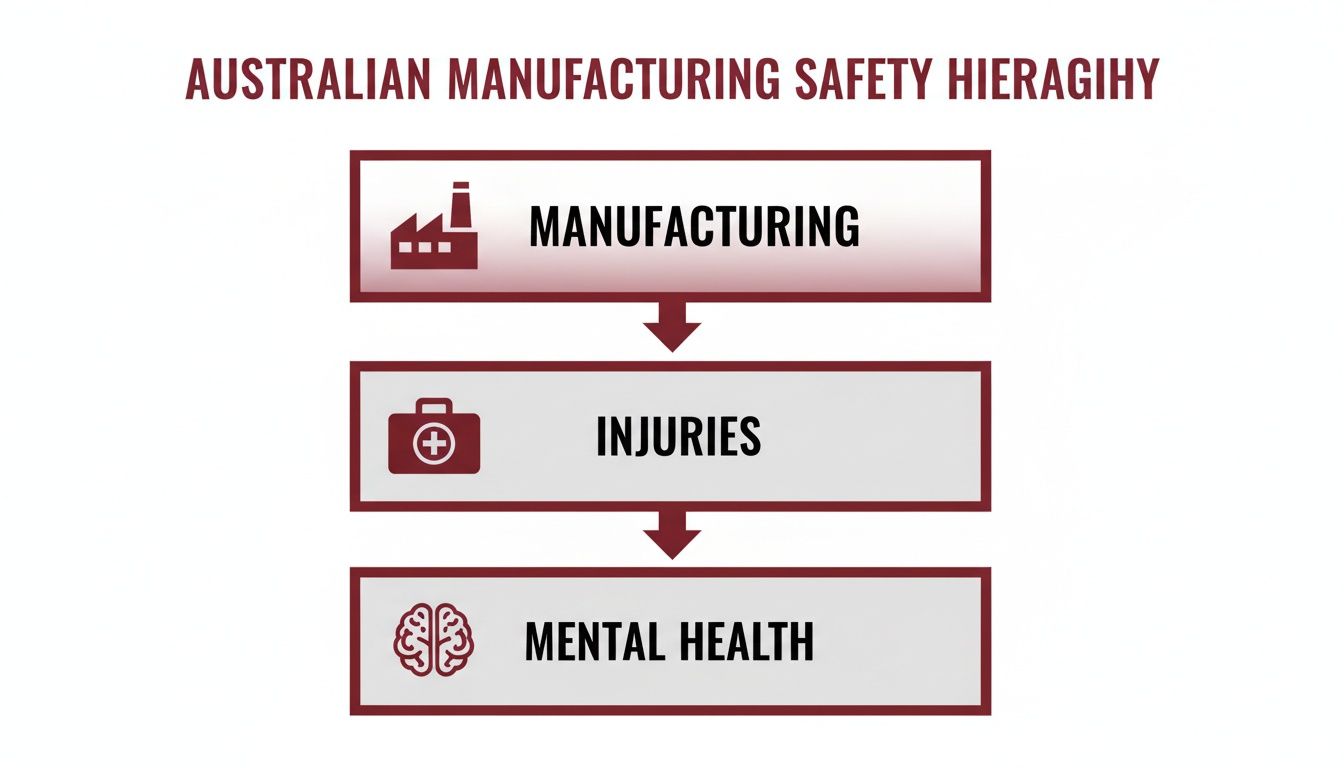
This really brings home the point that a solid safety strategy needs to look at everything from the factory floor to the psychological wellbeing of your team, reinforcing the value of a multi-layered approach to risk control.
Deconstructing the Hierarchy Levels
The Hierarchy of Controls is structured as an inverted pyramid. The most effective controls are at the wide top, and the least effective are at the narrow bottom. Let’s walk through each level using a common pharmaceutical scenario: managing an operator’s exposure to a potent powdered substance, like an Active Pharmaceutical Ingredient (API).
Elimination: This is the gold standard because it removes the hazard completely. For our API, you’d ask: Can we get rid of the powdered form entirely? Maybe the product can be reformulated to remove that ingredient, making the whole process inherently safe from that specific risk.
Substitution: If elimination is off the table, the next best option is to swap the hazard for something less risky. The question becomes: Can we substitute this hazardous powder with a safer alternative? This could mean switching to a liquid or pellet version of the API, which dramatically cuts down the risk of workers inhaling airborne dust.
Engineering and Administrative Controls
When you can't eliminate or substitute a hazard, you shift focus to putting a barrier between people and the danger. These next two levels are still highly effective because they don't depend entirely on people remembering to follow rules every single time.
Engineering Controls are physical modifications to the workplace that isolate or contain the hazard. For our powdered API, this would look like:
- Installing a glovebox or containment isolator where the powder is handled. This creates a solid physical barrier between the operator and the API.
- Fitting a local exhaust ventilation (LEV) system right above the weighing station. This acts like a high-powered vacuum, capturing dust at the source before it has a chance to escape into the room.
By designing safety directly into the process, engineering controls reduce the potential for human error. They are the workhorses of effective risk management in a pharmaceutical setting.
Administrative Controls involve changing the way people work around the hazard. These are considered less reliable because they hinge on consistent human behaviour. Examples include:
- Developing and enforcing strict Safe Work Procedures (SWPs) for every step of weighing and handling the API.
- Restricting access to the weighing area, allowing only fully trained and authorised personnel to enter.
- Implementing rigorous cleaning and decontamination protocols to manage any residual dust on surfaces.
The Final Line of Defence: PPE
At the very bottom of the pyramid, we find Personal Protective Equipment (PPE). This is your last resort, used only when the other controls can't bring the risk down to an acceptable level on their own. For our API powder, this would mean mandating respirators, specialised gloves, lab coats, and safety glasses.
It’s absolutely critical to remember that PPE only protects the person wearing it, and its effectiveness depends entirely on correct selection, fit, and consistent use. If the equipment fails or someone uses it improperly, that person is completely exposed to the hazard.
This top-down approach is the foundation of a resilient safety system. It shifts your strategy from being purely reactive (just handing out masks) to being proactive by designing risk out of your processes from the start. This is precisely the methodology that underpins a robust safety management system compliant with ISO 45001.
Using ISO 45001 to Manage Pharmaceutical Safety
Identifying the sheer variety of workplace safety risks in pharmaceuticals is a huge first step, but it’s really just the starting line. The true test is turning that awareness into a robust system that actively prevents people from getting hurt. This is exactly where ISO 45001, the global standard for occupational health and safety (OH&S), comes in.
Think of ISO 45001 not as a restrictive rulebook, but as a proven framework for weaving safety into the very fabric of your daily operations. It’s not about ticking boxes or creating documents that gather dust. It’s about building a proactive culture where you can turn unpredictable risks into controlled, manageable processes.
This approach helps you get ahead of the game, shifting from simply reacting to incidents to building a system that anticipates and neutralises hazards before they can cause any harm.
How ISO 45001 Addresses Key Pharmaceutical Risks
The real power of ISO 45001 in a pharmaceutical setting is how its clauses connect directly to the specific hazards your team faces every single day. It’s a way of translating the standard's requirements into tangible actions that protect people.
A great example is how the standard underpins training. For effective risk communication and compliance, a solid safety data sheets training program is non-negotiable in any pharmaceutical workplace, and ISO 45001 gives you the structure to make it happen.
The table below shows how different parts of the standard map directly to the common risks we've discussed, turning compliance into a practical safety tool.
How ISO 45001 Addresses Key Pharmaceutical Risks
| ISO 45001 Clause | Requirement Focus | Application in a Pharmaceutical Setting |
|---|---|---|
| Clause 5.4 | Consultation and Participation of Workers | Getting direct feedback from lab technicians on ergonomic risks in their workstations or from production staff on machinery guarding. |
| Clause 6.1.2 | Hazard Identification and Assessment of Risks | Systematically documenting chemical exposure risks from APIs, biological hazards in R&D, and manual handling risks in the warehouse. |
| Clause 7.2 | Competence | Ensuring anyone handling potent compounds or operating complex machinery is properly trained, qualified, and understands all control measures. |
| Clause 8.1 | Operational Planning and Control | Developing and enforcing strict protocols for chemical handling, lockout/tagout procedures for machine maintenance, and safe work methods for repetitive tasks. |
| Clause 8.2 | Emergency Preparedness and Response | Creating and drilling detailed response plans for specific scenarios like a major solvent spill, loss of containment, or a medical emergency from exposure. |
| Clause 9.1 | Monitoring, Measurement, Analysis | Tracking safety performance through leading indicators (e.g., safety audits completed) and lagging indicators (e.g., incident rates) to spot trends. |
| Clause 10.2 | Incident, Nonconformity and Corrective Action | Establishing a clear process for investigating not just accidents but also near misses, to find the root cause and prevent it from happening again. |
This systematic approach demonstrates that ISO 45001 isn't just a certificate for the wall; it’s a living management system that addresses your most critical operational risks head-on.
From Emergency Plans to Continual Improvement
A truly effective safety system doesn't just manage the day-to-day; it also prepares for the unexpected and learns from every experience, good or bad. ISO 45001 provides the perfect structure for this comprehensive approach.
This constant cycle of planning, doing, checking, and acting is what drives real, sustainable improvement and builds a resilient organisation.
ISO 45001 isn't about reaching a perfect, static state of 'safety'. It's about creating a dynamic system that constantly adapts and improves, ensuring your safety practices evolve right alongside your business and its risks.
Here’s how a few other crucial clauses fit into the big picture:
Emergency Preparedness and Response (Clause 8.2): This goes far beyond a basic fire drill. It requires you to have detailed, practiced plans for credible scenarios, like a major chemical spill, a biological containment breach, or a serious medical event.
Monitoring, Measurement, Analysis (Clause 9.1): You simply can't manage what you don't measure. This part of the standard pushes you to track safety performance with leading indicators (like safety observations) and lagging indicators (like incident rates), giving you the data to spot weaknesses.
Continual Improvement (Clause 10.3): This is the engine that drives the whole system forward. It obligates your organisation to learn from incidents, near misses, and audits to constantly refine your processes and strengthen your defences.
By putting these principles into practice, you build a holistic safety management system that is far more powerful than the sum of its parts. If you're considering this for your business, you can learn more about the specifics of achieving ISO 45001 certification and how it can be shaped to your unique operational needs. A structured approach like this doesn’t just protect your team—it also strengthens your operational reliability and builds your reputation as a responsible leader in the industry.
The Hidden Dangers: Managing Substance Impairment at Work
Some of the most serious risks in a pharmaceutical plant aren't the ones you can easily see, like chemical spills or faulty machinery. The threat of substance impairment is a far more complex and human challenge, yet it poses an equally significant danger. In an environment where a single miscalculation can have catastrophic results, an employee's impaired judgment is a risk we simply can't afford to ignore.
This isn't a theoretical problem. The data from Australian workplaces paints a stark picture. In one recent quarter, amphetamine-type substances (ATS) were found in a staggering 53.2% of all positive drug tests. The overall positive screening rate of 3.1% is concerning enough, but for the pharmaceutical sector—where staff handle powerful controlled drugs daily—it's downright alarming. Within those positive results, opioids held steady at 16% and cocaine use jumped to 8.5%.
When you realise that one in nine Australian workers who used illicit drugs in the past year admit to doing so at work, this issue shifts from a remote possibility to a tangible, everyday risk. For a deeper dive into the numbers, the TDDA Imperans Report uncovers some eye-opening key workplace drug trends.
A Human Problem Needs a Structured Solution
Dealing with substance impairment effectively requires a delicate balance of clear policy and genuine support. This is where a framework like ISO 45001 truly shines, guiding businesses to manage this very human issue with a structured, fair, and safety-focused approach. It helps move the conversation away from just punishment and towards creating a culture of safety and wellbeing.
Your starting point must be a robust, clearly communicated policy. This isn't just a document that gets filed away; it should set out unambiguous rules about drug and alcohol use that apply to everyone, from the lab technician to the CEO.
A strong policy isn't about trying to catch people. It's about setting crystal-clear safety expectations, especially for anyone in a safety-critical role. Everyone needs to understand their duty to keep themselves, and their teammates, safe.
Putting a Fair and Effective Policy into Action
To make your policy more than just words on a page, you need to build a system around it that people understand and trust.
Here’s what that looks like in practice:
- Education and Awareness: Don't just hand out a rulebook. Actively teach your team why this matters. Explain the unique dangers of impairment in a pharmaceutical setting and walk them through the company's policy so there are no surprises.
- Clear and Fair Testing: Your screening protocols must be transparent. Outline exactly when testing might occur—like pre-employment, random, or after an incident—and ensure your process is fully compliant with Australian legal standards. Fairness is key to building trust.
- Real Support Systems: Show that you care about your people's wellbeing. Offer confidential access to an Employee Assistance Program (EAP) or other support services for anyone struggling with substance use. Providing resources and exploring addiction topics for groups can also be a valuable part of a broader employee wellness initiative.
This balanced approach shows a true commitment to safety. It recognises that your people are your greatest asset and that managing human-related risks is a core part of building a genuinely safe workplace.
Answering Your Pharmaceutical Safety Questions
When you’re trying to get a handle on safety in a pharmaceutical setting, especially in a small or medium-sized business, a lot of practical questions come up. Let's tackle some of the most common ones that teams ask when they start formalising their Work Health and Safety (WHS) systems, particularly when aiming for a solid framework like ISO 45001.
We’re a Small Lab. Where Do We Even Start with ISO 45001?
It’s easy to feel overwhelmed, but the first step is actually quite simple: find out where you are right now. The best way to do this is with a gap analysis. Think of it as putting a pin on a map. You’re comparing what you currently do for safety against what the ISO 45001 standard asks for. This process quickly shows you what you’re already doing well and, more importantly, exactly where the gaps are.
Once you have that clear picture, your next move is to dive into a formal risk assessment. This isn't just a tick-box exercise. It's about methodically walking through your lab and identifying every single thing that could potentially harm someone—from a chemical splash to a repetitive strain injury. Evaluating the real-world risk of each hazard gives you a priority list, so you can focus your energy on fixing the biggest dangers first. This assessment is the bedrock of your entire safety system.
How Does ISO 45001 Actually Help with Handling Dangerous Chemicals?
This is where the standard really shines. ISO 45001 gives you a robust, structured way to manage the ever-present risks of chemical handling. It does this through a core requirement called 'Operational Planning and Control', which basically says you need clear, written rules for every stage of a chemical's life in your facility.
This means you’ll develop and enforce specific procedures for:
- Safe Storage: How to properly segregate chemicals that react with each other and ensure you have the right ventilation.
- Controlled Handling: The exact, step-by-step process for weighing, mixing, and moving hazardous substances.
- Emergency Response: What to do, step-by-step, in the event of a spill, accidental exposure, or containment failure.
- Correct Disposal: Making sure you’re following all the rules for getting rid of hazardous waste safely and legally.
On top of this, the standard’s emphasis on competence and training means you have to prove that every person handling these materials knows exactly what they’re doing and why. It’s a systematic approach that dramatically cuts down the risk of human error, which is crucial for managing the unique workplace safety risks in pharmaceuticals.
Do We Really Need ISO 45001 Certification to Win Government Tenders?
While it might not be explicitly written into law for every single tender, ISO 45001 certification is fast becoming the de facto prerequisite for winning significant contracts, both with government and large private companies. It’s essentially the industry’s gold standard—a clear signal that you take safety and quality seriously.
Think about it from the procurement team's perspective. ISO 45001 certification is independent, third-party proof that your business has a reliable safety system. It tells them you can handle complex risks responsibly, which de-risks their supply chain and makes you a far more trustworthy and attractive partner.
Achieving certification shows you’ve gone beyond just basic compliance. It proves you have a culture of proactive risk management built into how you operate every day. In a competitive bidding process, that’s a powerful advantage that can set you apart from the pack.
Ready to transform your approach to pharmaceutical safety and gain a competitive advantage? The team at ISO45001 Consulting provides expert, end-to-end guidance to help Australian SMEs achieve certification efficiently. We tailor our systems to your unique operations, ensuring you not only meet but exceed safety standards. Visit us at https://iso45001.net.au to learn how we can help you build a safer, more successful business.
Recent Comments