
For any Australian business, achieving workplace health and safety compliance is far more than a legal hoop to jump through. It's a fundamental pillar for operational excellence and genuine, long-term success. For small and mid-sized enterprises (SMEs), approaching Work Health and Safety (WHS) proactively isn't about ticking boxes—it's about building a powerful strategic asset that protects both your people and your profitability. This guide provides an in-depth look at managing occupational health, safety regulations, and creating a robust safety culture.
Why Proactive WHS Compliance Is a Competitive Advantage
Let’s be honest, for many SMEs, safety compliance can feel like just another cost. But when you start treating it as a core business function, its real value becomes crystal clear. Think of a robust WHS system, especially one aligned with a framework like ISO 45001, as an investment. It’s an investment that pays you back through a stronger reputation, better efficiency, and sustainable growth.
This shift in mindset is what separates businesses that simply avoid penalties from those that actively build a resilient, high-performing operation.

The real-world consequences of poor safety practices are stark. The statistics alone should make any business owner pause and think. In a recent year, a tragic 188 Australian workers were killed on the job. The leading cause was vehicle incidents, accounting for 42% of these fatalities, with falls from a height coming in second at 13%.
What's really concerning for many SMEs is that 80% of these deaths and 61% of serious compensation claims happened in just six industries, including construction, transport, and manufacturing. If you’re in one of these sectors and bidding for tenders, these numbers highlight just how critical demonstrable compliance is.
The data isn't just a national headline; it represents direct risks to businesses like yours. Understanding these figures is the first step to mitigating them.
How Key Australian WHS Statistics Impact Your Business
This table breaks down how national safety data translates into tangible risks for an SME, showing why getting ahead of compliance is non-negotiable.
| Hazard Category | Fatality Contribution | Primary Industries Affected | Business Risk Without Controls |
|---|---|---|---|
| Vehicle Incidents | 42% of fatalities | Transport, Postal & Warehousing; Agriculture, Forestry & Fishing; Construction | Skyrocketing insurance premiums, vehicle downtime, potential manslaughter charges, loss of transport contracts. |
| Falls from Height | 13% of fatalities | Construction; Agriculture, Forestry & Fishing | Immediate project shutdowns, hefty fines from SafeWork, reputational damage making it hard to win new work. |
| Being Hit by Moving Objects | 9% of fatalities | Transport, Postal & Warehousing; Construction | Worker compensation claims, lost productivity from stop-work orders, and difficulty retaining skilled staff. |
These statistics aren't just numbers on a page; they represent real events that can cripple a small or mid-sized business. Proactive safety isn’t just about protecting people—it’s about protecting your entire operation from these very real and costly outcomes.
Gaining a Commercial Edge Through Safety
A proven commitment to WHS is a powerful differentiator in today's market. When you're bidding for those larger government or private sector contracts, a certified safety management system is often a deal-breaker. It tells a potential client that you’re reliable, professional, and serious about how you run your business.
The benefits go well beyond just winning new work:
- Attracting Top Talent: A strong safety culture makes your company an employer of choice. It helps you recruit and keep skilled people who rightly care about their wellbeing.
- Reducing Financial Risk: Getting ahead of safety minimises incidents. That means a lower chance of facing disruptive fines, legal battles, and climbing insurance premiums.
- Improving Operational Efficiency: A well-designed safety system does more than prevent accidents; it pinpoints operational risks, leading to fewer disruptions, less downtime, and better productivity across the board.
By embedding safety into your daily operations, you transform it from an administrative task into a cultural norm. This proactive stance not only insulates your business from risk but also builds a foundation for sustainable growth and a trusted brand reputation.
To really see how WHS compliance becomes a strategic tool, it helps to look at the bigger picture and understand the top benefits of meeting security compliance. The core principles of managing risk and protecting your brand are the same, reinforcing why a solid safety framework is absolutely essential for any modern business to succeed.
Understanding Your Core Legal Responsibilities
If you want to achieve genuine workplace health and safety compliance, you first need to get your head around the legal bedrock it's all built on. Here in Australia, that foundation is the Work Health and Safety (WHS) Act. Think of it less like a rigid rulebook and more like a framework that spells out your fundamental duties to protect everyone your business touches.
A key concept in the WHS Act is the Person Conducting a Business or Undertaking (PCBU). This isn't just a fancy new term for "employer." It's intentionally broad to cover the full spectrum of modern work arrangements. Whether you're a company, a sole trader, a partnership, or even a volunteer group, if you're running the show, you're the PCBU—and you hold the primary duty of care.
What Does the "Primary Duty of Care" Actually Mean?
In plain English, being a PCBU means it's your job to ensure the health and safety of your workers, so far as is reasonably practicable. This extends beyond just your direct employees; it covers contractors, volunteers, and even visitors who might be affected by your work. It's a proactive duty—you can't just wait for an accident to happen and then react. You have to be actively managing risks from the get-go.
So, what does "reasonably practicable" look like on the ground? It's a bit of a balancing act. You need to weigh up a few things:
- How likely is it that someone could get hurt? (The likelihood of the hazard occurring).
- If something does happen, how bad could it be? (The degree of harm).
- What do you know, or what should you know, about the risk and the fixes? (Ignorance is no excuse).
- What solutions are out there to eliminate or reduce the risk? (The availability and suitability of controls).
- What's the cost of putting those solutions in place? (Cost can only be a factor if it's "grossly disproportionate" to the risk).
For instance, on a construction site, this means putting up proper edge protection on a second-storey build, not just telling the crew to "watch their step." In a factory, it means installing fixed guards on machinery, not just handing out safety glasses and hoping for the best. It’s about choosing the most robust and reliable fix, not just the easiest one.
Making Sense of the Hierarchy of Control
To help figure out what's "reasonably practicable," the WHS regulations give us a fantastic tool: the hierarchy of control. This is a simple model that ranks safety measures from the most effective down to the least. The golden rule is to always start at the top and work your way down.
- Elimination: Can you get rid of the hazard completely? This is the best-case scenario. For example, designing a process so no one has to work at heights in the first place.
- Substitution: If you can't eliminate it, can you swap it for something safer? Think about replacing a toxic cleaning solvent with a non-toxic one.
- Isolation: Can you physically separate people from the hazard? This could be safety barriers around a robot arm or a soundproof box for a noisy generator.
- Engineering Controls: Can you make a physical change to the workplace? A great example is installing a mechanical lift to avoid risky manual handling.
- Administrative Controls: These are the procedures you put in place, like Safe Work Method Statements (SWMS), job rotation to limit exposure, or specific training sessions.
- Personal Protective Equipment (PPE): This is your last line of defence. We're talking hard hats, gloves, and goggles. It’s the least reliable because it depends on people wearing it correctly every single time.
A classic mistake many businesses make is jumping straight to PPE. True compliance means you’ve systematically worked through the hierarchy to find the best possible solution, not just the cheapest or quickest one.
It's a Team Effort, From the Top Down
Safety isn't a one-person show. The WHS Act is smart about this, setting out clear duties for different roles to build a culture where everyone is accountable.
- Officers: These are your directors and senior leaders—the people making the big financial and policy decisions. They have a duty of due diligence, meaning they have to be proactive in ensuring the business meets its WHS obligations. They can be held personally liable if they don't.
- Workers: This includes both employees and contractors. They have a responsibility to take reasonable care of their own safety and not put others at risk. They also need to follow any reasonable safety instructions and cooperate with the company's policies.
When you build a safety system that aligns with ISO 45001, you're essentially embedding these legal duties into the DNA of your business. This ensures your safety plan isn't just gathering dust on a shelf for an audit; it's a living system built on a rock-solid legal foundation. While our focus is Australia, it's often useful to see how these principles are applied elsewhere; for a look at a similar framework, this UK workplace safety compliance guide offers good insights, as many core ideas are shared internationally.
Pinpointing Hazards and Assessing Real-World Risks
Alright, this is where workplace health and safety stops being about paperwork and starts getting real. To truly get on top of compliance, you need to look at your own operations with fresh eyes. This isn’t some abstract exercise; it’s about rolling up your sleeves and spotting what could actually hurt someone in your business. For a small or mid-sized business, this has to be practical and efficient.
The absolute heart of any decent safety system, especially one gunning for ISO 45001, is a solid process for identifying hazards and assessing the risks they pose. Without this, you’re just flying blind.
Practical Ways to Uncover Workplace Hazards
Forget the image of a safety inspector with a clipboard and a long face. The best insights often come from simply watching, listening, and being curious. Finding hazards isn't a one-and-done task; it’s something you need to have your radar on for constantly.
Here are three straightforward but incredibly effective techniques that work time and time again:
- Walk the Floor (Properly): Don't just wander through. Look at every task as if you’ve never seen it before. Start asking "what if?" What if that pallet on the top rack falls? What if that frayed cord gets snagged? Pay attention to the things people get used to, like constant loud noise, poor lighting, or just general mess.
- Talk to Your Crew: Your people on the ground are your best asset. They know the workarounds, the shortcuts, and the equipment that's on its last legs. You need to build a culture where they feel comfortable pointing things out without copping any blame. Toolbox talks are a good start, but often the best intel comes from a casual chat by the workbench.
- Dig into Your History: Your incident reports, even the ones for tiny nicks and scrapes, are a goldmine of information. Are you seeing patterns? Are trips always happening in the same spot? Is one particular job always leading to minor injuries? A near miss is a gift—it's a free lesson on how to prevent a real disaster. Make sure you’re learning from it.
Moving Beyond the Obvious Physical Risks
When most people think of workplace hazards, they picture things like faulty ladders or unguarded machinery. And yes, those are absolutely critical. But a modern approach to workplace health and safety compliance means looking deeper, at the dangers you can't always see—psychosocial hazards.
We're talking about the aspects of work design and management that can cause psychological harm, like extreme stress, burnout, or bullying. Ignoring these is simply not an option anymore. In fact, mental health conditions now account for a staggering 12% of all serious workers' compensation claims in Australia. That figure has jumped by 161% in the last decade alone. What’s more, the time off needed for these claims is nearly five times longer than for physical injuries. The impact is enormous, both on your people and your bottom line. You can see the full picture in the latest Australian work health and safety statistics.
So, what are we looking for?
- Unreasonable job demands paired with little control
- Poor relationships, conflict, or a toxic team culture
- Unclear roles or a lack of support from managers
- Any form of workplace bullying or harassment
Actively managing these psychosocial risks isn’t just good practice; it's a core requirement of modern WHS laws and a key part of the ISO 45001 standard. The goal is a workplace that's not just physically safe, but psychologically healthy too.
Prioritising Your Efforts with a Risk Matrix
Once you've got a list of hazards, you'll quickly realise you can't tackle everything at once. You need a simple, logical way to decide what to fix first. That's what a risk assessment is for—it's about weighing up how likely something is to go wrong against how badly someone could get hurt if it does.
A risk matrix is the perfect tool for this. It's a simple grid where you plot the likelihood of an incident against its potential consequence. This quickly helps you sort your risks into clear categories like 'High', 'Medium', or 'Low'.
Think of it like this:
- High Risk: An un-guarded cutting machine used every day by several staff. The likelihood of an incident is high, and the consequence—say, an amputation—is severe. This is a stop-everything-and-fix-it-now problem.
- Medium Risk: A power cord trailing across a walkway that's used a few times a day. The consequence could be a broken bone (moderate), and it’s reasonably likely to happen. This needs to be sorted out pretty quickly.
- Low Risk: A slightly uneven paving stone in a garden area that people rarely walk on. The likelihood is low, and the worst-case scenario is probably a minor trip or sprain. This can be scheduled for repair when time allows.
Following this process ensures you're putting your time, money, and energy into the things that pose the biggest threat. All this vital information gets funnelled into your central safety document; you can get a clearer picture of this by reading our guide on what is a risk register. By systematically identifying and assessing your real-world risks, you build a safety system that's a perfect fit for the way your business actually operates.
Building and Implementing Your ISO 45001 System
Once you’ve got a clear picture of your workplace hazards, it’s time to get your hands dirty. This is where you move from assessment to action, turning those findings into a living, breathing safety management system. An effective ISO 45001 system isn't a hefty folder gathering dust on a shelf; it's a practical toolkit that weaves safety into the very fabric of your daily operations.
The real goal here is to build a framework that your team actually understands, uses, and believes in. This means developing clear policies, documenting safe procedures for your riskiest jobs, and having a solid emergency plan that everyone knows how to follow.
The Foundation: Your WHS Policy
Think of your Work Health and Safety (WHS) Policy as the constitution for your entire safety system. It's a straightforward, public statement declaring your commitment to keeping your people safe. But it has to be more than just corporate fluff; it needs to be a genuine promise, signed off by top management to show everyone that leadership is 100% on board.
A strong policy will always commit to a few key things:
- Preventing work-related injuries and illnesses.
- Meeting all your legal and other obligations.
- Continuously improving the WHS management system.
- Actively consulting with and involving your workers.
This policy really sets the tone for your whole safety culture. It's the document you display with pride, run through during inductions, and use to keep yourselves honest.
From Policy to Practice: Safe Work Method Statements
For anyone in high-risk construction work, a Safe Work Method Statement (SWMS) is a non-negotiable legal requirement in Australia. But the thinking behind it—breaking down a job step-by-step to spot and control risks—is gold for any high-risk task, no matter the industry. A good SWMS is a practical guide, not a bureaucratic nightmare.
Let’s say a mid-sized manufacturing business brings in a new piece of machinery. A genuinely useful SWMS would:
- Break down the job: List every single step needed to operate the new equipment safely.
- Pinpoint the hazards: What could go wrong at each step? Think nip points, electrical risks, or manual handling strains.
- Spell out the controls: Get specific. Machine guards must be in place, lockout-tagout procedures must be followed, or a two-person lift is mandatory.
The best SWMS come from sitting down with the people who will actually be doing the job. They’re the ones on the ground who know the practical realities and can help create a document that works on the workshop floor, not just in theory.
This simple flow chart captures the essence of assessing hazards, which is the heart of creating any effective safety procedure.
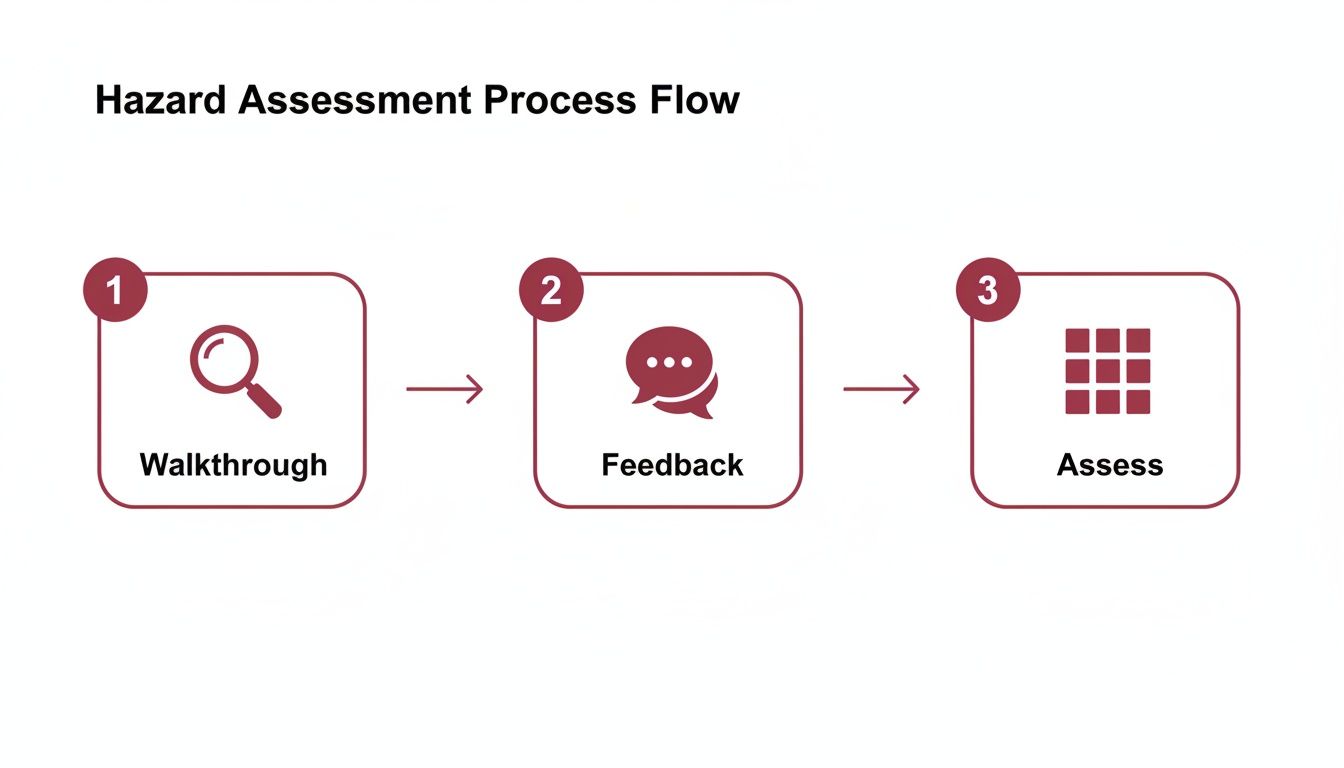
It’s a great visual reminder that managing hazards starts with getting out there and observing (Walkthrough), gets better with team input (Feedback), and becomes effective through structured evaluation (Assess).
Planning For When Things Go Wrong
No matter how watertight your systems are, you have to be ready for emergencies. Your emergency plan needs to be simple, accessible, and well-rehearsed. It should cover every plausible scenario for your workplace, whether that's a fire, a medical event, a chemical spill, or even a security threat.
A solid emergency plan must include:
- Clear Evacuation Procedures: Detailed maps showing the quickest exit routes and designated assembly points.
- Defined Roles and Responsibilities: Who’s the fire warden? Who are the trained first-aiders? No confusion.
- Communication Methods: How will you alert everyone? How do you contact emergency services?
- Regular Drills: This is crucial. The only way you’ll ever know if your plan actually works is by testing it.
A plan stuck in the manager’s office is completely useless. Every single person on your team needs to know exactly what their role is when an alarm goes off.
Rolling Out the System and Getting People on Board
Look, creating the documents is only half the job. Implementation is what makes the difference. This is where you make safety part of the natural rhythm of your business, not just another task to tick off.
Engaging toolbox talks are a fantastic way to do this. Ditch the one-way lectures and make them interactive chats about a specific risk or a recent near-miss. Ask your team for their thoughts on a new SWMS or get their feedback on the last safety drill. This builds a sense of ownership and reinforces the idea that safety is everyone’s job.
Most importantly, you need to create channels where workers feel psychologically safe to raise concerns. Whether that’s an open-door policy, a formal hazard reporting system, or an anonymous suggestion box, people have to believe they can speak up without any negative comeback. Getting to that level of trust is a huge milestone, and understanding the full journey to ISO 45001 certification provides a great roadmap for building these foundational cultural elements. This two-way conversation is the lifeblood of a system that actually learns and gets better over time.
Nailing Your Internal Audits and Getting Ready for Certification
For a lot of business owners, the word “audit” brings on a cold sweat. It sounds like a high-stakes exam where you’re just one slip-up away from failing. Let's change that mindset. An internal audit of your workplace health and safety compliance system isn't a test; it's a health check. It’s your best chance to spot opportunities for improvement long before an external auditor walks through your door.
Think of it as the final dress rehearsal before opening night. It’s how you see what’s really working, find the gaps, and fix them without any pressure. A good internal audit process takes the fear out of the equation and builds real confidence in your team and your systems.
How to Run an Internal Audit That Actually Works
The whole point of an internal audit is to make sure you’re doing what you say you’re doing. It’s a practical exercise in checking your day-to-day operations against your own safety documents and the ISO 45001 standard. It's not about catching people out; it’s about working together to find better ways of doing things.
It helps to break it down into three simple activities:
- A Look at the Paperwork: Start with your core documents. Does your WHS policy still make sense for how you operate today? Are your Safe Work Method Statements (SWMS) up-to-date and actually relevant to the work your team is doing?
- A Chat with the Team: This is where the truth comes out. Go and talk to people across the business—from the factory floor to the office. Ask them about their safety training. Do they know how to report a hazard? Do the procedures you’ve written actually work in the real world?
- A Walk Around the Workplace: Head out to the workshop, the construction site, or wherever the work gets done and just watch. Are people following the procedures you spent all that time writing? Is the right personal protective equipment (PPE) being used, and used correctly? You can’t get this kind of insight from behind a desk.
Once you've gathered all this info, you need to document what you’ve found. Don’t overthink it; a massive, formal report isn't necessary. A simple log detailing what you saw, what’s going well, and what needs a bit of work is perfect.
The most crucial part of an internal audit is what comes next—the corrective action plan. This is your road map for improvement. For every issue you find, you should clearly define what needs to be done, who is responsible for doing it, and a realistic deadline for completion.
Getting Through the External Certification Audit
After running a solid internal audit and getting your corrective actions in motion, you'll feel far more prepared for the external certification audit. This is the formal bit, handled by an accredited third-party certification body, which leads to your shiny new ISO 45001 certificate.
Choosing the right certification body is a big first step. Make sure they are accredited by JAS-ANZ (the Joint Accreditation System of Australia and aNew Zealand)—that's the gold standard for credibility here. It’s also a smart move to pick auditors who have experience in your industry. They’ll get the unique risks you face and won't try to apply a one-size-fits-all approach.
The certification audit itself usually happens in two stages:
- Stage 1 Audit: Think of this as a desktop review. The auditor will sit down with your safety manual, policies, risk assessments, and procedures to check that your system, on paper, ticks all the ISO 45001 boxes. They’re making sure you have all the essential pieces of the puzzle.
- Stage 2 Audit: Now it’s time for the on-site visit. The auditor comes to your workplace to see your system in action. They'll talk to your team, watch work being done, and check records like training logs and inspection reports to confirm you’re actually following through on your documented plans.
When the auditors are on-site, remember they aren’t there to trip you up; their job is to verify that you meet the standard. Be open, be honest, and treat them as a partner in the process. If they raise a “non-conformance” (a fancy term for an area that doesn’t quite meet the standard), don’t panic. It happens, and it’s a normal part of the journey.
Your job is to respond professionally. Work with the auditor to understand the issue, agree on a practical fix, and then show them the evidence once you’ve implemented it. This proactive attitude shows you’re committed to getting it right, and that’s exactly what auditors love to see. It sets you up for a smooth certification and a safety system you can truly be proud of.
Beyond Certification: Sustaining Long-Term Compliance
Getting your ISO 45001 certification is a huge achievement, but it’s really just the starting line. The real win comes from weaving workplace health and safety compliance into the very fabric of your business culture, day in and day out. A truly effective safety system is dynamic; it breathes and grows with your company, not a dusty folder you pull out once a year for an audit.
Keeping that momentum going is about more than just ticking boxes. It’s about making continuous improvement a core part of how you operate. This commitment creates a living safety system that learns, adapts, and ultimately protects your people while strengthening your business for the long haul.
Driving Improvement with Management Reviews
One of the most powerful tools for keeping your system alive is the management review. This shouldn't be a tick-and-flick exercise. It’s a dedicated, formal meeting where your senior leadership team gets together to take a good, hard look at how your WHS system is actually performing. It's the perfect chance to step back from the daily grind and see the bigger picture.
In these meetings, you need to be analysing key safety data and looking for trends. It’s not just about tallying up incident stats; it's a proactive check to see if you're hitting your safety goals.
For a management review to be genuinely useful, make sure your agenda covers:
- WHS Objectives: Are we on track to meet the safety targets we set? If we’re falling short, what are the roadblocks?
- Incident and Audit Data: What are our incident reports, near-misses, and internal audits telling us? Where are the patterns?
- Worker Feedback: What are the people on the ground saying? What concerns or brilliant ideas have they raised?
- Legislative Changes: Are there any updates to Australian WHS laws that require us to adjust our approach?
Keeping Your System Relevant and Effective
A safety system that never changes is a safety system that's becoming obsolete. Your business isn't static—you bring in new equipment, take on different kinds of projects, and hire new people. Your safety processes have to keep up.
True continuous improvement is about fostering a culture of curiosity and learning. It’s about treating every near-miss as a free lesson and actively seeking out feedback from your team to make your processes smarter and safer.
Let's think about a real-world example. Say there's a near-miss with a forklift in your warehouse. A purely compliance-focused approach might just be to retrain the operator and move on.
But a continuous improvement mindset goes much deeper. It prompts you to ask better questions:
- Could we improve visibility at that specific intersection?
- Do we need to implement properly marked pedestrian walkways?
- Is our current traffic management plan actually still fit for purpose, or was it designed when we had half the staff?
This proactive thinking transforms your safety system from a reactive, rule-following function into a smart, strategic part of your business. It helps you anticipate risks before they turn into incidents and ensures your workplace health and safety compliance is robust, relevant, and genuinely protecting your most valuable asset—your people.
Your Top WHS Compliance Questions Answered
If you're running a small or mid-sized business in Australia, you've probably got a few questions about workplace health and safety. It's a complex area, and it's easy to feel unsure. Here are some of the most common queries we hear from business owners who are starting to think about ISO 45001.
If We Follow the WHS Act, Do We Really Need ISO 45001?
This is a great question, and it gets right to the heart of the matter. Following the WHS Act is your legal duty—it's the bare minimum you must do to operate legally and safely in Australia. Think of it as the foundation.
ISO 45001, on the other hand, is a voluntary standard that builds a robust structure on top of that foundation. It's about going beyond just ticking the boxes. Achieving the standard shows your clients and partners that you have a world-class, systematic approach to proactively managing health and safety. For many businesses, it’s the key that unlocks opportunities to tender for major government and corporate contracts.
How Long Does it Take to Get Certified?
There's no single answer here, as it really depends on the size and complexity of your business. But for a typical SME that already has some decent safety practices in place and is keen to get it done, you're generally looking at a timeframe of 3 to 6 months.
The biggest factors that influence the timeline are your team's commitment and the resources you can dedicate.
A word of advice: don't focus solely on speed. The real goal is to build a safety system that genuinely works for your business and will stand the test of time. Rushing the process often results in a system that looks good on paper but doesn't fit how your team actually works.
What’s the Biggest Mistake We Could Make?
From experience, the most common pitfall is treating safety as just a paperwork exercise. It’s easy to fall into the trap of creating a mountain of documents simply to pass an audit, without ever truly embedding those processes into your daily operations.
This 'tick-and-flick' approach almost always fails, and here’s why:
- It creates a huge disconnect. Your team starts to see safety as an annoying add-on, not an integral part of their job.
- It completely misses the point. The system never leads to real safety improvements on the ground, which defeats the entire purpose.
- It’s impossible to maintain. A system that isn’t part of your daily rhythm will quickly become outdated, ignored, and irrelevant.
True compliance happens when safety is woven into the fabric of your business—how your team communicates, makes decisions, and gets the job done every single day.
Ready to build a safety system that not only ensures compliance but also gives you a serious competitive advantage? The team at ISO45001 Consulting holds a 100% success rate in guiding Australian businesses right through to certification. We manage the complexity, so you can stay focused on running your business. Visit us online to get started.
Recent Comments