
A risk register in health and safety is a formal, living document used to identify, analyse, evaluate, and manage potential workplace hazards. Think of it as your safety blueprint—it’s not just compliance paperwork, but a hands-on tool for preventing accidents before they ever get a chance to happen. A comprehensive hazard identification and risk management process is fundamental to creating a safe work environment.
Understanding Your Safety Blueprint
Could you imagine trying to look after complex machinery without a service log? You'd have no history of past breakdowns, no schedule for vital maintenance, and no way to spot recurring faults. A health and safety risk register does exactly that, but for the wellbeing of your team. This critical tool forms the core of any robust risk management framework.
It's the central hub where you systematically document every potential danger you can think of, from something as simple as a slippery floor to the complexities of chemical exposure. This process involves a detailed risk assessment to understand the potential severity and likelihood of each identified hazard.
But this document is so much more than a list. It’s a dynamic tool that helps you prioritise which risks need your immediate attention and resources. By mapping out where the real dangers lie, you can implement targeted controls and build a genuinely safer workplace from the ground up.
Why It's Foundational For Australian Businesses
For any Australian SME, a well-kept risk register is non-negotiable, especially if you're in a high-risk industry like construction, manufacturing, or transport. It’s the core of any solid workplace health and safety (WHS) management system, acting as the single source of truth for identifying, assessing, and tracking hazards.
Keeping it up-to-date isn't just about ticking boxes; it's a proactive strategy. When you consider the national fatality rate sits at 1.3 deaths per 100,000 workers, you realise just how critical these preventative measures are. You can get a clearer picture by looking into the key WHS statistics in Australia.
Beyond the obvious—and most important—job of protecting your people, a good risk register serves several other crucial business functions:
- ISO 45001 Certification: It’s the cornerstone of an Occupational Health and Safety Management System (OHSMS). Auditors will look straight to it for clear evidence that you're actively managing risk.
- Winning Tenders: Trying to land a big contract? Many government and large corporate clients demand proof of robust safety systems, and your risk register is exhibit A.
- Legal Compliance: It's your proof of due diligence. A comprehensive register helps you meet national and state WHS laws, shielding your business from hefty fines and legal dramas.
Why a Risk Register Is a Non-Negotiable Business Tool
It's easy to look at a risk register and see paperwork. But to truly understand its value, you need to see beyond the columns and rows. It’s not just about defining what a risk register is in health and safety; it's about recognising it as a powerful, non-negotiable tool for any smart business.
Viewing it as just another administrative task is a huge missed opportunity. Instead, think of it as a strategic asset that actively protects your people, your bottom line, and your hard-earned reputation.
A solid risk register fundamentally changes your approach to safety from reactive to proactive. You stop just responding to incidents after the damage is done and start building a system that spots and neutralises threats before they can cause harm. This is the cornerstone of a genuine safety culture, where everyone on the team feels empowered to flag a potential danger.
Driving Compliance and Due Diligence
Here in Australia, keeping a detailed risk register is a fundamental part of meeting your legal duties under Work Health and Safety (WHS) laws. It's the physical proof that you're exercising due diligence by actively looking for and managing hazards in your workplace.
This document is your first line of defence. If a serious incident ever occurs, a well-maintained register shows regulators that you took all reasonably practicable steps to keep people safe. This can be critical in protecting your business from hefty fines and legal trouble. It's a clear, running record of your commitment.
A risk register isn’t just about ticking a compliance box or avoiding fines. It’s about building an operational backbone that supports sustainable growth. It signals to clients, partners, and your own team that your business is built on a solid foundation of responsibility and care.
Unlocking Commercial Advantages
A strong safety record, backed up by a detailed risk register, offers real commercial benefits that go straight to your bottom line. It’s a powerful signal that you run a well-managed organisation, which often leads to tangible financial gains. To get a better handle on its strategic importance, you can learn more about the purpose of a risk register in our detailed guide.
Here’s how it gives your business an edge:
- Lower Insurance Premiums: Insurers look favourably on businesses that can prove they are on top of their risks. Your register is exactly the kind of evidence that can lead to better premiums.
- Reduced Lost Time: It's a simple equation: fewer incidents mean less downtime, fewer workers' compensation claims, and more consistent productivity.
- Winning Competitive Tenders: These days, many government and large corporate contracts demand proof of a mature safety system. A thorough risk register is often a non-negotiable part of the pre-qualification process, giving you a serious advantage over the competition.
- Enhanced Reputation: A visible commitment to safety builds trust with customers and makes it easier to attract and keep great employees.
Building Your Risk Register From the Ground Up
Alright, let's move from theory to practice. A truly effective risk register isn't just a laundry list of things that could go wrong; it’s a structured, logical tool. Think of it as a storybook for each hazard, where every column adds a new chapter, guiding you from problem to solution.
This structure is what turns a basic spreadsheet into a dynamic safety management powerhouse. It provides the clarity needed to transform a static document into a living, breathing action plan that your team can actually use.
Getting this foundation right is crucial. It's the key to building a document that not only ticks the boxes for Australian WHS laws but also makes a genuine difference to safety on the ground.
As you build it, keep in mind the core benefits you're aiming for: better compliance, a safer workplace, smarter decisions, and ultimately, a stronger business.
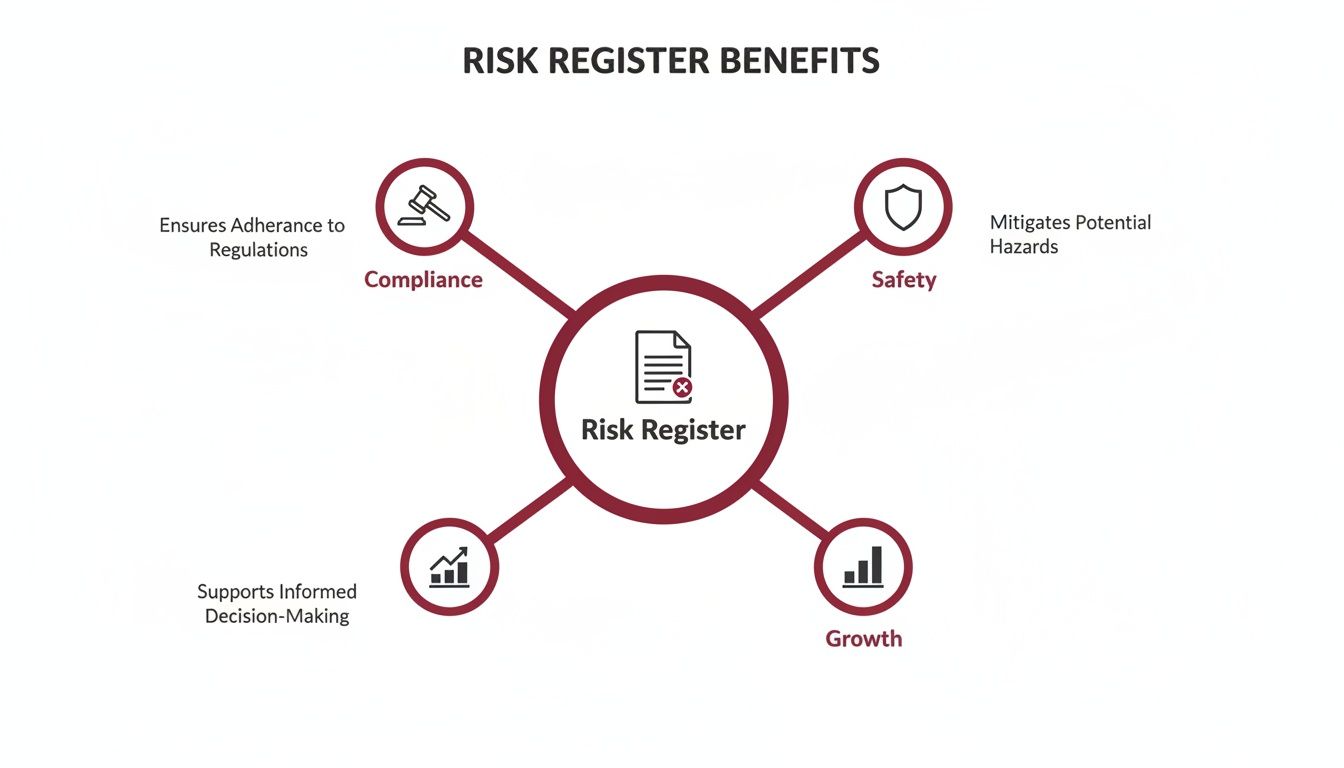
The image above highlights how these elements all feed into each other. Good safety isn't a cost centre; it's a direct investment in your business's success.
Deconstructing the Key Fields
So, what are the essential ingredients? While you can always tailor your register, there are a few non-negotiable fields that form the backbone of any good one.
- Hazard Identification: This is your starting block. You need to be specific. "Lifting" is too vague. A better entry is, “Manual handling of heavy 25kg cement bags from pallet to wheelbarrow.” See the difference?
- Risk Description: Now, describe what could actually happen. What's the potential outcome of that hazard? For our example, the risk is "Musculoskeletal injuries, including acute back strains and chronic sprains, from repetitive lifting and awkward twisting motions."
- Existing Control Measures: What are you already doing about it? Be honest. This might include things like providing trolleys, running an annual manual handling training session, or having a two-person lift policy for certain items.
- Risk Rating (Before Controls): Here’s where you grade the risk using a risk matrix. You need to figure out the likelihood (is an injury almost certain, or rare?) and the consequence (would it be a first-aid issue, or a fatality?). Combining these gives you an initial score, often colour-coded as Low, Medium, High, or Extreme.
- Additional Control Measures: Based on that initial score, what else can you do? This is your chance to get proactive. Think about the hierarchy of controls. Can you eliminate the risk (e.g., order pre-mixed concrete delivered by pump)? Can you substitute or engineer a solution (e.g., use a forklift with a bag attachment)? Don't just jump to handing out more PPE.
- Residual Risk Rating: Once you've planned your new controls, you rate the risk again. The aim here is to demonstrate a clear reduction. Your new, improved score should show the risk is now at an acceptable, manageable level.
- Action Owner and Due Date: This is about accountability. A risk register without names and dates is just a wish list. Assign a specific person to implement each new control and give them a realistic deadline.
A strong risk register entry is specific, measurable, and actionable. It leaves no room for ambiguity and clearly outlines who needs to do what by when, making it a practical tool for driving safety improvements.
The difference between a weak, check-box entry and a strong, actionable one is massive. A weak entry gets you nowhere, while a strong one actively prevents incidents.
Let's look at a quick comparison.
Anatomy of a Risk Register Entry: Weak vs. Strong
| Field | Weak Entry Example | Strong Entry Example |
|---|---|---|
| Hazard Identification | Forklift | Operation of 2.5-tonne gas forklift in a high-pedestrian traffic warehouse aisle (Aisle 3) during peak dispatch hours (2-4 pm). |
| Risk Description | Someone could get hit. | High potential for a collision between the forklift and a pedestrian, leading to serious impact injuries, fractures, or fatality. |
| Existing Controls | Driver is licenced. | Licenced operator, annual refresher training, forklift has a flashing light. |
| Risk Rating (Initial) | High | Likelihood: Possible (3) / Consequence: Major (4) = Risk Score: 12 (High) |
| Additional Controls | Be more careful. | 1. Install physical barriers and designated pedestrian walkways in Aisle 3. 2. Implement a "no forklift" policy in Aisle 3 during peak hours. 3. Install proximity sensors on the forklift. |
| Residual Risk Rating | Low | Likelihood: Rare (1) / Consequence: Major (4) = Risk Score: 4 (Low) |
| Action Owner & Due Date | Management | Action 1: John Smith (Warehouse Manager) by 30/11. Action 2: JS by 15/11. Action 3: Michael Chen (Maintenance Lead) by 31/12. |
As you can see, the detail in the strong entry makes it a genuine tool for risk management, not just a document to be filed away.
For a deeper dive, our complete guide on how to create a risk register walks you through this entire process step-by-step.
Creating and Maintaining a Living Safety Document
A health and safety risk register isn't a "set and forget" document. Think of it less as a finished report and more as a live dashboard for your workplace safety. Creating it is just the starting line; its real value comes from weaving it into the very fabric of your daily operations.
For it to be genuinely useful, your risk register needs to reflect and guide your safety compliance best practices, especially in high-stakes environments like a construction site. A static document gathering dust in a filing cabinet protects no one. The only way it can keep your team safe is if it keeps pace with the constant changes in your business.
When you get this right, the register stops being a mere compliance chore and becomes a powerful, proactive tool for managing safety.
A Practical Step-by-Step Process
Keeping your register alive and relevant comes down to a simple, repeatable cycle. This isn’t about creating more paperwork—it’s about building smart safety habits that stick.
Get the Right People in the Room: Don't try to build this from an office. You need to involve the people on the ground—the machine operators, forklift drivers, and site workers who face the risks firsthand every single day. Their insights are gold; they’ll spot hazards a manager might never see.
Hunt for Hazards Systematically: Move beyond simple brainstorming. Use structured, practical methods to uncover what could go wrong. This means conducting regular workplace walkthroughs, digging into past incident and near-miss reports, and talking directly with your team about their concerns.
Assess and Prioritise: With your list of hazards, it's time to use your risk matrix. This is a crucial step that helps you separate the minor issues from the major threats. It ensures you're focusing your time, money, and energy where they’ll have the biggest impact—on the risks with the highest likelihood and most severe consequences.
Put Controls in Place and Assign Ownership: For each of your high-priority risks, decide on the best control measures using the hierarchy of controls. Document these clearly in the register, make sure someone's name is next to it ("who"), and give them a clear deadline for getting it done ("by when").
Lock in a Review Schedule: Finally, make reviews a non-negotiable part of your routine. Add the risk register as a standing agenda item for management meetings and team toolbox talks. A fixed schedule means it never falls off the radar.
Knowing When to Update Your Register
While your regular review schedule is the baseline, some events demand an immediate update. This is all about being responsive and agile.
A living risk register is one that changes when your business changes. It must be updated immediately following any significant shift in your operations to remain relevant and effective.
Here are the key triggers that should have you reaching for the register straight away:
- After any incident or near-miss: An incident is a massive red flag. It’s undeniable proof that a control failed or a hazard was completely overlooked. A thorough review isn't just a good idea; it's essential.
- When you bring in new equipment or machinery: A new machine brings new, and often unexpected, risks. These have to be assessed and controlled before anyone starts using it.
- When work processes change: Even a small tweak to how a job is done can introduce new ergonomic strains or procedural dangers that weren't there before.
- When new legislation or standards are released: Your register must always be aligned with the latest Australian WHS laws. Ignorance of a new regulation is no defence.
By treating your risk register as a dynamic tool, you build a truly resilient safety system. It's how you move beyond just ticking compliance boxes to actively creating a safer, more productive workplace for everyone.
How Your Risk Register Powers Your ISO 45001 Certification
If your business is chasing the gold standard in workplace safety, then ISO 45001 certification is likely on your radar. The good news is that you don't need to build a complex safety system from the ground up. The journey starts with a tool you should already be using every day: your health and safety risk register.
This single document is the absolute backbone of a successful Occupational Health and Safety Management System (OHSMS). When an auditor walks through your door, your risk register is one of the very first things they’ll ask to see. Why? Because it provides concrete, documented proof that your commitment to safety is real—not just a policy gathering dust on a shelf.
It shows them you have a methodical way of spotting hazards, figuring out how serious the risks are, and putting the right controls in place to manage them. These are the core pillars of the ISO 45001 standard.
The Central Pillar of Your OHSMS
Picture your OHSMS as a house. Your policies and procedures might be the walls and the roof, but your risk register is the foundation everything else is built on. It directly ticks the boxes for several key clauses within the ISO 45001 framework, proving your organisation is proactive about safety, not just reacting when things go wrong.
An auditor will comb through your register to verify that you are:
- Systematically identifying hazards across all parts of your business.
- Analysing and evaluating risks to understand their potential impact.
- Planning actions to address these risks and grabbing opportunities to improve.
- Implementing and maintaining operational controls to keep those risks in check.
Without a detailed and living risk register, trying to prove you meet these fundamental requirements is next to impossible.
An ISO 45001 auditor reads your risk register like a story. It tells them how you spot threats, how you decide what to worry about, and what you’re actually doing to protect your people. A flimsy register is a dead giveaway for a weak safety system.
From Compliance Box-Ticking to Strategic Advantage
In Australia, the focus on improving WHS outcomes is sharper than ever. Your risk register is the engine room of an ISO 45001-compliant system, helping you manage risks in a country where statistics like Western Australia’s 1.9 fatality rate per 100,000 workers are a stark reminder of what's at stake. For any SME, it turns abstract safety goals into a clear, actionable plan. You can find out more about national work health and safety statistics to get the bigger picture.
This is exactly the kind of proactive, hands-on management that certification bodies want to see. Having clear Standard Operating Procedures (SOPs) is also crucial here, as they ensure the controls you've listed in your register are applied consistently by everyone, every time. This creates a reliable and auditable trail of action.
Ultimately, your risk register stops being a simple compliance task and becomes a genuine strategic advantage. It showcases a robust safety culture that auditors, clients, and your own team can see and trust.
Common Risk Register Mistakes and How to Avoid Them
It's one thing to have a risk register. It's another thing entirely to have one that actually works. Far too often, even with the best intentions, these documents become a box-ticking exercise, gathering dust on a shelf while doing little to protect your team.
Let's walk through the most common traps businesses fall into, and more importantly, how you can sidestep them to create a register that makes a real difference.
The "Too Vague" Problem
The single biggest mistake? Being hopelessly generic. A line item that just says “Slips and Trips” is completely useless. What can anyone do with that? It’s not a risk; it's a category.
A truly effective entry gets specific. It pinpoints the real-world hazard, like “Water pooling near the main entrance during rain.” Now that is something you can act on. It immediately points you towards solutions like non-slip mats, better drainage, or warning signs.
Ignoring Your Greatest Safety Asset
Another classic blunder is creating the register in a vacuum. When a management team sits in an office and tries to imagine all the workplace hazards, they are guaranteed to miss the mark. They simply don't have the on-the-ground perspective.
Your frontline workers—the people operating the machinery, navigating the warehouse floor, and interacting with customers—are your single greatest safety asset. They live and breathe these risks every day. Their insights are not just "nice to have"; they're essential for getting an accurate picture of what's really happening.
A risk register should be a collaborative document, not a top-down directive. The most insightful safety solutions often come from the employees who know the job inside and out.
The Dangers of a "Set and Forget" Mindset
Perhaps the most damaging mistake of all is treating the risk register as a one-and-done task. You create it, file it away, and congratulate yourself on being compliant. But a register that isn't reviewed becomes outdated almost instantly, rendering it useless.
To be effective, it has to be a living, breathing document.
- Schedule Regular Reviews: Don't leave it to chance. Formally schedule reviews—quarterly or semi-annually—as a fixed agenda item in your WHS meetings.
- Update After Incidents: Every single incident or near-miss is a learning opportunity. It should automatically trigger a review of the register to see if your controls failed or if the risk was misjudged.
- Reflect Operational Changes: Bringing in new equipment? Changing a work process? Hiring new staff? All these changes can introduce new hazards that need to be assessed and added to your register.
By steering clear of these common errors, your register transforms from a static piece of paper into a dynamic and powerful tool that actively protects your workforce and strengthens your business.
Your Risk Register Questions Answered
Let's clear up a few common questions that pop up when businesses start getting serious about their health and safety risk registers.
How Often Should We Be Looking at Our Register?
Think of your risk register as a living document, not a "set and forget" task you tick off once a year. While a formal review at least annually is a good baseline, you should be revisiting it anytime something significant changes.
This could mean after a safety incident or even a near-miss. It could be when you bring in a new piece of machinery, or even when you change a work process. These moments introduce new variables, and your register needs to reflect that new reality.
What's the Difference Between a Hazard and a Risk Again?
This is a classic, and getting it right is fundamental.
A hazard is the thing that has the potential to cause harm. Think of a trailing electrical cord across a walkway, a bottle of cleaning chemical, or a noisy piece of equipment.
The risk is the chance of that harm actually happening, and how bad it could be. For the trailing cord, the risk is the high likelihood of someone tripping, falling, and potentially suffering a fracture. The hazard is the cord; the risk is the trip and injury.
Is a Simple Spreadsheet Good Enough for Us?
For many small and medium-sized businesses here in Australia, a well-organised spreadsheet is absolutely fine. It gets the job done without overcomplicating things.
The real test isn't the software, but whether the tool you choose is accessible, easy to update, and actually gets used by your team. If your operations are particularly complex or you're growing fast, you might find dedicated WHS software offers better reporting and tracking down the line. But don't feel you need to start there.
Who's Actually in Charge of This Thing?
Ultimately, the buck stops with the business owner or director when it comes to workplace safety. They hold the final responsibility.
However, managing the risk register day-to-day should be a team sport. It’s crucial to involve managers, supervisors, and especially the workers on the floor. They're the ones who see the hazards firsthand and will have the most practical insights for controlling them.
Getting your risk register right is a cornerstone of meeting your safety obligations and achieving ISO 45001 certification. It can feel like a daunting task, but it doesn't have to be.
At ISO45001 Consulting, we help businesses turn this compliance headache into a genuine strategic advantage. We make sure your safety systems aren't just a binder on a shelf, but a practical, effective part of how you work every day.
Ready to build a safer, more competitive business? Visit us at https://iso45001.net.au to get started.
Recent Comments