
An occupational health and safety certification is a formal acknowledgement that your business’s safety management system meets the rigorous requirements of a globally recognised standard, such as ISO 45001. For an Australian small or medium-sized enterprise (SME), this isn't just a piece of paper; it's tangible proof of your commitment to protecting your team, effectively managing workplace risks, and ensuring you meet your legal obligations. This guide provides an in-depth look at what the certification process involves and why it's a critical investment for your business.
Why an Occupational Health and Safety Certification is a Smart Move for Your Business
For Australian SMEs, particularly those in high-risk sectors like construction, manufacturing, or transport, obtaining an occupational health and safety certification is a fundamental part of a robust business strategy. It's about building a resilient, competitive, and responsible company from the ground up. Pursuing a standard like ISO 45001 is a direct investment in your company’s future—safeguarding your people, your finances, and your reputation.
The consequences of an inadequate safety management system can be catastrophic. Beyond the human cost, workplace incidents can trigger a tidal wave of financial pain—including operational downtime, investigations, and skyrocketing insurance premiums. For an SME, this kind of disruption can derail projects, shatter client trust, and threaten the business's viability. A certified safety management system moves your business from a reactive stance to a proactive one.
Gaining a Real Edge in Tenders
In the competitive Australian market, formal certification is often a prerequisite for government contracts or major private sector tenders. An ISO 45001 certificate signals to potential clients that your business operates professionally and has a structured approach to managing workplace hazards. It immediately differentiates you from competitors who cannot provide the same level of assurance, unlocking opportunities for bigger and better contracts.
Cutting Down Risks and Staying Compliant
A proper OHS management system provides a framework to methodically identify, assess, and control risks before they lead to accidents. The statistics paint a sobering picture. Australia saw 188 work-related fatalities in a recent year, with industries like construction and transport remaining particularly hazardous. Vehicle incidents accounted for 42% of these tragedies, highlighting the critical need for robust safety protocols. A certified system ensures you’re not just meeting but exceeding your legal duties under Australian Work Health and Safety (WHS) laws.
A single serious incident can threaten the very survival of an SME. ISO 45001 certification isn’t a cost; it's an insurance policy against operational and financial disaster. It provides the structure to protect your most valuable asset—your people.
Before we move on, let's pull all that together. This table breaks down what ISO 45001 really means for a business like yours.
ISO 45001 Certification At a Glance for Australian SMEs
| Key Aspect | Why It Matters for Your SME |
|---|---|
| Competitive Advantage | Win more tenders and gain access to larger projects that require formal certification. |
| Risk Management | Systematically identify and control hazards, drastically reducing the chance of incidents. |
| Legal Compliance | Provides a clear framework to meet and exceed Australian WHS legal requirements. |
| Financial Protection | Helps avoid the crippling costs of accidents, fines, and increased insurance premiums. |
| Reputation & Trust | Shows clients, employees, and the community that you take safety seriously. |
| Improved Culture | Fosters a proactive safety-first mindset throughout your entire team. |
Ultimately, getting certified brings value that goes far beyond the certificate hanging on the wall. It helps you build a genuine culture of safety, makes your operations more efficient, and earns trust with both your staff and your customers.
For a deeper dive, you can learn more about the benefits of an ISO 45001 certification for your business in our detailed guide. It’s a commitment that truly pays off, securing your company’s long-term health and growth.
Getting Your Ducks in a Row for ISO 45001
Kicking off the journey to an occupational health and safety certification is a big step. But before you dive into writing a single procedure, it’s crucial to build a solid foundation. Getting this initial stage right will save you a world of headaches, time, and money down the track. Think of this as your pre-game warm-up, setting your business up for a smooth run to certification.
It all starts at the top. The first, and most important, piece of the puzzle isn’t a document—it’s genuine commitment from leadership. We’re not talking about just a signature on a policy; we’re talking about active, visible support. This means allocating a realistic budget for resources, training, and the audit itself, and giving your team the time and authority to make real changes. Safety has to become part of your business DNA, not just a box-ticking exercise.
When you get this right, the benefits flow directly to your bottom line, helping you win work, protect your people, and secure your company's future.
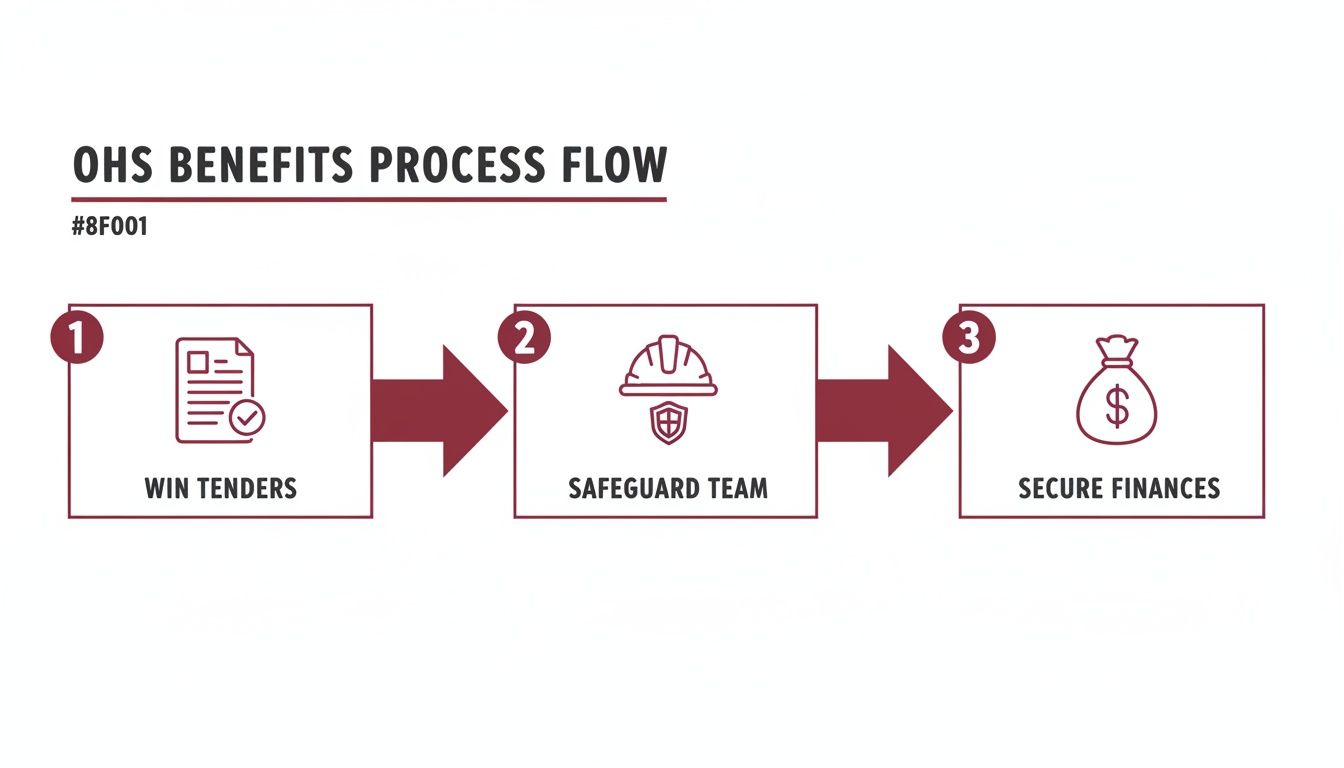
As you can see, a strong safety system isn't just an operational cost; it's a direct driver of commercial success.
First, a Reality Check: The Gap Analysis
Your first practical move is to figure out exactly where you're starting from. A gap analysis is basically a health check for your current safety practices, comparing what you do with what the ISO 45001 standard requires.
The aim here isn't to find fault, but to get a clear, honest picture of the road ahead. You'll need to take a hard look at your operations, any documents you have, and the real safety culture on the ground.
Here’s a good starting point for your review:
- Existing Policies: Do you have a safety policy? More importantly, does it actually reflect how you work every day?
- Risk Management: How do you spot hazards and assess risks right now? Is there a consistent process, and is it written down anywhere?
- Legal & Compliance: Are you confident you know all the Australian WHS laws that apply to your business? Can you prove you’re meeting them?
- Team Competence: How do you make sure your people are properly trained for their roles? Are you keeping records of this training?
- When Things Go Wrong: What’s your process for dealing with an incident or a near-miss? Is there a formal way to investigate and learn from it?
Defining Your Boundaries: The Scope
Once you know where your gaps are, you need to decide what parts of your business the OHS management system will actually cover. This is called defining the "scope," and for an SME, it's about keeping things practical and focused.
For instance, a small manufacturing business with one factory in Western Australia has a pretty simple scope. It would cover all the activities, products, and services at that single site. Easy.
But what about a team of mobile electricians based in Melbourne who work on-site for clients all over Victoria? Their scope is more complex. It has to cover their workshop, their vehicles, and the constantly changing, uncontrolled environments they work in every day.
Defining your scope clearly from the outset ensures your safety system is built for your real-world operations. It stops it from becoming a bureaucratic monster that tries to cover things you don't even do.
Nailing Down Your Legal Duties
One of the non-negotiables of ISO 45001 is proving you comply with all your legal obligations. For any Australian business, this means getting on top of the Work Health and Safety (WHS) Act, Regulations, and Codes of Practice relevant to your industry and state.
Your system needs a process to:
- Identify which WHS laws apply to you.
- Access the most up-to-date versions of them.
- Understand how they relate to your specific workplace hazards.
- Embed these rules into your daily safety procedures.
Honestly, skipping this homework is one of the most common reasons businesses stumble during their first audit. Putting in the effort now to build this foundation of commitment, self-awareness, and legal understanding will make the rest of the certification process so much smoother and far more valuable.
Building Your OHS System Without the Bureaucracy
Let's get into the heart of it—building your actual occupational health and safety certification system. When you hear "management system," many business owners picture dusty binders filled with useless procedures nobody ever reads. Let's be clear: that’s not what we’re doing here.
The goal is to build a lean, practical system that genuinely protects your people and makes your business run smoother. This is about creating core documents that reflect how your team actually works, not trying to cram your operations into some generic, off-the-shelf template. A good OHS system should feel like a natural part of the workday, not another layer of bureaucracy.
Crafting Your Core OHS Documents
Your OHS system is built on a few cornerstone documents. Think of them as the skeleton of your safety framework—they provide the structure, but the real muscle comes from tailoring them to your specific workplace risks and daily grind.
You’ll need a few key pieces:
- The OHS Policy: This is your public commitment. It needs to be a straightforward, no-fluff statement declaring your dedication to safety, signed off by the top brass.
- Risk and Opportunity Register: This is your living, breathing log of hazards. It’s where you’ll document what could go wrong, figure out how serious it is, and plan what you'll do about it.
- Legal and Other Requirements Register: This is your proof that you’re across your obligations under Australian WHS laws and are actively meeting them.
- Operational Procedures: These are your practical, step-by-step guides for getting high-risk jobs done safely.
A Practical Example: Crafting a SWMS
Let’s put this into a real-world context. Imagine you run a small roofing business. One of your most vital operational procedures will be a Safe Work Method Statement (SWMS) for working at heights. A generic template just won't cut it.
A useful, site-specific SWMS for your crew would look something like this:
- First, you break the job down into clear steps: "Accessing the roof," "Removing old materials," "Installing new sheeting," and "Clearing the site."
- Next, for each of those steps, you pinpoint the specific hazards. We're talking about the real stuff: falls from an unprotected edge, dropping tools on someone below, or back injuries from lugging heavy materials around.
- Then, you get super specific about the control measures. Not just "be safe," but "Install temporary edge protection," "Establish a tool exclusion zone on the ground," and "Use a mechanical hoist for all materials over 20kg."
See the difference? This document isn't just to tick a box for an auditor. It's a tool your team uses on-site, every day, to stay safe. That’s a functional safety system in action.
Rolling Out the System Effectively
Writing the documents is only half the battle. Bringing them to life is what really matters. Implementation is all about smart communication and training—you can’t just email a new manual and hope for the best.
You need a proper rollout plan. Kick things off with training that’s actually engaging and relevant to what people do. A quick toolbox talk on the new SWMS before a roofing job starts is a thousand times more effective than a two-hour PowerPoint snoozefest in the office.
The true measure of your system isn't how it looks on paper, but whether it changes behaviour on the ground. Great implementation makes safety the easiest and most natural way to get the job done.
It's also crucial to open up clear lines of communication. Your team must feel they can report a hazard or suggest a better way of doing things without getting blamed. This feedback is gold; it’s what helps you fine-tune your processes and keep improving. For some businesses, simple additions like following effective warehouse floor marking guidelines can be a game-changer for day-to-day safety and workflow.
Failing to get this right has a staggering cost. The latest data reveals Australian workplaces dealt with 146,700 serious workers' compensation claims in a single year. Industries like construction (12%) and manufacturing (10.1%) are significant contributors. With the median cost for each claim hitting $21,600, a practical ISO 45001 system isn't just an expense—it's a critical investment in your business's stability. A proactive approach turns safety from a chore into a genuine business advantage.
Getting Through Your Internal and External Audits
For many Aussie SMEs, the word “audit” brings on a cold sweat. It sounds like a high-stakes exam you can’t afford to fail. But when it comes to getting your occupational health and safety certification, you need to flip that mindset.
Think of audits less as a final test and more as a health check for your safety system. They are your chance to prove everything is working as it should be and, just as importantly, to find ways to make it even stronger. It’s not about catching you out; it’s about confirming you’ve built a system that genuinely protects your people.
The Internal Audit: Your Dress Rehearsal
Before you even think about calling in the external auditors, you need to run your own internal audit. Treat this as a full dress rehearsal. It’s your opportunity to kick the tyres on your new OHS management system without the pressure of the main event. You get to find the weak spots and fix them first.
A proper internal audit is so much more than a simple box-ticking exercise. It's a deep dive to see if your safety procedures are actually being followed out on the floor and whether they’re making a real difference. We've got a whole guide on this because it's that important—you can read up on what an ISO internal audit involves here.
Essentially, your internal audit needs to answer three questions:
- Are we walking the talk? Do our day-to-day operations actually line up with what's written in our manuals?
- Does our system tick all the ISO 45001 boxes? Have we addressed every single mandatory clause of the standard?
- Is it actually working? Can we see clear evidence that our system is identifying hazards and preventing injuries?
Just a tip: make sure the person or team doing the audit isn't marking their own homework. You need fresh, objective eyes. The report from this audit becomes your roadmap for fine-tuning everything before the certification body shows up.
The External Certification Audit: A Two-Part Story
Once you’ve acted on the findings from your internal review, it’s showtime. You'll bring in an accredited certification body, and their audit is almost always broken into two stages.
Stage 1: The Paperwork Check
The first stage is basically a "desktop audit." The auditor sits down with all your documentation—your OHS policy, your procedures, risk assessments, and training records. They’re checking to see if, on paper, your system has been designed to meet the ISO 45001 standard.
They'll be looking for things like:
- A clear, compliant OHS Policy.
- Properly defined roles and responsibilities.
- Documented processes for risk assessment and legal compliance.
- Your safety objectives and the plans you have to achieve them.
At the end of Stage 1, you’ll get a report. It will flag any potential issues or "non-conformances" that need sorting out before they’ll even book in Stage 2. It’s a vital checkpoint to make sure your foundations are solid.
Stage 2: The On-Site Reality Check
Now for the real-world test. In Stage 2, the auditor comes to your workplace—whether that’s a construction site, a factory floor, or an office—to see if your safety system is truly alive and kicking. This is where they confirm you’re actually doing what your paperwork says you do.
They won't just be sitting in a meeting room. They'll be out there observing how people work, checking equipment, and having conversations with your team. They might ask a forklift driver about a specific safety procedure or check a supervisor's logbook for recent safety inspections. What they're after is hard evidence that your system is implemented, understood, and effective.
The auditor isn't looking for perfection. They want to see a living, breathing safety culture that can spot its own problems and fix them. That’s what continuous improvement is all about.
How to Handle Audit Findings
It’s pretty normal for an audit to turn up a few issues, which are formally called "non-conformances." Don't panic. These aren't failures; they’re signposts for improvement. They usually fall into two camps: Minor or Major.
- A Minor Non-Conformance is a small slip-up, like a single instance where a procedure wasn't followed perfectly. You’ll just need to provide a plan to correct it.
- A Major Non-Conformance points to a more serious breakdown, like a whole section of the ISO 45001 standard being missed. This has to be fixed before you can be certified.
What matters most is how you respond. Don't just slap a band-aid on the symptom. Dig deep to find the root cause of the problem and put a permanent fix in place. This shows the auditor you’re serious about real, long-term improvement—which is the whole point of getting your occupational health and safety certification in the first place.
Choosing the Right Certification Body and Budgeting for Success
Getting your financial and partnership decisions right is one of the most important parts of your journey to ISO 45001 certification. This isn't just about chasing the cheapest quote; it's about finding a partner who genuinely gets your industry and can add real value to your business.
Making the right choice here can make the whole process a breeze. On the flip side, the wrong one can lead to a world of frustration and wasted cash.
In Australia, there's one non-negotiable: your certification body must have accreditation from the Joint Accreditation System of Australia and New Zealand (JAS-ANZ). Think of it as the gold standard. A JAS-ANZ tick means the certifier has been independently vetted and is competent to audit against standards like ISO 45001.
You might find non-accredited bodies offering a cheaper deal, but their certificate often isn't worth the paper it's printed on. It simply won't be recognised in tenders, which defeats the whole purpose for many businesses.
How to Select Your Certification Partner
Picking a certifier is a lot like hiring a key contractor—you've got to do your homework. Line up a few potentials and really grill them. Don't be shy about asking direct questions to find the best fit.
Here’s what you should be asking:
- Are you JAS-ANZ accredited for ISO 45001? This is your opening question. Ask to see their accreditation certificate.
- What's your experience in our industry? An auditor who knows the difference between a construction site and a manufacturing plant will give you a far more relevant and insightful audit.
- Tell me about your auditors. Get the details on their qualifications, hands-on industry experience, and auditing style. You want a practical person, not someone who's only ever read the textbook.
- Can you walk me through your pricing? Insist on a clear, itemised quote that breaks down audit days, travel, and any sneaky ongoing surveillance fees.
Picking a certification body on price alone is a classic rookie error. A good auditor gives you insights that make your business safer and better; a cheap one just ticks boxes. Remember, the goal is a robust safety system, not just a certificate for the wall.
Budgeting for the Full Certification Journey
Having a clear picture of the full financial commitment from the get-go helps you plan properly and avoids nasty surprises down the track. The price of an occupational health and safety certification goes well beyond the final audit fee. It's an investment, and you need to know what you’re in for.
For a typical Aussie SME, you're looking at a timeline of anywhere from three to twelve months from start to finish. How long it takes really depends on how complex your business is, what safety systems you already have in place, and how many resources you can dedicate to the project.
To give you a realistic idea, here's a look at the costs you should be ready for.
Estimated ISO 45001 Certification Costs for Australian SMEs
Budgeting for certification requires looking at the total investment, not just one line item. This table breaks down the potential expenses to help you plan effectively.
| Cost Component | Typical Range for an SME (10-50 Employees) | Key Considerations |
|---|---|---|
| Consultancy Fees | $5,000 – $15,000+ | This depends on how much support you need. A good consultant can dramatically speed up the process and help you avoid common pitfalls. |
| Certification Body Fees | $4,000 – $8,000 (for a 3-year cycle) | This covers the initial Stage 1 & 2 audits, plus the yearly surveillance audits. The final cost is based on your employee numbers and site complexity. |
| Internal Resources | Varies (Time is Money) | Don't forget to account for the time your own people will spend on training, implementing changes, and sitting in on audits. This is a real cost. |
| New Equipment/PPE | As required | Your initial gap analysis might highlight a need for new safety gear or machinery upgrades to properly manage risks. |
By budgeting for all these moving parts and setting a realistic timeline, you're setting your business up for a much smoother, stress-free certification process. This kind of strategic planning ensures your investment pays off with what matters most—a safer workplace and a real competitive advantage.
Staying Certified and Constantly Improving
Getting that occupational health and safety certification is a brilliant achievement, but it’s really just the beginning of the journey. The real magic of ISO 45001 happens day-to-day, as you maintain the system and weave a culture of safety improvement into the very fabric of your business. This is where all that initial hard work starts to pay dividends, shifting your company from just being compliant to being genuinely, proactively safe.
The certification isn't a "set and forget" deal. It's built on a cycle designed to keep your OHS system dynamic and effective. You'll have regular surveillance audits, usually once a year, where an auditor visits to make sure your system is still meeting the standard and creating positive results. Think of it as a regular health check for your safety processes.
The Management Review: More Than Just a Meeting
One of the most important parts of keeping your certification is the management review. This isn't just another box-ticking meeting; it's a dedicated, high-level look at how your business is actually performing on the safety front. Leadership needs to regularly sit down and properly analyse OHS data, go through incident reports, track progress against safety goals, and discuss the findings from recent audits.
This process keeps safety firmly on the leadership agenda. It’s where you need to ask the tough questions:
- Are our safety goals still the right ones for the risks we face today?
- What patterns are emerging from our incident and near-miss reports?
- Have we put enough resources—time, money, people—into our OHS system?
- Are our people on the ground actually involved and giving us feedback?
Continuous improvement isn’t about huge, dramatic overhauls. It’s about the small, consistent tweaks—a refined procedure here, better training there—that together build a much stronger and more resilient safety culture over time.
Keeping Your System Alive and Kicking
A safety system that doesn't change quickly becomes useless. Your business is always evolving—new contracts, new equipment, new people, changing regulations. Your OHS system has to keep up.
This means you’ve got to be regularly updating your risk assessments, fine-tuning procedures based on what your team is telling you, and setting fresh, challenging safety objectives each year.
To really keep your certification and foster genuine improvement, you need to know if your training is actually working. You can learn more about that in this comprehensive guide to measuring training effectiveness. A well-oiled and evolving OHS system doesn’t just keep the auditor happy; it keeps you ready for new tenders, helps you adapt to whatever comes next, and, most importantly, protects your people. And at the end of the day, they're your most valuable asset.
Got Questions About OHS Certification? You're Not Alone.
Diving into the world of occupational health and safety certification for the first time can feel a bit overwhelming. It's only natural to have questions. Here are some of the most common ones we get from Australian SMEs just like you, with straight-to-the-point answers based on our experience.
So, How Long Does ISO 45001 Certification Actually Take?
This is the million-dollar question, and the honest answer is: it depends.
For a typical SME that already has some basic safety processes humming along, you're likely looking at a timeframe of three to six months from start to finish. But if you’re building your safety system from the ground up, or you run a particularly complex operation, it’s more realistic to budget for nine months, maybe even a full year.
The key is to be realistic about where you're starting from.
Is ISO 45001 a Legal Requirement in Australia?
Strictly speaking, no. The government doesn't legally require you to have ISO 45001 certification.
However—and this is a big however—it's globally recognised as the gold standard for meeting your legal duties under Australia's Work Health and Safety (WHS) laws. For many businesses, it quickly becomes a commercial necessity. Trying to win a government tender or land a contract with a major corporate player without it? Good luck. It's often a non-negotiable prerequisite.
What's the Difference Between AS/NZS 4801 and ISO 45001 Anyway?
Think of it as an evolution. ISO 45001 is the current international standard, which has replaced the old local standard, AS/NZS 4801.
The most significant change is that ISO 45001 places a much stronger focus on leadership commitment and genuinely involving your workers in safety decisions. It’s less about a folder sitting on a shelf and more about a living, breathing safety culture. It also uses the same high-level structure as other major ISO standards (like ISO 9001 for quality), which is a huge help if you want to integrate your management systems down the track.
Recent Comments