
For Australian businesses in high-risk sectors like construction and manufacturing, ISO 45001 certification has shifted from a ‘nice-to-have’ to an essential commercial tool. It's the global benchmark for occupational health and safety systems, and frankly, it's becoming a non-negotiable for landing major government and private contracts.
The standard gives you a practical framework to manage workplace safety, stay on the right side of the law, and prove you’re serious about protecting your people.
Why ISO 45001 Certification Is a Game Changer for Australian SMEs

In a crowded market, ISO 45001 is what makes proactive businesses stand out. It takes you beyond just ticking compliance boxes and turns your entire approach to health and safety into a real strategic advantage. For many Australian SMEs, this certification is the key that opens the door to bigger, more profitable contracts that were previously out of reach.
Take a mid-sized construction firm in Victoria bidding on a major infrastructure project. Without ISO 45001, their tender might not even make the shortlist. With it, they instantly signal to the procurement team that they have a robust, internationally recognised system for managing risks and keeping workers safe.
A Growing National Trend
This isn’t just a hunch; the numbers tell the story. Australia has seen a massive jump in ISO 45001 certifications, climbing from 6,157 in 2023 to 9,467 in 2024. That's an incredible increase of over 50% in just one year, putting Australia 6th in the world for adoption.
This surge shows that smart businesses are getting on board, realising the standard is the best way to align with Australia's tough Work Health and Safety (WHS) laws.
Aligning with Australian WHS Laws
At the heart of any safe workplace is understanding business risk management, and this is where ISO 45001 really shines. Its structured framework helps you nail your legal duties under WHS legislation by embedding clear processes for:
- Hazard Identification: Actively searching for potential sources of harm before they cause an incident.
- Risk Assessment and Control: Properly evaluating those risks and putting effective controls in place.
- Worker Consultation: Making sure your team is involved and has a say in safety decisions.
- Continuous Improvement: Constantly reviewing how you’re doing and finding ways to get better.
By adopting ISO 45001, you're not just getting ready for an audit. You're building a resilient safety culture that protects your people, boosts your reputation, and sets your business up for long-term growth. It's a clear signal to everyone that safety starts at the top.
The Real-World Payback of ISO 45001 on Your Business
Let’s be honest, chasing certifications can feel like a box-ticking exercise. But when it comes to ISO 45001, the benefits for Australian SMEs are anything but abstract. This isn't just about satisfying legal duties; it's about making your business fundamentally stronger, safer, and more profitable.
Investing in a proper Occupational Health and Safety (OH&S) system pays real dividends. Think safer teams, fewer costly disruptions, and a serious advantage when you’re up against the competition. When your crew knows you genuinely care about their well-being, you see it in their work, their attitude, and the overall productivity of the business.
Driving Down Incidents and Costs
The first and most obvious win from a well-run OH&S system is a sharp drop in workplace incidents. The numbers don't lie. In Australia, certified businesses report a Lost Time Injury Frequency Rate (LTIFR) of just 1.16 per million hours worked. That’s a massive improvement over the 2.21 LTIFR seen in non-certified companies—a 47% difference.
This isn't just a number on a page; it has life-changing implications. Data from the same research shows certified organisations had 11 workplace fatalities, while their non-certified peers had 45. For high-risk industries like construction and manufacturing, that statistic alone is a powerful reason to act. You can dig into the full analysis in this study on enhancing OHS performance through ISO 45001.
Fewer injuries mean more money in your pocket, simple as that. Here’s how:
- Lower Insurance Premiums: Insurers see that ISO 45001 certificate and recognise you as a lower risk, which often translates to better workers' compensation premiums.
- Less Downtime: Every injury that takes someone off the job causes delays, throws projects off schedule, and can even lead to contractual penalties.
- Avoiding Hefty Fines: A solid system is your best defence against breaches of Australia’s tough WHS laws and the significant fines that come with them.
Gaining a Powerful Competitive Edge
In the competitive world of tendering, ISO 45001 can be your golden ticket. For many government and large corporate contracts, it’s not just a ‘nice-to-have’—it’s a non-negotiable prerequisite. Holding that certificate shows you operate professionally and can be trusted to manage risk, often putting your proposal right at the top of the pile.
I once worked with a South Australian HVAC installation company. They were fantastic at what they did but kept getting knocked back on pre-qualification for major commercial jobs. After getting their ISO 45001 certification, everything changed. Within two years, their incident rate fell by over 60%, and they landed three massive contracts that were previously out of reach. The investment paid for itself in the first year alone.
ISO 45001 gives clients instant confidence. To see how this standard fits within the bigger picture of international compliance, this guide to global compliance certification is an excellent resource. It’s a clear signal that you have robust processes to keep people safe on site.
Building a Stronger, Safer Culture
The benefits go far deeper than just financials and contracts. Implementing ISO 45001 reshapes your company’s DNA for the better. The standard requires genuine commitment from leadership and active participation from your entire team, which breaks down silos and fosters a culture where safety is everyone’s job.
You start moving away from the old-school "blame game" after something goes wrong and shift towards a proactive mindset focused on preventing incidents before they ever happen.
When your team is directly involved in spotting hazards and assessing risks, they become more invested and vigilant. This builds a powerful, resilient safety culture where people genuinely look out for each other. And that, more than anything else, is the most valuable asset you can build for the long-term health of your business.
Your Step-By-Step Roadmap to ISO 45001 Certification
Getting started with ISO 45001 certification can feel like a huge undertaking, but it's really a logical, step-by-step journey. The best way to approach it is to break it down into manageable stages. Think of it less like cramming for an exam and more like building a solid foundation for a genuine safety culture that sticks.
This roadmap will walk you through the entire process, from that first look at your current systems to the final audit. Each step naturally builds on the one before it, helping you create a robust Occupational Health and Safety (OH&S) management system that's actually right for your business.
Starting With a Gap Analysis
Before you start building anything, you need to know what you're working with. A gap analysis is exactly that—an honest assessment of your current safety practices against the official ISO 45001 standard. This isn't about finding fault; it's about spotting opportunities for improvement.
You'll take a hard look at your existing procedures, documentation (or the lack of it), and how your team handles safety day-to-day. This first step is critical because it shows you what you're already doing well and, more importantly, where the holes are. It saves a massive amount of time and money by letting you focus your efforts precisely where they're needed most.
Developing Your OHS Management System
Once you know where the gaps are, you can start putting the building blocks of your system in place. This means creating the key documents and processes that will become the backbone of your approach to health and safety. Steer clear of generic, off-the-shelf templates; for a system to be effective, it has to reflect how your business actually works.
You’ll need to create a few core documents:
- OHS Policy: This is your high-level commitment to safety, signed off by top management. It really sets the tone for everyone.
- Risk and Opportunity Register: This is a live document. It’s where you’ll identify workplace hazards, assess the risks they pose, and plan out how you’ll control them.
- Legal and Other Requirements Register: This is crucial for tracking your obligations under Australian WHS laws, as well as any other client or industry-specific rules you need to follow.
- Objectives and Plans: Here, you'll set measurable safety goals (like reducing manual handling injuries by 15%) and map out a clear plan to hit them.
- Incident Response Procedures: You need clear, practical steps for what to do when things go wrong, from basic first aid right through to a full investigation.
Implementation and Training
Let's be honest, a brilliant safety manual is useless if it just gathers dust on a shelf. The implementation phase is where your documented system comes to life. It's all about rolling out your new procedures, communicating the changes to your team, and making sure everyone knows what their role is.
Training is absolutely essential here. This isn't just a box-ticking exercise; it's about making sure your people are competent and confident. For example, if you introduce a new permit-to-work system for high-risk jobs, the team members involved need to be trained thoroughly on how to use it correctly. This phase is all about embedding safety practices into your daily work until they just become the way things are done.
The following graphic really drives home the core benefits of this whole process, showing why each step is so important for building a safer, more efficient, and more competitive business.
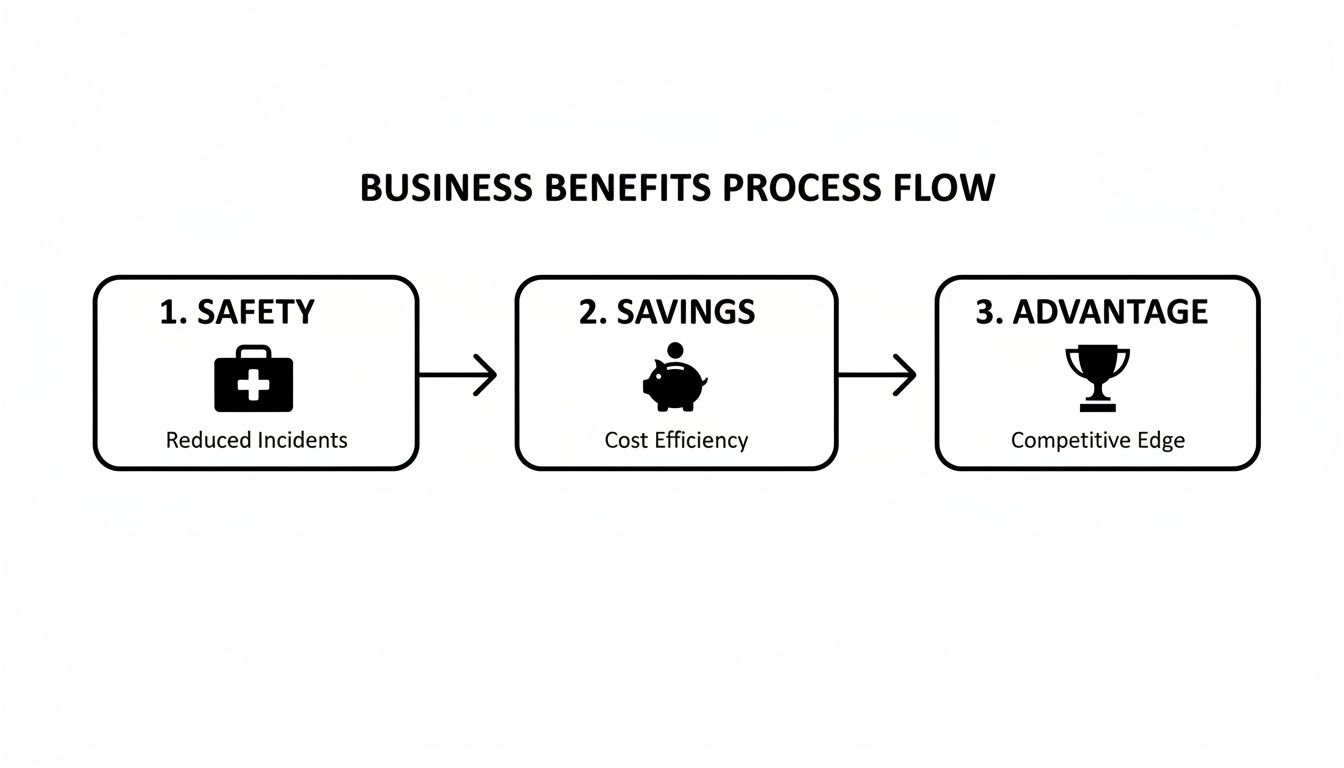
As you can see, the effort you put into the certification process pays off directly with better safety outcomes, real cost savings, and a clear advantage in the market.
Conducting an Internal Audit
Before you call in the external auditors, you need to check your own work. An internal audit is like a dress rehearsal for the main event, but it’s much more than just a practice run. It’s one of your best tools for improvement.
During the internal audit, a competent (but independent) person from your team or a consultant will systematically check if your OHS system is actually working as designed. Are people following the new procedures? Are records being kept properly? Are you on track to meet your safety targets?
This process is designed to find any "non-conformities" so you can fix them before the official certification audit. It's a huge confidence-builder and a crucial step for ensuring the external audit goes smoothly. To get a better handle on what's involved, check out our detailed guide on the ISO certification process.
An internal audit is your system's first real test. It's far better to find and fix a problem yourself than to have an external auditor point it out. A thorough internal audit is one of the strongest indicators of a successful certification outcome.
Getting Ready for the External Audit
This is the final hurdle. The external audit is done by an accredited, third-party certification body and it’s usually split into two parts.
- Stage 1 Audit: Think of this as a readiness review. The auditor mainly looks at your documentation to make sure you have all the required pieces of an ISO 45001 system in place on paper. They’ll also confirm the scope of your system and check that you’re ready for the main audit.
- Stage 2 Audit: This is the big one. The auditor will visit your workplace to see your OHS management system in action. They'll talk to your staff, watch how work is done, and review records to make sure you're not just saying the right things, but actually doing them.
The auditor is looking for objective proof that your system meets the ISO 45001 standard. If they find any major issues, you'll need to sort them out before you can get certified. Once you pass the Stage 2 audit, you’ll be recommended for ISO 45001 certification—a formal thumbs-up that recognises your commitment to workplace health and safety.
How Long Does ISO 45001 Certification Take?
One of the first questions businesses ask is, "How long will this all take?" While it varies depending on your company's size, complexity, and how much you already have in place, we can map out a typical timeline. For most small to mid-sized businesses in Australia, the journey from start to finish is quite manageable.
The table below breaks down the key phases and provides a realistic timeframe for each.
| Phase | Key Activities | Typical Duration |
|---|---|---|
| Preparation & Planning | Management commitment, initial research, selecting a consultant (if needed), project kickoff. | 2 – 4 Weeks |
| Gap Analysis | A detailed review of your current OHS practices against the ISO 45001 standard to identify what’s missing. | 1 – 2 Weeks |
| System Development | Writing the OHS policy, procedures, risk registers, and other required documentation based on the gap analysis. | 4 – 8 Weeks |
| Implementation & Training | Rolling out new procedures, training staff on their roles and responsibilities, and gathering initial records. | 4 – 12 Weeks |
| Internal Audit | Conducting a full internal audit of the new system to find and fix any issues before the external audit. | 1 – 2 Weeks |
| Certification Audit | The two-stage audit process (Stage 1 and Stage 2) conducted by your chosen external certification body. | 2 – 4 Weeks |
| Total Estimated Time | From start to receiving certification. | 4 – 9 Months |
Keep in mind that this is a guide. A well-resourced team in a less complex business might move faster, while a larger organisation might need a bit more time, especially during the implementation phase. The key is to be realistic and plan accordingly.
What to Expect: Costs, Timelines, and Common Pitfalls
So, you’re thinking about getting ISO 45001 certified. It's a fantastic move for your business, but let's be upfront about what's involved. This isn't just about ticking boxes; it's a real investment of time, money, and effort. Knowing the practical side of things from the get-go helps you plan properly and avoids any nasty surprises.
The financial side of things for an Australian small or medium-sized business (SME) really breaks down into a few key areas. You've got the fees you pay the certification body, the money you might spend on a consultant to guide you, and, of course, the internal cost of your own team's time. Each piece of that puzzle is vital for a successful outcome.
Getting a Handle on the Costs
Before you can build a solid business case for certification, you need to understand the investment. It’s not a one-off payment; the costs cover the initial setup and the ongoing work to keep your safety system effective.
Here’s a realistic breakdown of where the money goes:
- Consultancy Fees: This is optional, but honestly, having an expert on your side can save you a world of pain. A good consultant helps you create documentation that actually fits your business and guides you through implementation, preventing costly mistakes and speeding everything up.
- Certification Body Audits: You can't skip this one. This is the fee for the initial two-stage audit to get certified in the first place, plus the annual surveillance audits required to keep your certificate on the wall.
- Internal Resources: Don't overlook the value of your team’s time. Your staff are the ones who will be involved in creating procedures, getting trained, and talking to the auditors. Their time is a real cost.
When you weigh it up, the cost-benefit analysis for ISO 45001 certification in Australia stacks up, especially for SMEs in high-risk industries. An initial audit for a medium-sized business might cost around $4,000, but that investment pays for itself by cutting down accident rates and even lowering your insurance premiums. In a country with major industries like construction and mining, where workplace safety is paramount—certified companies report 75% fewer deaths—this standard’s framework is simply invaluable. You can explore more on the cost-benefit of ISO 45001 in Australia.
Common Pitfalls and How to Sidestep Them
After more than a decade in this game, I’ve seen businesses stumble on the same hurdles time and time again. The good news is they’re all avoidable. Just knowing what to watch out for is half the battle won.
The biggest mistake we see is treating certification as a paperwork exercise. An effective OH&S system has to live and breathe within your daily operations; it can't just be a folder on a shelf.
Let's walk through the most common missteps and, more importantly, how you can get it right from the start.
1. The "Copy-Paste" Safety Manual
It’s so tempting to download a generic template, slap your logo on it, and call it a day. But auditors can spot this a mile away. These off-the-shelf documents almost never reflect how your business actually works, which means you end up with a system nobody uses and that crumbles under the first sign of scrutiny.
- How to fix it: Your documentation has to be yours. It needs to describe your specific activities, identify your unique hazards, and detail the control measures your team can realistically put in place.
2. When Management Isn't Really on Board
If the bosses see ISO 45001 as just another certificate to hang in reception, the whole thing is destined to fail. Without their active support—providing resources, showing up to reviews, and genuinely championing safety—employees won't buy in, and the system will quickly fall apart.
- How to fix it: Leadership has to be visible from day one. They need to be the ones communicating why this is important, setting clear safety goals, and leading by example.
3. Training That Doesn't Stick
You can have the most beautifully written procedures in the world, but they're completely useless if your team doesn't know about them or understand how to use them. Weak training leads to people not following the rules, which is a massive red flag for any auditor.
- How to fix it: Create a training plan that’s practical. Use toolbox talks, hands-on demonstrations, and clear, simple language to make sure everyone understands their part in keeping the workplace safe.
4. Walking into the Audit Unprepared
Showing up for your Stage 2 audit without being ready is a recipe for a very stressful and potentially unsuccessful day. A lot of businesses just don't realise the level of detail an auditor will go into, from checking records to interviewing staff on the floor.
- How to fix it: Run a full internal audit first. Think of it as a dress rehearsal. It’s your chance to find and fix the gaps in your system before the certifier shows up, so you can walk into the real audit feeling confident and prepared.
So You're Certified, Now What? Maintaining Momentum and Driving Real Improvement
Getting that ISO 45001 certificate is a fantastic achievement, but it’s really the starting line, not the finish. The true benefit comes from weaving your Occupational Health and Safety (OHS) management system into the very fabric of your business, making it a living, breathing part of your culture. This is where you shift from building the system to truly using it to get better every day.
This commitment is what turns a compliance exercise into a powerful tool for creating a genuinely safer and more productive workplace. It's about embedding safety so deeply into your operations that it becomes second nature for everyone, from the front office to the factory floor.

Staying on Track with Surveillance Audits
To keep your certification, your external certification body will visit for annual surveillance audits. Think of these as a yearly health check for your OHS system. They're there to confirm that the system is not only running but is still effective and meeting the standard’s requirements.
While they aren’t as full-on as the initial certification audit, they are just as crucial. The auditor will dip into different parts of your system, looking for evidence that you're:
- Keeping good records: Are your incident reports, training logs, and management reviews all current?
- Auditing yourself: Can you show that you're regularly checking your own processes for gaps?
- Walking the talk: Is your team actually following the procedures you wrote down?
I always tell clients to view surveillance audits as a fresh set of expert eyes. They’re a fantastic opportunity to get an independent perspective, catch things you might have overlooked, and keep the whole team accountable.
Using Internal Audits to Get Better, Not Just to Pass
The requirement to conduct regular internal audits is one of the most valuable parts of the standard, but it’s often misunderstood. So many businesses see it as a chore—something to tick off before the "real" auditor shows up. That’s a huge missed opportunity. A well-run internal audit is your chance to see what’s really happening on the ground.
Instead of just hunting for non-conformances, a proactive internal audit asks better questions. Are our risk controls practical and effective? Is there a simpler, safer way to do this task? What are those near-misses trying to tell us? The answers you find should be front and centre in your management review meetings, giving you the solid data you need to make smart decisions. For a closer look at this process, check out our guide on what an ISO internal audit involves.
The Three-Year Recertification Cycle
Your ISO 45001 certificate is valid for three years. At the end of that period, you'll undergo a full recertification audit. It's more comprehensive than the annual check-ups, diving deep into your entire OHS management system to ensure it's still fit for purpose and compliant.
This three-year rhythm gives your improvement efforts a natural structure. It pushes you to not just maintain the status quo but to actively enhance your system over time. When your recertification audit rolls around, you should be able to proudly show a clear track record of finding and acting on opportunities to make your workplace safer. It’s the ultimate proof that your commitment to health and safety is genuine, consistent, and delivering real-world results.
Got Questions About ISO 45001? We've Got Answers
When businesses start getting serious about ISO 45001, a lot of practical questions naturally pop up. Even with a clear plan, the real-world details can feel a bit fuzzy. Here, we'll tackle the most common queries we hear from Australian SMEs, drawing from years of experience helping businesses just like yours get certified.
Think of this as your go-to cheat sheet for clearing up any lingering doubts about the process, what's required, and what it all really means for your business.
How Long Does It Really Take to Get ISO 45001 Certified?
This is the million-dollar question, and the honest answer is: it depends. The timeline can swing quite a bit depending on the size of your business, the complexity of your operations, and frankly, how solid your existing safety systems are.
For a typical small to mid-sized business that’s more or less starting from scratch, you should realistically budget for three to six months. This window covers the whole nine yards—from the initial gap analysis and building your documentation, right through to the final external audits.
What really speeds things up? Having dedicated people on the job and genuine, visible commitment from the leadership team. When everyone's pulling in the same direction, the entire process flows much more smoothly.
What’s the Deal with AS/NZS 4801 vs ISO 45001?
Anyone who’s been in business for a while will remember the old AS/NZS 4801 standard. It was the go-to benchmark for health and safety in Australia and New Zealand for years. ISO 45001 is the international standard that has now completely replaced it.
While both standards share the goal of creating safer workplaces, there are some key differences. ISO 45001 uses a high-level structure known as "Annex SL," which is just a technical way of saying it’s designed to slot in perfectly with other big-name standards like ISO 9001 (Quality) and ISO 14001 (Environment). This makes running an integrated management system a whole lot easier.
Beyond the structure, ISO 45001 puts a much bigger spotlight on a few critical areas:
- Leadership & Management Buy-In: The standard insists that top management is actively involved and held accountable for safety performance. It can't just be delegated away.
- Worker Participation: It explicitly requires businesses to consult with and involve their non-managerial staff when making safety decisions.
- Proactive Mindset: It pushes for a more forward-thinking approach, asking you to identify not just risks, but also opportunities to improve safety.
Simply put, all new certifications are for ISO 45001 now. Any business that held the old AS/NZS 4801 certification has had to make the switch.
We’re a Small Business with Only 10 Employees. Is ISO 45001 for Us?
Absolutely. One of the biggest myths we have to bust is that ISO standards are only for massive corporations. The reality is that ISO 45001 is designed to be completely scalable. It can be adapted to fit any organisation, no matter the size or industry.
The key is to build a system that’s a good fit for the scale of your operations and the specific risks you face. The paperwork and processes for a 10-person electrical contracting firm will look very different—and be far simpler—than for a 200-person manufacturing plant.
The aim is to create a safety system that's effective and genuinely useful for your team, not to drown everyone in a mountain of paperwork. This is where an experienced consultant can be invaluable, helping you tailor a system that adds real value without becoming a burden.
Do We Need to Hire a Full-Time WHS Manager?
This is another common worry for SMEs, and the short answer is no, not necessarily. While someone does need to have formal responsibility for looking after the OHS management system, this role can often be handled by someone already on your team.
In many smaller businesses, we see this responsibility successfully managed by an Operations Manager, HR Manager, or even one of the company directors. What's crucial is that this person is given the authority, resources, and—most importantly—the time to manage the system properly.
A hybrid approach also works brilliantly. Many SMEs assign the day-to-day management internally but bring in an external consultant for periodic support. This can be a really cost-effective way to get expert guidance for trickier tasks, like conducting internal audits or running the annual management review, keeping you on track without the overhead of a full-time hire.
At ISO45001 Consulting, we take the complexity out of the certification journey. With a 100% success rate, we provide practical, end-to-end support that is built around your business, ensuring you get certified efficiently so you can focus on what you do best. Learn how we can help your business achieve ISO 45001 certification.
Recent Comments