
Quick Summary: To effectively prioritise risks in a risk register, you must score each hazard based on its likelihood of occurring and the severity of its potential consequences. This creates a risk rating that helps you focus resources on the most critical threats first, transforming your register from a simple list into a strategic action plan for safety and compliance.
The most effective way to prioritise the items in your risk register is to score each hazard based on two simple factors: how likely it is to happen and what the consequences would be if it did. This method gives you a clear risk rating, turning a long list of potential problems into a manageable, ranked action plan. This guide explains how to prioritise risks in a risk register by focusing your energy where it matters most to keep your workplace safe and compliant.
Why Prioritising Your Risk Register is a Game Changer

For many operations managers in construction, manufacturing, and field services across Australia, the risk register often feels like a chore. It's frequently seen as just another piece of paperwork required for a tender or to satisfy an ISO 45001 audit.
But what if you viewed it differently? A well-prioritised risk register is more than a static document; it's one of the most powerful strategic tools you have for building a more resilient and proactive business.
Knowing how to properly sort and rank the hazards in your register transforms it from a simple list into a dynamic action plan. It tells you exactly where to direct your limited time, money, and personnel—at the threats that could genuinely shut down your operations, injure your team, or damage your reputation.
This guide is for Australian SMEs who need to move beyond a "box-ticking" mindset. We'll show you how to turn this fundamental safety process into a genuine competitive advantage.
Moving Beyond Simple Compliance
The true power of risk prioritisation comes to life when you integrate it into your daily operational decisions. A properly organised register helps you answer critical questions with confidence:
- Which hazards are serious enough to demand immediate capital investment?
- What should we focus our next toolbox talk or safety training session on?
- Which of our processes carry the highest inherent risk and need a complete re-evaluation?
By systematically ranking risks, you're essentially creating a clear roadmap for safety improvements. It replaces guesswork and gut feelings with a data-driven approach that auditors, clients, and your own workers can trust.
This entire process forms the backbone of any effective Occupational Health and Safety (OHS) management system. If you’re aiming for ISO 45001 certification, demonstrating a logical, systematic method for evaluating risk is absolutely non-negotiable. It’s how you prove that you have a firm grasp of your unique risk profile and are actively working to control it.
Understanding the basics of a risk register is the first step, but mastering its prioritisation is what truly separates successful businesses from the rest. Throughout this guide, we'll walk through practical steps and use real-world examples to help you do just that.
Getting Your Risk Criteria and Scoring Right
Before you can prioritise risks, you need a solid, consistent method for measuring them. Relying on gut feelings or using vague terms like 'high' and 'low' is insufficient. It leads to inconsistency, debates, and a risk register that doesn't effectively guide action.
The first crucial step is to build your evaluation framework. Think of it as your rulebook. It defines precisely what you mean by 'likelihood' and 'consequence', ensuring everyone is on the same page. This is not just good management practice; it's a critical component for ISO 45001 auditors. They need to see a systematic, repeatable process, and this is where it begins.
How to Define Risk Likelihood
Likelihood refers to the probability that a specific risk event will occur. To make this concept useful, we need to structure it with clear definitions.
For most small to medium-sized businesses, a simple five-point scale is ideal. It provides your team with clear, descriptive levels that can be applied to real-world situations.
Here’s a common scale that works well:
- Almost Certain: Expected to occur in most circumstances. It's a regular part of operations.
- Likely: Will probably occur. It has happened before, and the conditions are right for it to happen again.
- Possible: Might occur at some point. It’s a known possibility but not a frequent event.
- Unlikely: Not expected to happen, but it cannot be completely ruled out.
- Rare: Would only occur in exceptional or bizarre circumstances.
These definitions prevent pointless debates. Instead of arguing whether a risk is "kind of likely," the team can refer to the definitions and decide if it’s ‘Possible’ or ‘Unlikely’, making the process far more objective.
How to Define Risk Consequence
Consequence is the other half of the risk equation: if the event occurs, how severe is the impact? A common mistake is to only consider physical safety. While crucial, it's not the complete picture.
To get a true picture of risk, you must evaluate the fallout from multiple angles: health and safety, financial impact, operational downtime, and reputational damage. A risk that seems minor from a safety perspective could be financially catastrophic.
For instance, non-compliance issues can be as damaging as a workplace accident. When creating your framework, you must consider financial penalties from regulatory bodies, such as the costs associated with understanding ATO audit penalties. A major compliance breach can have devastating consequences.
Here’s a practical way to structure a multi-faceted consequence scale:
| Rating | Health & Safety | Financial Impact | Reputation/Compliance |
|---|---|---|---|
| 5 – Catastrophic | Fatality or permanent disability | > $250,000 loss | National media attention, prosecution |
| 4 – Major | Serious, irreversible injury | $50k – $250k loss | Major breach of legislation |
| 3 – Moderate | Lost Time Injury (LTI) | $10k – $50k loss | Formal notice from regulator |
| 2 – Minor | First aid or medical treatment | < $10k loss | Minor, easily rectified breach |
| 1 – Insignificant | No injury | Negligible financial loss | No compliance impact |
The key is to customise this for your business. A $50,000 loss might be 'Catastrophic' for a small two-person team but only 'Moderate' for a larger manufacturing company. Adjust the figures and descriptions to reflect your operational reality. Your goal is to create a practical tool that accurately reflects how your business operates.
Establishing these criteria upfront provides the foundation for the next step: building the risk matrix that will bring this framework to life.
Bringing It All Together: Your Practical Risk Matrix
Once you’ve defined what ‘likely’ means and what a ‘catastrophic’ outcome looks like for your business, it's time to combine these two elements. This is where you can finally see which risks demand your immediate attention.
The best tool for this is a simple 5×5 risk matrix. This is more than a compliance checkbox; it's a powerful visual tool that maps your likelihood and consequence scores against each other, providing an instant, clear hierarchy of what to address first.
Think of it as the engine of your risk assessment. It transforms your carefully considered criteria into a clear, colour-coded action plan.
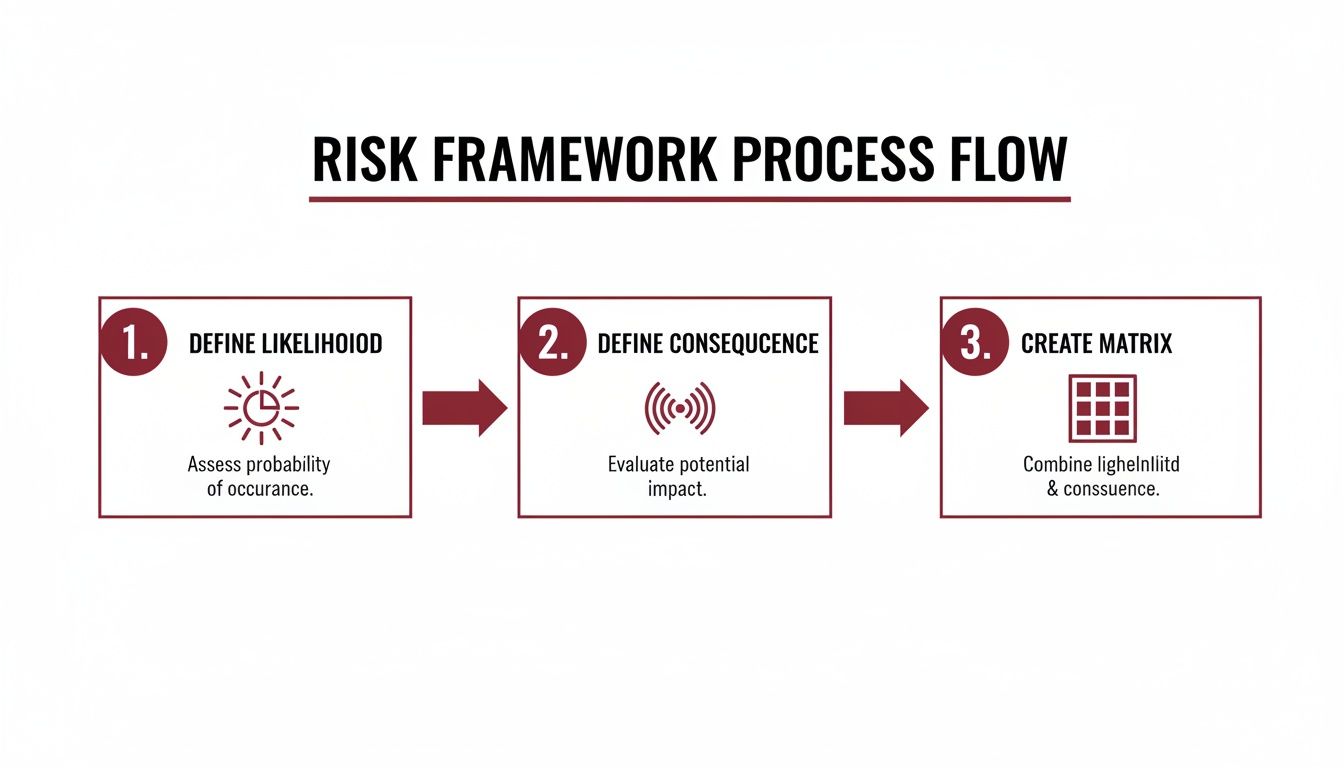
The process is straightforward: with clear definitions of likelihood and consequence as your foundation, your matrix becomes a reliable guide for every safety-related decision you make.
Creating a Colour-Coded Picture of Your Risks
The power of a risk matrix lies in its simplicity. You simply multiply the likelihood score (1-5) by the consequence score (1-5) to get a risk score between 1 and 25.
These scores are then grouped into intuitive, colour-coded levels. These colours—typically green, yellow, orange, and red—serve as a visual shorthand that cuts through the noise, making it immediately obvious where the greatest dangers lie.
Sample 5×5 Risk Prioritisation Matrix
Here is a practical example of a 5×5 matrix you can adapt for your business. It is the standard format and provides an excellent starting point.
| Likelihood ↓ / Consequence → | 1 – Insignificant | 2 – Minor | 3 – Moderate | 4 – Major | 5 – Catastrophic |
|---|---|---|---|---|---|
| 5 – Almost Certain | 5 (Medium) | 10 (High) | 15 (Extreme) | 20 (Extreme) | 25 (Extreme) |
| 4 – Likely | 4 (Low) | 8 (Medium) | 12 (High) | 16 (Extreme) | 20 (Extreme) |
| 3 – Possible | 3 (Low) | 6 (Medium) | 9 (Medium) | 12 (High) | 15 (Extreme) |
| 2 – Unlikely | 2 (Low) | 4 (Low) | 6 (Medium) | 8 (Medium) | 10 (High) |
| 1 – Rare | 1 (Low) | 2 (Low) | 3 (Low) | 4 (Low) | 5 (Medium) |
Underpinning this matrix, you need clear rules about what each colour means in practice.
- Extreme (15-25): Stop work. This requires immediate action to reduce the risk. No one continues until it has been addressed.
- High (10-14): Involve senior management immediately. Urgent action and controls are necessary.
- Medium (5-9): A manager must be assigned responsibility. A plan is needed to address the risk in a timely manner.
- Low (1-4): No immediate panic, but do not ignore it. Manage this through your standard operational procedures and monitor it.
This structure moves you away from subjective feelings and provides a consistent, defensible method for prioritisation.
Putting Your Risk Matrix into Action
Let's see how this works in the real world with a couple of common scenarios for Australian SMEs. This is where theory becomes a tool that genuinely keeps people safe.
Scenario 1: Construction Firm – Fall from Height
Imagine a small residential construction crew working on a two-storey home. There is no edge protection installed on the second-floor slab.
- Likelihood: The team is moving around the area all day, so exposure is high. A simple trip or misstep is entirely plausible. Let's call it a 4 (Likely).
- Consequence: A fall from that height is life-altering. You're looking at a fatality or a permanent, disabling injury. That’s an undeniable 5 (Catastrophic).
- Risk Score: 4 (Likelihood) × 5 (Consequence) = 20 (Extreme).
When you plot that on the matrix, it’s deep in the red. This isn't a risk you can "manage" later. It's a stop-work situation until proper guardrails or another fall prevention system is in place.
Scenario 2: Manufacturing Business – Machinery Entanglement
Picture a metal fabrication workshop with an old lathe. The guard around the rotating chuck is missing, and some workers wear loose-fitting shirts.
- Likelihood: With daily use by multiple operators, the missing guard and loose clothing make an incident almost a matter of 'when', not 'if'. We’d rate this a 5 (Almost Certain).
- Consequence: Entanglement with a lathe is horrific. It means amputation, de-gloving, or other life-changing injuries. This is a 4 (Major) consequence.
- Risk Score: 5 (Likelihood) × 4 (Consequence) = 20 (Extreme).
Again, the score lands squarely in the 'Extreme' category. This tells the manager that waiting for the next scheduled service is out of the question. The lathe needs to be locked out immediately until a new guard is fitted and a strict dress code is enforced and understood by everyone.
What’s Your Appetite for Risk?
The thresholds you set for ‘Low’, ‘Medium’, ‘High’, and ‘Extreme’ are a direct reflection of your organisation's risk appetite—the amount of risk you’re prepared to accept to achieve your objectives.
For any business serious about safety and achieving ISO 45001 certification, the appetite for risks that could lead to serious injury or death must be effectively zero. Your matrix should be designed to make these critical hazards impossible to ignore.
A well-defined matrix and a clearly stated risk appetite provide a solid, objective framework for prioritisation. It removes guesswork and personal opinion from the equation, focusing the entire team on the facts. This is exactly the kind of systematic, mature approach to safety that auditors—and your clients—want to see.
Defining Treatment Priorities and Action Plans
So, you have your risk matrix and a score for each hazard. Now what? A number on its own doesn't achieve much. The entire point is to translate that score into a clear, immediate response. This is the moment your risk register transforms from a static spreadsheet into a dynamic tool that actively protects people. It’s how you move from merely identifying risks to actually controlling them.

Knowing how do you prioritise risks in a risk register is all about driving decisive action. You need to establish clear, non-negotiable rules for each risk level. This way, everyone from the person on the tools to the director in the office knows exactly what is expected when a particular risk rating is identified.
Setting Non-Negotiable Action Rules
The colours on your matrix aren't just for decoration; they should trigger specific, mandatory actions. This completely removes guesswork and ensures a consistent response every single time.
Here’s a practical set of rules you can adapt for your own business:
- Extreme Risk (Red): Simple. The activity stops immediately. Senior management must be notified straight away, and work cannot resume until new controls are implemented that bring the risk down to an acceptable level. No exceptions.
- High Risk (Orange): This demands urgent corrective action. The responsible manager must develop and implement a treatment plan within a very short timeframe, such as 24 to 48 hours.
- Medium Risk (Yellow): The risk needs to be managed through a formal corrective action plan. It must be assigned to a specific person with clear deadlines for implementing new controls.
- Low Risk (Green): These are generally handled by your standard operating procedures. No special action is needed immediately, but they should still be monitored and reviewed periodically to ensure nothing has changed.
This kind of structured response is absolutely crucial. And it’s not just for WHS anymore; this systematic approach is being adopted across other business areas. For example, Australian businesses are increasingly using formal registers to manage cyber threats, especially as data breaches rise. You can get a better sense of this trend from the Office of the Australian Information Commissioner's (OAIC) findings, which are discussed on riskonnect.com.
Applying the Hierarchy of Controls
Once you know a risk needs to be treated, the next question is how. The gold standard here is the Hierarchy of Controls. This is the internationally recognised model for choosing the most effective safety measures, ranked from most effective to least effective.
- Elimination: Can you completely remove the hazard? This is always the best option.
- Substitution: Can you replace the hazardous process or substance with a safer one?
- Engineering: Can you physically isolate people from the hazard? Examples include machine guards or safety barriers.
- Administration: Can you change the way people work? This includes training, safe work procedures, and warning signs.
- Personal Protective Equipment (PPE): Can you protect the worker with gear like hard hats, gloves, or respirators? This is your absolute last line of defence.
Your goal should always be to use the highest-level control that is reasonably practicable. Relying on PPE as your primary solution is a common mistake and a major red flag for any ISO 45001 auditor.
Turning Plans into Accountable Actions
Let’s return to our construction firm and the 'High' risk of falls from height. Their action plan in the risk register needs to be specific, not a vague wish-list.
Instead of just writing "Install fall protection," a proper, robust action plan looks more like this:
- Control Measure: Install a compliant temporary edge protection system (Engineering Control).
- Responsible Person: John Smith (Site Supervisor).
- Due Date: Immediately (before any further work at height).
- Status: In Progress.
See the difference? This simple change transforms the risk register from a list of problems into a proper project plan. It clearly spells out what needs to be done, who is responsible for it, and by when. This is the level of detail that drives real safety improvements on the ground and demonstrates you’re serious about managing your risks.
Integrating Your Risk Register with ISO 45001
If you're an Australian SME working towards ISO 45001 certification, your risk register isn't just another piece of paperwork. It is the single most important document you will present to an auditor to prove you are serious about managing Occupational Health and Safety (OHS) risks. This register serves as the bridge connecting your everyday safety tasks directly to the core requirements of the standard.
When an auditor examines your register, they see your process in action. All the effort you've invested in identifying hazards, assessing their likelihood and consequences, and then deciding on controls—that’s precisely what Clause 6.1.2 (Hazard Identification and Assessment of Risks and Opportunities) is all about. A solid register demonstrates that you are making informed decisions, not just guessing. They can point to any high-priority risk and follow the trail to the controls you’ve implemented, proving your system works.
Moving Beyond Basic Compliance
To build a truly mature safety system that stands up to scrutiny, your register needs to do more than just list the obvious hazards. The mark of an advanced approach is to consider the things you don't know yet. This is where you can add categories for 'potential risks' and 'missing information'.
Potential Risks: These are plausible threats on the horizon that have not yet materialised. A manufacturing business, for example, might list 'introducing a new chemical without a full safety data sheet assessment' as a potential risk, even if there are no immediate plans to do so.
Missing Information: This involves acknowledging the gaps in your knowledge. A construction firm could note 'unknown ground conditions on a future site' as a risk. The lack of information is the risk, and it requires a plan.
This forward-thinking approach shows an auditor that your safety culture is proactive, not just reactive. You are actively scanning for emerging threats and acknowledging what you don't know. In many high-stakes industries, this is already standard practice. A study of Australian pharmaceutical risk management plans found an almost equal focus on important identified risks (34.6%), important potential risks (32.9%), and missing information (32.5%). This highlights the importance of addressing all three areas for a truly robust safety framework.
Linking Your Register to Specific Hazards
A well-integrated risk register also focuses on the specific, high-consequence hazards that are unique to your industry. For any business with significant electrical equipment, this must include risks like arc flash. Identifying and controlling these dangers is a non-negotiable part of a compliant system, often addressed by building a bulletproof Arc Flash Safety Training Program.
By documenting the need for this specialised training directly in your register—linked to an 'Extreme' or 'High' consequence score for electrical work—you create a crystal-clear audit trail of proactive risk management.
Ultimately, your goal is to demonstrate that your risk register is a living, breathing component of your management system. It's not a document created once and filed away. It's the central hub that drives safety planning, resource allocation, and continuous improvement.
When an auditor sees this level of integration—connecting risk scores to action plans, acknowledging potential threats, and addressing knowledge gaps—they see a business that has truly embedded safety into its operations. This is the essence of what ISO 45001 aims to achieve. To get started on this foundational document, you can review our detailed guide on how to create a risk register.
Reviewing and Updating Your Risk Register for Continuous Improvement
You've analysed the data, prioritised your hazards, and your risk register is looking sharp. That’s a significant step forward, but don't file it away just yet. The biggest mistake businesses make is treating their risk register as a one-and-done document. It is not.
A risk register is a living component of your safety system. It must evolve as your business does. This cycle of review and continuous improvement is precisely what the ISO 45001 standard is all about—it proves your safety management is an active, responsive part of your daily operations. Thinking about how you prioritise risks in a risk register must include a plan for keeping it current. Otherwise, all that hard work quickly becomes irrelevant, a snapshot of a workplace that no longer exists.
Nailing Down a Practical Review Schedule
To keep your register genuinely useful, you need a consistent rhythm for reviewing it. This doesn't need to be complex, but it must be documented and followed.
For most small to medium-sized businesses, a simple, two-tiered schedule works best:
- Quarterly Check-ins: At a minimum, set a recurring date every three months to review the entire register. Pay close attention to your 'High' and 'Medium' risks to assess how your control measures are performing.
- Immediate Reviews: These are non-negotiable and are triggered by change. If something significant happens, you must revisit the register immediately.
What triggers an immediate review?
- Any incident, accident, or near-miss.
- Introducing new machinery or equipment.
- Changing a work process or procedure.
- Receiving new information about a hazard, such as from a SafeWork alert.
Updating Scores When Controls Are in Place
The entire purpose of implementing controls is to make the workplace safer. Your risk register needs to reflect that. When your manufacturing team installs a new physical guard on a machine—a classic engineering control—the likelihood of an entanglement incident plummets.
During your review, you must go back and re-score that risk. What was once an 'Extreme' risk might now be classified as 'Medium'. This isn't just paperwork; it’s tangible proof that your safety system is working. It justifies the time and money spent on the fix and helps you focus on the next most significant threat.
This dynamic approach transforms your register from a static compliance document into a genuine management tool. It gives you an accurate map of your current safety landscape and helps you make smarter decisions about what to tackle next.
This isn't just a small business practice; major government bodies operate this way. The Australian Bureau of Statistics (ABS), for example, has a dedicated committee providing senior oversight to ensure its risk frameworks are constantly reviewed and improved. For insights into how risk is managed at a national level, the Critical Infrastructure Annual Risk Review 2024 offers valuable information.
Keeping Everyone in the Loop: Consultation and Management Review
Finally, remember that reviewing the register is not a solo mission for the safety officer. To do it properly, you need to involve people from all levels of the business.
- Talk to Your Team: The people on the tools are your experts. When you review controls, ask for their feedback. Do the new procedures work on a busy Tuesday morning? Have they noticed any new issues you might have missed?
- Brief the Bosses: Your high-priority risks, and how you're managing them, should be a permanent item on the agenda for management meetings. This gives leadership visibility, helps you secure the resources you need, and sends a clear message that safety is a core business value, not just a workshop issue.
Common Questions About Prioritising Risks
When you're deep in risk assessments, a few questions always arise. This is completely normal. Getting these details right is what separates a tick-box exercise from a genuinely effective safety system. Let's address some of the most common ones.
How Often Should We Be Looking at Our Risk Register?
The short answer for ISO 45001 is at least annually. However, if you're only reviewing it once a year, you're missing the point.
Think of your risk register as a living document. It needs attention whenever things change. A significant incident occurs? Review the register. Introducing a new piece of equipment or changing a core process? Time for a review. You should also update it when safety legislation changes or as a key agenda item in your management meetings.
Pro Tip: For your medium-to-high risks, a quick quarterly check-in is a great habit. It helps confirm your controls are still effective and keeps safety at the forefront.
What's the Real Difference Between a Hazard and a Risk?
This is a critical distinction, and getting it wrong can derail your entire assessment. It’s simpler than it sounds.
- A hazard is the thing that has the potential to cause harm. It's the source of danger. Examples include a wet floor, an unguarded saw blade, or working on a roof.
- A risk is the likelihood that the hazard will cause harm, combined with the severity of that harm. So, the risk isn't just "the roof"; it’s the high likelihood of a serious injury from falling off that roof.
You identify hazards, but you prioritise risks.
Can We Have More Than One Risk Register?
Yes, and it's often advisable if your business has multiple distinct operations. A small workshop might manage with a single central WHS risk register, but this approach rarely works as a business grows.
It is smart practice to maintain separate registers for different sites, departments, or even specific types of risk. You might have one for hazardous chemicals, another for major construction projects, and a general one for the office.
The golden rule is consistency. No matter how many registers you have, they must all use the same prioritisation methodology. Your risk criteria, scoring system, and matrix need to be identical across the board to provide a true, business-wide picture of your risk profile.
Getting your head around the details of ISO 45001 can feel like a mammoth task, but you don't have to figure it out on your own. At ISO45001 Consulting, we work with Australian SMEs every day to build practical safety systems that actually work—protecting your team and helping you win bigger contracts. Find out how we can help you achieve certification with a 100% success rate.
Recent Comments