

Quick Summary: The manufacturing industry faces significant health and safety risks, including ergonomic injuries, machinery accidents, chemical exposure, and falls. A proactive approach is essential, involving systematic risk assessments and implementing the hierarchy of controls to manage mechanical, chemical, physical, and ergonomic hazards. Conforming to standards like ISO 45001 helps ensure legal compliance and fosters a resilient safety culture.
When you walk onto a factory floor, you're stepping into a complex world of incredible productivity. But that world is also filled with serious health and safety risks, from heavy machinery and hazardous chemicals to the sheer physical demands of the job. Understanding the primary health and safety risks in manufacturing (general) is the first step toward creating a secure workplace. Dangers like ergonomic injuries, being struck by moving objects, falls, and chemical exposure are ever-present. Getting a handle on these isn't just a matter of compliance; it's fundamental to keeping your team safe.
To build a genuinely secure workplace, you first need to understand the full scope of potential hazards. This goes far beyond just ticking boxes on a checklist. It's about protecting the lives and wellbeing of the people who are the engine of your business. The factory floor is a dynamic environment where massive machines, potent chemicals, and fast-moving people all come together, creating a unique set of hazards that require constant attention and a systematic approach to safety.
Why Manufacturing Safety Demands a Proactive Approach
Waiting for an accident to happen before you act is a recipe for disaster. A reactive safety culture is not only dangerous but also incredibly costly. The smart approach is proactive—actively hunting for potential hazards before they have a chance to cause harm. It’s about digging deeper than the obvious dangers to get to the root causes of accidents and injuries.
The real-world impact of these risks is stark. In Australia, the manufacturing sector is the fifth most dangerous industry, with a fatality rate of 10 deaths per 100,000 workers. That number alone highlights just how critical robust safety systems are. For a closer look at the data, SafeWork SA's manufacturing compliance campaign information offers some sobering insights.
Common Dangers on the Factory Floor
If you know what causes the most injuries, you can focus your efforts where they'll make the biggest difference. The statistics for Australian manufacturing tell a clear story:
- Body Stressing: This is the biggest culprit, causing 37.8% of injuries. Think strains from lifting heavy items, pushing carts, or doing the same motion over and over again.
- Being Hit by Moving Objects: Accounting for 20.8% of incidents, this covers everything from forklift collisions to being struck by machine parts or falling materials.
- Hitting Objects with the Body: We've all done it, but on a factory floor, walking into stationary equipment can cause serious harm. This makes up 13.1% of injuries.
- Falls, Trips, and Slips: Another 12.9% of injuries come from something as simple as a wet floor, a cluttered walkway, or an uneven surface.
By systematically addressing these core health and safety risks in manufacturing, businesses can move from a state of constant reaction to one of confident control, fostering a workplace culture where every employee feels secure and valued.
This guide will give you a clear framework for spotting, assessing, and controlling these hazards, helping you lay the groundwork for a safety management system that is both resilient and effective.
Understanding the Four Main Types of Workplace Hazards
To get a real grip on health and safety in a manufacturing setting, you need a way to make sense of the chaos. Think of it like a mechanic organising their workshop. If all the tools—spanners, drills, grinders, and solvents—are just thrown in a big pile, finding what you need is a nightmare, and it’s easy to grab the wrong thing or hurt yourself. It's the same with workplace safety.
When you start sorting potential dangers into clear, logical categories, you can tackle them one by one. This systematic approach is the bedrock of any good risk assessment, making sure nothing important falls through the cracks.
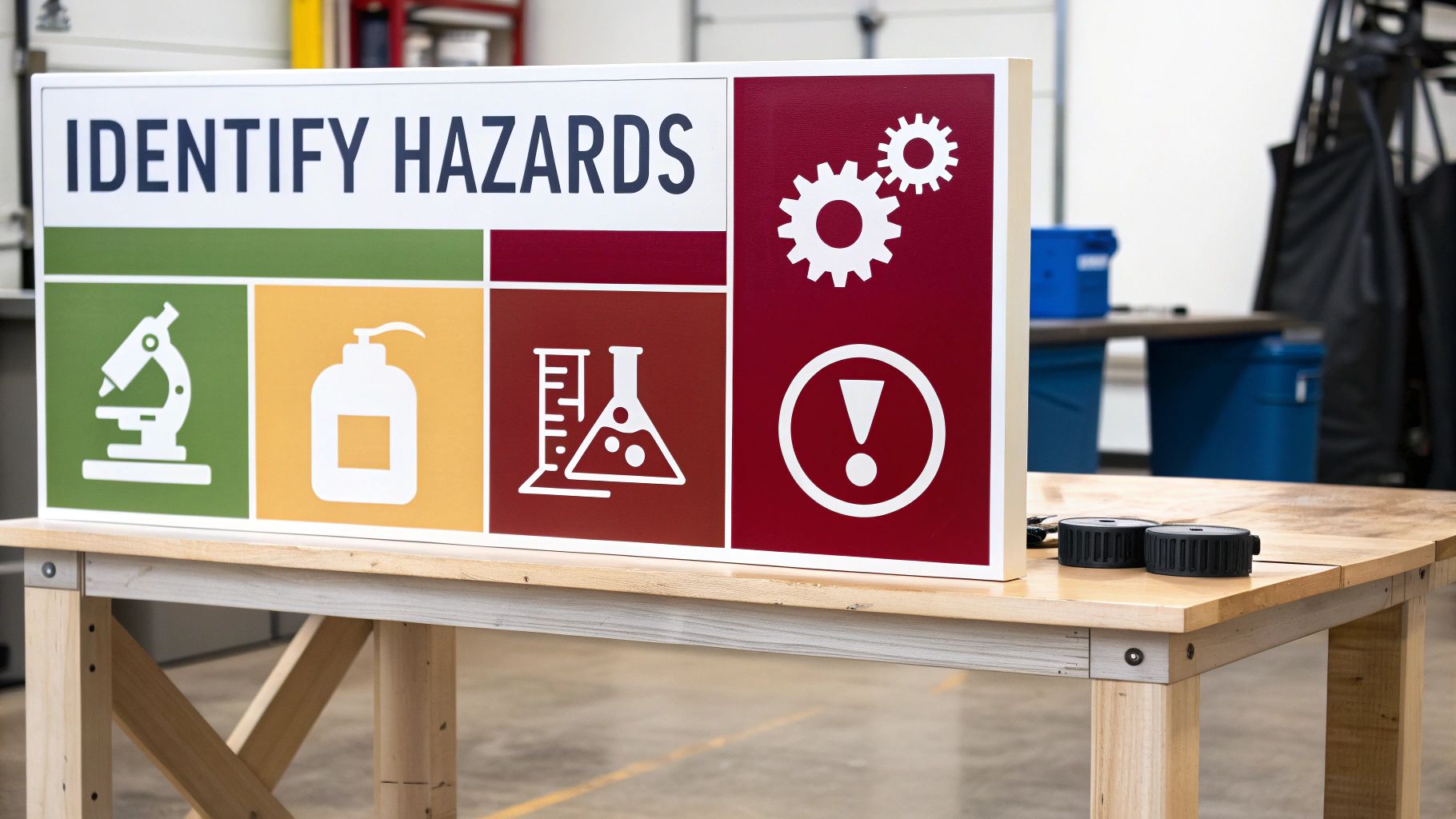
We can break down just about every hazard you'll find on a factory floor into four main types: Mechanical, Chemical, Physical, and Ergonomic. Once you understand what to look for in each category, you can walk through your facility with a trained eye and spot the threats hiding in plain sight.
Mechanical Hazards
Mechanical hazards are all about machinery and equipment with moving parts. These are often the most obvious dangers you’ll see—anything that can cut, crush, shear, or pull a worker in. The sheer force and speed involved mean incidents are almost always serious.
Common examples include:
- Unguarded Machinery: Think exposed belts, gears, rollers, or blades on presses and conveyors. They can snag a piece of clothing or a limb in a split second.
- Moving Parts: Forklifts zipping around corners, robotic arms swinging into place, and automated vehicles all create serious collision risks on a busy floor.
- High-Pressure Systems: Hydraulic and pneumatic lines are under incredible pressure. A sudden failure can turn a fitting into a projectile or spray high-pressure fluid, causing severe injuries.
Chemical Hazards
Next up are chemical hazards. This covers any substance—solid, liquid, or gas—that can cause harm. The danger isn’t always immediate; while some chemicals cause burns on contact, others lead to long-term health issues after years of low-level exposure. From raw materials to cleaning supplies, these are everywhere in manufacturing.
You'll often find these risks linked to:
- Solvents and Cleaning Agents: The degreasers used to keep machinery running often contain powerful compounds that can be corrosive or toxic if handled improperly.
- Process Dusts: Grinding metal, cutting stone, or even sanding wood creates fine airborne dust. Inhaling particles like silica or metal dust can cause devastating lung diseases.
- Gases and Vapours: Welding creates fumes, forklifts produce exhaust, and a leak in a refrigerant line can release toxic gases like ammonia. These can poison a worker or displace the oxygen in a room.
Learning to see the factory floor through these four hazard lenses completely changes your approach. You stop just reacting to accidents and start proactively looking for patterns of risk. It’s how you build a safety culture that's truly resilient.
Physical Hazards
Physical hazards are environmental factors that can cause harm without direct contact. These are often just "part of the scenery" in a workplace, which makes them easy to ignore until it's too late. Because they're part of the environment, they can easily affect your entire workforce.
Keep an eye out for these key physical hazards:
- Excessive Noise: That constant roar of machinery isn't just annoying; it causes permanent hearing loss. Any noise level above 85 decibels is a red flag for long-term exposure.
- Electrical Faults: Frayed wiring, overloaded circuits, or missing ground connections are ticking time bombs that can lead to electric shock, burns, or a catastrophic fire.
- Extreme Temperatures: Working near furnaces or inside large freezers puts immense stress on the body. Without proper controls and work-rest cycles, you're risking heat stroke or hypothermia.
Ergonomic Hazards
Finally, we have ergonomic hazards. These are all about the relationship between the worker and the work itself. They crop up when a task puts unnatural or excessive strain on the body, leading to musculoskeletal disorders (MSDs) and repetitive strain injuries (RSIs).
These are easily the most overlooked of the health and safety risks in manufacturing (general), yet they're responsible for a huge number of workplace injuries.
Look for issues like:
- Poor Workstation Design: An assembly line that’s too high or a workbench that’s too low forces people into awkward, hunched postures all day long.
- Repetitive Motions: Tasks that require the same small movements over and over again, like packing boxes or tightening screws, slowly wear down muscles and tendons.
- Manual Handling: Lifting heavy objects without proper technique or mechanical aids is one of the quickest ways to cause a debilitating back injury.
How to Conduct a Practical Risk Assessment
Once you’ve learned how to spot hazards, the next logical step is figuring out just how dangerous they really are. This is the heart of a practical risk assessment. Think of it less as a box-ticking exercise and more like organised ‘safety detective work’—a structured way to find hidden dangers, understand what could happen, and build a solid plan to stop it.
This isn’t about creating paperwork that just gathers dust. It's a living, breathing process that makes your workplace safer by turning what you see into real, protective actions. By using a clear, repeatable method, you give your team the power to get on the front foot and manage the common health and safety risks in manufacturing.
Step 1: Hunt for Hazards
Your first mission is to systematically scan your entire workplace. With your knowledge of the four main hazard types—mechanical, chemical, physical, and ergonomic—you need to walk through every single part of your operation.
Look closely at each task, every piece of equipment, and all the substances you use. Crucially, talk to the people doing the work day in and day out. They often have the best insights into the dangers that aren't obvious during a quick walk-through. Your goal here is to create a complete list of everything that has the potential to cause harm.
Step 2: Identify Who Is at Risk and How
A hazard by itself is just a potential problem. The real risk appears when people come into contact with it. For every hazard on your list, you need to ask a simple question: Who might be harmed, and how?
Don’t just think about the obvious person. Consider everyone who might be affected:
- Direct operators carrying out the task.
- Maintenance staff who come in to service the machinery.
- Cleaning crews who might be working after hours.
- Visitors or contractors who aren’t familiar with your site’s layout or rules.
For example, an unguarded conveyor belt is a clear mechanical hazard. It’s a risk not only to the person feeding materials onto it but also to a new employee being shown the production line for the time. Get specific about how they could be hurt—entanglement, crushing injuries, or serious abrasions.
Step 3: Evaluate the Severity and Likelihood
This is where you start to prioritise. Not all risks are created equal, so you need a logical way to sort the urgent from the important. For each risk, you’ll assess two key things: the likelihood of something actually happening and the severity of the injury if it does.
A simple risk matrix is a brilliant tool for this. It helps you visually map out each risk, making it immediately obvious which ones need your attention right now. For instance, a small trip hazard in a rarely used storeroom is probably low likelihood, but a faulty safety guard on a press used every single day is a much bigger, more immediate problem.
The point of a risk assessment isn't to eliminate every single risk—that's often impossible. The real goal is to make sure you have applied reasonably practicable controls to manage it. This documented process is your proof of due diligence and the foundation of a safe workplace.
Step 4: Record and Implement Control Measures
With your risks prioritised, it’s time to take action. For every significant risk, you need to decide on and implement control measures to either get rid of it completely or reduce it to the lowest possible level. This is where you formally document your plan.
Your findings become the backbone of a vital safety document. For Australian businesses serious about safety and compliance, understanding how to create a risk register is an absolute must. This document is your official record, detailing the hazard, the assessed risk level, the controls you’ve put in place, and who is responsible for making sure they stay effective.
Step 5: Regularly Review and Refine
Finally, remember that a risk assessment is not a one-and-done job. Your workplace is always evolving—new machinery arrives, processes get updated, and new people join the team. Any of these changes can introduce new hazards or change the nature of existing risks.
Set a clear schedule to formally review your risk assessments. A good rule of thumb is at least annually, or whenever a significant change happens. This ongoing cycle of review and refinement is what keeps your safety management system relevant and effective, protecting your team from harm year after year.
Putting the Hierarchy of Controls into Action for Real Safety
So, you’ve done your risk assessment and you’ve got a list of hazards that need attention. What now? How do you choose the right way to manage them? This is where the Hierarchy of Controls becomes your most valuable tool. It’s the globally recognised best-practice framework for tackling workplace risks, not just in manufacturing, but across every industry.
Think of it as an upside-down pyramid. The most powerful, effective solutions are at the wide top, while the least effective—though often the most common—are at the narrow bottom. The golden rule is to always start at the top. You only move down to a lower level when the option above simply isn't reasonably practicable.
What makes this framework so effective is that it fundamentally changes your approach to safety. Instead of just defaulting to handing out safety glasses and calling it a day, it forces you to think more strategically. It pushes you to find smarter, more permanent ways to design safety right into your work processes from the ground up.
A solid risk assessment process—hunting for hazards, evaluating their potential harm, and then implementing controls—is the backbone of any robust safety system.
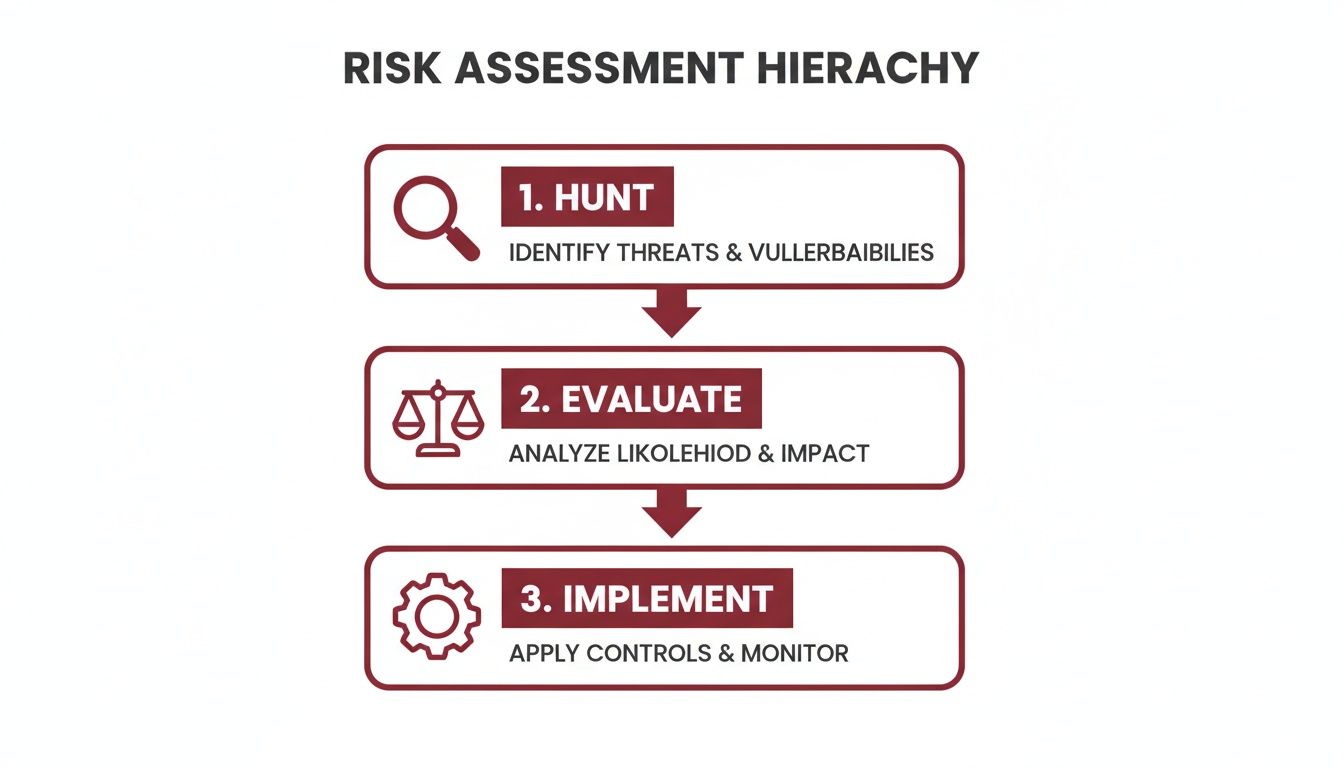
That final "Implement" step is precisely where the Hierarchy of Controls gives you the roadmap to choose the most reliable and lasting safety measures.
Level 1: Elimination
The absolute best way to control a risk is Elimination. It’s exactly what it sounds like: you get rid of the hazard completely. If the hazard no longer exists, there’s zero chance it can cause harm. This is the gold standard.
- Real-World Example: Imagine a furniture maker using a potent solvent-based adhesive that gives off nasty fumes. By redesigning their product to use mechanical fasteners like screws and clips instead, they eliminate the chemical hazard entirely. Problem solved.
Level 2: Substitution
If you can't get rid of the hazard, can you swap it for something safer? That's Substitution. This means replacing a hazardous chemical, a dangerous process, or a risky piece of equipment with a safer alternative that still gets the job done.
- Real-World Example: A metal fabrication workshop uses a harsh, corrosive chemical for cleaning parts. They find a new, water-based degreaser that works just as well but is far less hazardous to their team's skin and lungs. That's a smart substitution.
Level 3: Engineering Controls
When elimination and substitution are off the table, you turn to Engineering Controls. These are physical changes you make to the work environment that put a barrier between people and the hazard. The beauty of these controls is that they don't depend on someone remembering to do something—the protection is built right in.
Engineering controls are an absolute game-changer for managing health and safety risks in manufacturing (general).
Here’s what they look like in practice:
- Machine Guarding: Installing fixed guards around the moving parts of a lathe or a metal press. This physically stops a worker from accidentally getting a hand or clothing caught.
- Ventilation Systems: Placing a local exhaust ventilation (LEV) hood right over a welding job. It acts like a high-powered vacuum, sucking away toxic fumes at the source before the welder even has a chance to breathe them in.
- Noise Enclosures: Building a soundproof box around a deafeningly loud generator. This protects everyone on the workshop floor, not just the person standing next to it.
The real power of the top three levels—Elimination, Substitution, and Engineering—is that they tackle the risk at its source. They are proactive solutions that don’t rely on human behaviour, which makes them infinitely more reliable.
Level 4: Administrative Controls
Moving down the pyramid, we have Administrative Controls. These are all about changing the way people work. Think procedures, rules, safety signs, and training sessions. While they have their place, they are considered less effective because their success hinges entirely on people following instructions perfectly, every single time.
- Real-World Example: To manage the danger of forklifts and people sharing the same space, a warehouse paints clear pedestrian walkways on the floor, puts up strict speed limit signs, and makes it a rule to honk at every corner. Comprehensive operator training is also a key part of this.
Level 5: Personal Protective Equipment (PPE)
Right at the bottom, the very last line of defence, is Personal Protective Equipment (PPE). This is your gear: safety glasses, gloves, hard hats, earplugs, and respirators. It should always be the last resort.
Why is it the least effective? Because PPE does absolutely nothing to remove the hazard itself. It just puts a temporary barrier between the worker and the danger. Its effectiveness is fragile—it depends on the gear being the right type, fitted correctly, properly maintained, and worn 100% of the time. If the PPE fails, or someone forgets to wear it, the worker is completely exposed.
Meeting Your Legal Obligations with ISO 45001
In Australian manufacturing, workplace safety isn't just a good idea—it’s a legal imperative. Every business, big or small, has a fundamental duty of care under our Work Health and Safety (WHS) laws. This means you are legally required to protect your employees, contractors, and even visitors from harm.
Falling short doesn't just risk hefty penalties; it can lead to devastating and entirely preventable accidents. This legal duty requires far more than just common sense. It demands a structured, proactive approach to managing the countless health and safety risks in manufacturing (general). This is exactly why a formal framework isn't just helpful, it's essential for providing a clear roadmap to keep your people safe.
Moving Beyond Compliance to Culture with ISO 45001
This is where the international standard ISO 45001 comes in. It’s widely recognised as the gold standard for building a robust Occupational Health and Safety (OH&S) management system. Think of it less as a bureaucratic box-ticking exercise and more as a blueprint for weaving safety into the very fabric of your company's culture.
A system built on ISO 45001 is designed to be a living, breathing part of your operations, driving continuous improvement and helping you spot and stop incidents before they ever happen. The statistics really bring home the need for this. Recent data revealed that machinery operators and drivers had a work-related fatality rate over five times the national average, with vehicle incidents being a major culprit.
Implementing a framework like ISO 45001 gives you a systematic way to zero in on these high-risk areas and put strong, effective controls in place.
ISO 45001 transforms safety from a reactive, compliance-focused task into a proactive, strategic advantage. It demonstrates a powerful and verifiable commitment to the wellbeing of your team, building trust and fostering a culture where everyone looks out for each other.
Legal Duties and the Role of a Management System
Under Australian WHS law, the responsibility falls on the 'person conducting a business or undertaking' (PCBU) to ensure health and safety, so far as is reasonably practicable. This isn't a vague concept; it has very specific requirements, including:
- Providing and maintaining a safe work environment.
- Ensuring machinery, substances, and structures are used, handled, and stored safely.
- Providing adequate facilities for the welfare of all workers.
- Giving your team the right information, training, and supervision to protect them from risks.
An ISO 45001 management system aligns perfectly with these duties. It provides a structured process to not only meet your legal responsibilities but also to document that you're meeting them. To properly understand these obligations, you may need to conduct thorough legal research.
The Strategic Advantage for Manufacturing SMEs
For small to medium-sized manufacturers (SMEs), getting certified isn't just about safety—it's a massive business advantage. Many large corporations and government departments now require their suppliers to hold ISO 45001 certification. Why? Because it gives them solid proof that you have a reliable, audited system for managing safety.
This means certification can be the key that unlocks bigger, more profitable contracts and opportunities. By investing in a certified system, you're not just protecting your people. You’re positioning your business for serious growth and demonstrating a level of professionalism that makes you stand out. If this sounds like the right move for you, the first step is understanding the ISO 45001 certification process.
Your Manufacturing Safety Questions, Answered
Getting to grips with occupational health and safety can feel like navigating a maze. It’s natural to have questions. Let's tackle some of the most common ones we hear from manufacturing leaders.
Getting clear on these points is a great starting place for managing the typical health and safety risks in manufacturing.
What are the biggest safety risks I should be worried about?
Every manufacturing floor is different, but the data consistently points to a couple of major culprits. The number one issue? ‘Body stressing’ – things like manual handling, awkward postures, and repetitive movements that lead to sprains and strains. It's the slow-burn injury that can take people out of action for weeks.
Running a close second is injuries from ‘being hit by moving objects’. This could be anything from a forklift reversing around a blind corner to a component falling from a shelf. These two categories alone are responsible for the lion's share of serious injury claims, so they absolutely need to be at the top of your risk assessment list.
We're a small business. Is ISO 45001 really worth it for us?
Absolutely. Think of ISO 45001 not as a burden, but as a blueprint for building a rock-solid safety system. For a smaller operation, it's invaluable because it forces a shift from just reacting to incidents to actively preventing them in the first place. That’s a game-changer.
The benefits go beyond just keeping your team safe and avoiding costly downtime. It sharpens up your professional image and, crucially, can be the ticket to winning bigger contracts. Many larger organisations won't even consider a supplier without certified safety systems.
Is getting ISO 45001 certified a nightmare?
It can certainly look daunting from the outside, but it doesn't have to be a solo mission or an overwhelming one. It's a structured process, and like any project, it becomes far more manageable with the right plan and support.
Partnering with a specialist who lives and breathes this stuff can make all the difference. They can help you cut through the complexity, provide the right documentation, and guide you in building a system that actually works for your business, not a generic one-size-fits-all model. It’s about making the investment pay off in real-world safety, better efficiency, and tangible business growth.
With that kind of targeted support, you can stay focused on running your business, knowing the certification process is in safe hands.
Ready to build a safety system that protects your team and wins you more business? Expert guidance can help you achieve certification with a 100% success rate. Visit us at https://iso45001.net.au to learn how we can tailor a practical, effective safety management system for your company.
Recent Comments